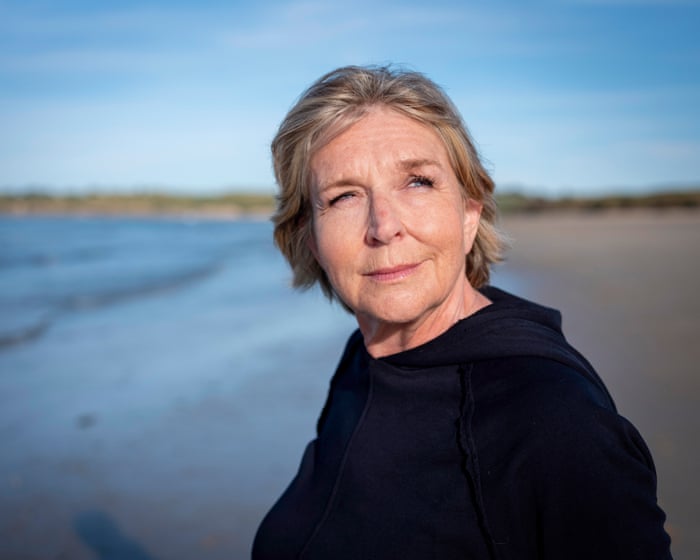
On the daytime TV giant This Morning, Fern Britton always had an appealing mix of warmth, no-nonsense capability, and a hint of danger—like she might blow it all up at any moment. And then she did.
The day she resigned in 2009, Britton didn’t plan it. But amid rumors of a feud with co-host Phillip Schofield, she took the scorched-earth route and walked away from her high-profile, high-paying job with nothing lined up. Wasn’t she worried about what came next?
“No, there’s something in me that decides very fast when I’ve got to get out. I’m not scared of the future. I’m not scared of stepping into nothing. A couple of people said, ‘What are you going to do?’ I’ll be fine.”
And she was. Britton went on to host her own chat show and had a run of truly heartwarming jobs—among them, BBC Two’s The Big Allotment Challenge—before becoming a successful author. Today, she’s at home in Cornwall, and she comes across just as you’d expect: down-to-earth (she’s sipping tea and eating a slice of Marks & Spencer fruit loaf), upbeat, with a steeliness that shows up when a question she doesn’t like comes up.
Britton turns 69 on Friday. Her 60s started off rough—her mother died, then her father, and when she was 63, her marriage of more than 20 years to TV chef Phil Vickery fell apart. Then she went through what she calls her “era of indolence,” as she describes it in her 2024 book. She stopped exercising, ate too much, and even took up smoking—all of which she’s now reversed. She brushes it off now. “You get through troubled water,” she says. “I’m getting tougher and less worried about things, and if you have any hurt or anger or anything, there’s no point in carrying it with you. I found it very easy, actually, to just…” She pauses. “That was then, and this is now.”
Britton does seem in a much better place. She loves living in her Cornish village, where she’s working on her 12th novel, has great friends, and has embraced all the freedoms of single life. Her latest passion is bellringing at her local church: “It’s marvellous,” she says. Her mother always reminded her that bad times will pass. “And she’s absolutely right. You’ve just got to keep putting one foot after another, that’s it. When you get to this age, you can look back over your catalogue of errors, excitements, the good, the bad, the sad, the happy, and think: ‘I learned a lot there.’” Weekly therapy has helped: “Life feels lighter and easier, and you can be kinder.” She smiles. “Forgiving people, and hope that they will forgive you for the shit you’ve done.”
When “the odd TV thing comes up,” she says, “that’s delightful.” Her latest is the second series of the self-explanatory Fern Britton: Inside the Vet’s on ITV. It’s a lovely watch—a dog has a grape-related emergency, a bulldog has a knee injury, and a cat needs some dental work. I could watch it all day, soothed by the calm care of these Bristol vets.
Britton started her TV career in the early 1980s. She moved from her Buckinghamshire village to London to attend the Royal Central School of Speech and Drama, where she studied stage management. She worked in theatre for a while, then sent more than 70 letters to every TV and radio station, asking to be a newsreader. Her naivety might have been comical, but it worked—she got a job at Westward Television, a regional franchise based in Plymouth, as a continuity announcer. (I’m reminded of the TV company in Rivals, the TV adaptation of Jilly Cooper’s novel set in the 80s: Britton laughs and says it was exactly like that.)From there, she became a presenter on BBC local news and was sent to London for a few weeks. She felt out of her depth because she hadn’t trained as a journalist. Newsreader Moira Stuart helped her. “She was great,” says Britton. “She might not like me saying this, but there was a certain racist, sexist element in newsrooms back then, and I think she felt it. One day she said to me, ‘This lot, they can’t organise a fart in a paper bag,’ and that’s just genius. I love her.” Not long after, Britton was offered a job as a stand-in presenter on the BBC’s new morning show, Breakfast Time.
It can’t have been easy being a young woman in TV in the 80s. “Well, looking back, yes, but at the time… We were really resilient, and it was just, well, that happens, these idiots.” One of the Breakfast Time anchors was Frank Bough, a hugely famous TV presenter at the time, who was later fired by the BBC after a scandal involving drugs and sex workers. “Frank just judged women by how attractive and ‘fuckable’ they were,” says Britton. At a team lunch, she sat next to Bough. “He turned to me, leaning back in his chair, and said, ‘I wonder how long it’ll be before I’m having an affair with you. Because I do have a very big cock.’ And you just go…” She makes a disgusted face. “So you had to have a lot of resilience, but I just thought, ‘strange, silly man’.”
Later, she says, “We just grew up with all the bottom pinching, being pinned up against a wall and trying to be kissed, or grappled with in a lift. Oh, for fuck’s sake. I know it’s wrong, and we now see, of course, that was wrong, but it does give you an inner strength and sense of self. I know I’m not a pushover.”
In her 2008 memoir, Britton wrote about the sexual assault she suffered when she was 21, before she went into TV. Apart from how awful the attack was – it happened several times over one night in her flat, with a man she had only just met – I was struck by how she reasoned away ever reporting it to the police (“because I didn’t have bruises and he didn’t hit me”). “I didn’t even know it had a name until about 10 years later, and I thought, hang on a minute, that was rape. He raped me. Many times, that night. That was my kind of naivety, really.” Her two daughters, she says, “are really feminist, very strict, and they’ve taught me a lot actually. My daughter said the other day, every woman knows someone who’s been raped or assaulted. No man knows a rapist. They’re still murdering and raping us. So, what do we do?”
Her daughter’s attitude is very different from how Britton processed the sexism she faced early in her career. “You see, you’re using the brain of a younger woman, 40 years later,” she says, when I ask if that sexism made her angry. “We didn’t have that. I loved the job.” But she put up with so much. Once, during Breakfast Time, when they had cut away to the news, she says a senior manager “came through a forest of cameras, and guests were there, and he said in front of them all, ‘You are terrible, you are awful. What are you doing?’ That was such humiliation.” After the show, she was called to his office, where he shouted at her even more. “I was crying, and all that day’s makeup was running. He said, ‘Put some makeup on before you leave the room.’ I said, ‘I’ve left it on my desk.’ So he went, got it, and made me put it back on.”In 1995, Britton. Photo: Alan Davidson/Shutterstock
How did it not crush her confidence? Britton smiles. “I don’t have any confidence. I just look like I do.” When she handed in her latest novel, she says, “I was sweating, thinking, this is the book where they finally find out I’m terrible.” When good reviews from readers started coming in, she says, “I just burst into tears. You think, yeah, but they’re still just being nice.”
She thinks it probably started in childhood. Her father was actor Tony Britton, who had already left her mother and older sister and was living with another woman. Britton was conceived during a visit he made to her mother, and he was rarely around as she grew up. She once convinced her English teacher to take the class on a trip to see him perform in a play in London, and managed to contact him through the theatre. He invited them to meet him backstage, and Britton, so afraid he wouldn’t even recognize her, made sure to push herself to the front.
View full image: Britton with her father and her mother, Ruth. Photo: ANL/Shutterstock
Her mother, she says, “was amazing, glamorous, gorgeous, and funny. My sister, beautiful, slender, she could have been an actor or a model. And there was me, a little chubby kid, not knowing what the hell was going to happen next.” When she told her father she was going to work in television, he told her, “You’re too fat to be Sue Lawley” (a broadcaster). Britton laughs. “So you just take these things on the chin and move on.”
Britton, of course, built a very successful TV career, most notably her 10 years on This Morning, and she has also hosted many shows, including Ready, Steady, Cook and her own interview series Fern Britton Meets… even though she says impostor syndrome has followed her throughout. “Oh, God, yes.” Off-screen, life could be tough – IVF, then postnatal depression after the birth of her twins, then divorce, then the birth of her third child. Because of her high profile as a TV presenter, she was also heavily scrutinized, especially her appearance and weight (one columnist shockingly called her an “obese old slapper”). It was particularly intense for a couple of years in the mid-2000s. How did she cope? “Not very well. Good at putting on a brave face, but not doing well inside.”
The lowest point was in 2008, when it was revealed she had gastric band surgery, and she was vilified in the press. Later, she found out her phone had been hacked, and in 2024 she was paid damages by News Group Newspapers, the owners of the now-defunct News of the World. “I never understood why the paparazzi were at places where I was. Terrifying for the kids, horrible.” Does she think it’s strange that there’s now much more tolerance for celebrities using weight-loss injections? “I don’t care, people can do what they want,” she says breezily. “What happened to me was criminal, literally.”
Britton’s resignation from This Morning in 2009 was sudden and short on details. “I don’t really want to go into that,” she says. “I probably never will, but yes, it was a day that changed in an instant, and suddenly I thought, ‘I’ve got to get out of here.'”
There had long been rumors of a rift with her co-host Phillip Schofield. In her autobiography, which came out the year before, she was nothing but complimentary about him, saying she loved working with him. But something went wrong. “It was hard, it was very difficult, very upsetting.” They had a good friendship, says Britton. “I don’t take that back, but then, you know, give it time, and it wasn’t right.”
Schofield’s successful TV career was ruined after he admitted to a relationship with a much younger ITV employee. “That one brought up very mixed emotions for me. I can’t really explain it, because we did have a very good working relationship, until we…”He didn’t, so it was tricky. I wish him well. I hope everything settles down and he finds some happiness.
View image in fullscreen
‘I am absolutely prepared for things to stop and change.’ Photograph: Harry Borden/The Guardian
In her 40s, work was steady. “In my 50s, it got harder. I knew it would run out. I am absolutely prepared for things to stop and change.” She started a new career in writing. “Then I thought, well, that’s television done, and now here I am doing Inside the Vet’s, and loving it.” She says it’s nice that many of the production team are people she worked with on This Morning, “and they remembered that maybe I’m okay to work with.”
Her children are grown up, and none of them seem to be nepo babies so far—instead, they have useful jobs. Her youngest daughter is a builder, her other daughter is training to be a nurse, one son is a teacher, and the other “is doing something with child psychology.” How has she managed to avoid raising, say, four influencers? Britton laughs. “They’ve never been like that. My older daughter said to me when she was quite young, ‘I don’t want to be rude, but your job is really boring, isn’t it?’”
So now, for the first time in years, Britton is without children or a husband at home, and she seems to be enjoying life. It feels like being back at that special moment, she says, “between leaving school and having to work or go to university or whatever. I think about how I was when I was 17, 18, 19, and everything was so much fun.” It’s about friends, silliness, and a little more joy (including bellringing!). “I think back to the person who’s still inside me, who I was when I was younger, and it’s still there. And that cheers you up for the day.”
Fern Britton: Inside the Vet’s airs on ITV1 at 11.30am on Sundays and is available on ITVX.
Information and support for anyone affected by rape or sexual abuse issues is available from the following organisations. In the UK, Rape Crisis offers support on 0808 500 2222 in England and Wales, 0808 801 0302 in Scotland, or 0800 0246 991 in Northern Ireland. In the US, Rainn offers support on 800-656-4673. In Australia, support is available at 1800Respect (1800 737 732). Other international helplines can be found at ibiblio.org/rcip/internl.html.
Frequently Asked Questions
Here is a list of FAQs based on the article title and theme you provided written in a natural tone with clear answers
Frequently Asked Questions
1 Who is Frank Bough and why did he say that to Fern Britton
Frank Bough was a famous British TV presenter Fern Britton then a young producer and later a presenter recounts that he made this crude unsolicited comment to her during a work meeting in the 1980s Its an example of the casual sexism and harassment women in TV faced back then
2 Is this a real quote or is it just a shocking headline
Yes the quote is real Fern Britton included this specific anecdote in her 2021 memoir The Good Life She uses it to illustrate the laddish and predatory culture she had to navigate as a woman in television during that era
3 What exactly is the article about
The article explores how Fern Britton survived and thrived in the maledominated TV industry of the 1980s and 90s It covers the sexism the old boys club mentality and how she eventually became a successful presenter on shows like This Morning and Ready Steady Cook
4 Was Frank Bough the only person who behaved like that
No Brittons memoir describes a widespread culture where inappropriate comments groping and pressure were common She names other powerful men in the industry who behaved poorly but the Frank Bough story is the most headlinegrabbing example
5 Why is Fern Britton only talking about this now
She has said that the MeToo movement gave her and other women the confidence to speak out about experiences they had previously kept quiet about She also felt that enough time had passed and she wanted to honestly document what life was really like for women in TV
6 Did Frank Bough ever apologize or respond
Frank Bough died in 2020 before Brittons book was published Because of this there was no public response from him Britton has said she never received an apology from him at the time