Christopher Nolan’s take on The Odyssey is far from the first film adaptation. As early as 1911, Italian director Giuseppe de Liguoro made a silent version called L’Odissea. Older readers might remember watching the futuristic animated series Ulysses 31 in the 1980s. O Brother, Where Art Thou? is based on The Odyssey. And if you squint really hard and ignore the “Goofy Goober” song, so is the first SpongeBob SquarePants movie.
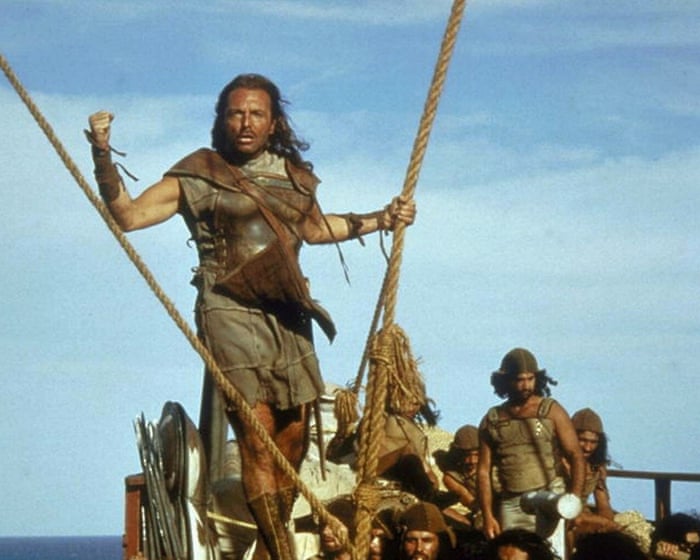
But the pre-Nolan adaptation with the biggest legacy is probably Andrei Konchalovsky’s two-part version, made in 1997 for the Hallmark Channel. This adaptation has been making the rounds recently, shared in clips on social media (the full version is easy to find on YouTube) and catching the eye of Joyce Carol Oates, who spent most of Thursday night tweeting enthusiastically about it.
The Odyssey: jaw-dropping action, dark magic, and dolphin cameos – discuss with spoilers
Read more
The scene that first caught Oates’s attention involves Circe (played by Bernadette Peters), who rushes toward Odysseus (Armand Assante), pushes his thighs apart, and positions herself against his crotch. Oates called this a “much more interesting interpretation than Nolan.” She also praised the portrayal of Odysseus (“So manly, so fully human”), the Hades segment (“mesmerizing”), and how much more expansive it felt (“which perhaps Nolan hadn’t seen”).
It’s worth noting that three decades ago, this adaptation wasn’t received so warmly. At the time, TV Guide said it “plays like a ‘Classics Illustrated’ adaptation of the original work,” while the St. Louis Post-Dispatch claimed Konchalovsky “couldn’t decide whether to make a cheerful comic book, in the style of Xena: Warrior Princess, or a Greek tragedy.” The Arizona Republic reviewer said, “Even though the made-for-TV movie is only four hours long, I wasted a fifth stewing over how godawful it was.” The Toronto Star, seemingly determined to find something nice to say, managed: “This Odyssey is not all an arduous task to sit through.”
If you watch it, two things will likely stand out about the Hallmark Odyssey. First, it attracted a lot of genuinely big stars. Greta Scacchi plays Penelope, Geraldine Chaplin plays Eurycleia, Christopher Lee plays Tiresias, Isabella Rossellini plays Athena, Vanessa Williams plays Calypso, and (I know this is a stretch) Eric Roberts plays Eurymachus.
Sex, beds, and grisly executions: what Christopher Nolan’s The Odyssey changed, invented – and left out
Read more
Second, and this is especially true if Nolan’s film was your first exposure to the story, the Hallmark Odyssey very much looks like something made for TV three decades ago. It’s full of bad wigs and glued-on beards. The Trojan War scenes have extras standing completely still in the background, clanking their swords together listlessly like they’re in a school play. The Cyclops is a giggling puppet bothered by a flute.
The biggest difference, of course, is that this version actually includes gods. And not to immediately disagree with Joyce Carol Oates, but you might suspect Nolan left them out of his version simply because of how awkwardly they’re handled here. The worst example is Hermes, played by Freddy Douglas, who appears as a flying man with frosted tips and what looks like a diaper. Every time he shows up, there’s terrible green screen, and he zips around the sky like someone caught on a fishing line. It looks awful now, and it probably didn’t look convincing in 1997 either. If you were Christopher Nolan trying to figure out how to adapt the poem after watching this, you’d probably try to pass off all the gods as weather too.
View image in fullscreen
Matt Damon and Zendaya in Christopher Nolan’s The Odyssey. Photograph: MElinda Sue Gordon / Universal Pictures / AP
That’s not to say there aren’t similarities to the original. For example, when Odysseus first meets Calypso, he’s just as weighed down by guilt and loss as he is in Nolan’s version. But how he deals with that guilt is completely different. While Matt Damon’s character willingly chooses memory loss to avoid thinking about the terrible things he’s done, Armand Assante’s Odysseus gets over it by immediately having sex with Vanessa Williams. And I mean right away, in front of everyone. To his credit, it does seem to work.
Then there’s the ending. Homer’s poem famously fizzles out—after Odysseus kills the suitors, the families of the dead come after him, and Athena has to step in and tell everyone to calm down. Nolan tries to clean things up by having Odysseus voluntarily go into exile after the massacre. The 1997 Hallmark version, on the other hand, ends with Odysseus killing everyone and then (you guessed it) immediately sleeping with Greta Scacchi.
All in all, it’s a strange one. The Hallmark Odyssey is longer than Nolan’s film, so it fits in more content. But it doesn’t have the same intensity, momentum, or spectacle. Still, you have to admire Hallmark’s ambition to take on something this big. If they had tried to adapt The Odyssey in 2026, it would almost certainly have been turned into a cheap Christmas movie called It’s Beginning to Look a Lot Like Ithaca.
So, as fun as it is, we can safely say the Hallmark Odyssey has been completely outdone by Christopher Nolan. And it’s likely to stay that way—at least until Elon Musk decides to release his historically accurate Grok version.
Frequently Asked Questions
Here is a list of FAQs about Joyce Carol Oatess comments on the 1990s TV adaptation of her work specifically Foxfire Confessions of a Girl Gang
BeginnerLevel Questions
Q Did Joyce Carol Oates write the 1990s TV version of Foxfire
A No She wrote the original 1993 novel The 1996 TV movie was adapted by screenwriter Elizabeth White
Q Did Joyce Carol Oates like the 1990s TV movie Foxfire
A Yes generally She has publicly praised the film especially the performances of the young cast She called it a faithful and powerful adaptation
Q What is the 1990s TV version of Foxfire about
A Its about a group of teenage girls who form a violent gang after one of them fights back against a sexually abusive teacher It deals with themes of female friendship rebellion and trauma
Q Was the TV movie a direct copy of Oatess book
A No The movie makes significant changes Its set in the 1990s and the plot is simplified The gangs violence is also less extreme than in the novel
Advanced InDepth Questions
Q What specific praise did Oates give the 1990s TV adaptation
A She specifically praised the film for capturing the emotional intensity of the book She noted that the director and cast understood the core theme of female bonding under duress even though the setting and details were changed
Q Did Oates have any criticisms of the TV movie
A She has been diplomatic but some critics note that the film softens the books brutality Oates herself has implied that the movie is a younger more hopeful version of her darker more cynical novel She didnt criticize it harshly but she acknowledged the difference in tone
Q Why did Oates agree to the adaptation if it changed the setting from the 1950s to the 1990s