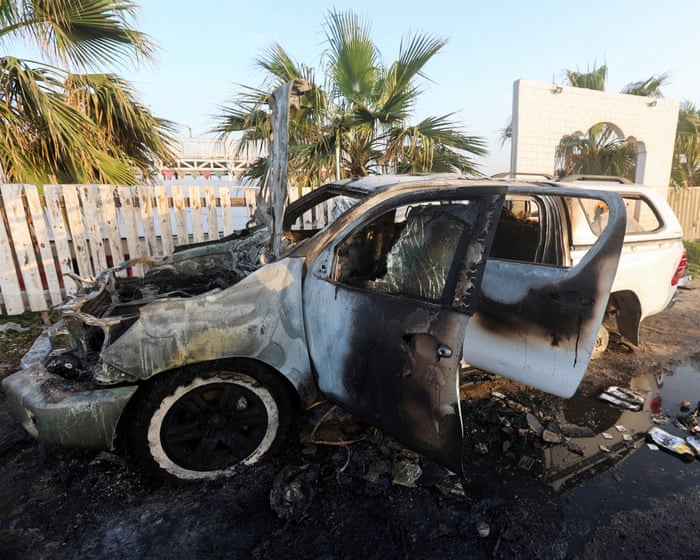
Seven aid workers killed in an airstrike in Gaza were singled out as targets under an Israeli military practice that assumes guilt by association, according to a Guardian investigation.
Last month, a senior Israeli military prosecutor announced he would not pursue criminal charges over the April 2024 incident, in which drones fired missiles at three clearly marked World Central Kitchen (WCK) vehicles shortly after they had escorted a food aid delivery in Gaza. The attack killed three British humanitarian workers, along with an Australian, a Palestinian, a Pole, and a dual US-Canadian national.
The official Israel Defense Forces (IDF) account pointed to specific mistakes made by a few officers. The victims were also blamed for hiring armed guards to protect the food convoy and for allegedly “deviating” from their agreed route.
Death on the road to Rafah: the night the IDF targeted World Central Kitchen aid workers
Read more
However, interviews with senior Israeli officers involved in the incident or familiar with the official investigation suggest it downplayed the role of a common IDF targeting practice that puts aid workers and civilians at risk, especially when combined with the army’s open-ended mission to end Hamas’s control over Gaza’s civil affairs.
More than 70,000 Palestinians have been killed by the Israeli military during the three years of the Gaza war. The army’s own internal data suggests over three-quarters of the dead were civilians.
The reserve colonel who ordered the strikes, Nochi Mendel, said the WCK workers became potential targets after a brief encounter—lasting only minutes—with armed guards assumed to be from Hamas (an assumption later shown to be baseless). He considered them to have “mixed together” with alleged Hamas militants, where “mixing together” was defined as being “near them, talking, playing, hanging out, and so on.” Asked whether the presence of armed men made the entire convoy a target, Mendel replied: “Certainly.”
He concluded: “They were not innocent because they were connected to Hamas.”
View image in fullscreen
The aftermath of the Israeli airstrike on the World Central Kitchen convoy in Gaza. Military prosecutors have ruled out criminal charges over the attack that claimed seven lives. Photograph: Ahmed Zakot/Reuters
Mendel was referring to a general policy called haflala (“incrimination”), which gives field commanders broad discretion to label someone a “terrorist,” including those “incriminated” by association. How haflala is applied in a given area is often passed down verbally in a commander’s mission brief to other officers.
He said his unit had been praised by the army hierarchy for its involvement in several strikes on what were deemed to be Hamas attempts to take over aid deliveries. “They applauded us and were pleased with our action,” he said. The only difference in the WCK incident was that foreign nationals were killed, he added. “That’s the whole difference. Not a substantive difference.”
First location map and timeline
When the WCK convoy was destroyed, it was nowhere near Israeli troops. Several Israeli officers familiar with the incident said the strikes were not ordered because of an immediate threat to Israeli lives, but to fulfill the mission of preventing Hamas from controlling aid deliveries.
Second location map and timeline
An IDF statement said the airstrikes resulted from an “erroneous assessment that Hamas military operatives were present in the vehicles, rather than from an intention to target the organisation’s personnel.” The statement added that “this assessment was compounded by serious failures to comply with applicable orders and procedures.” However, it said: “Following an in-depth examination of the findings and in light of the standards applicable under criminal law, it was determined that, despite the aforeme…”Given the failures mentioned, the circumstances of the incident did not create reasonable suspicion of a criminal offense that would justify opening a criminal investigation.
World Central Kitchen said the Israeli decision not to pursue criminal charges was “inconsistent with the full truth and deeply offensive.” The group added: “At the time of the deadly attacks, our team in Gaza was unarmed and posed no threat to anyone. The IDF had full visual clarity on our clearly marked humanitarian vehicles during the prolonged, multiple airstrikes. It knew our team’s movements, identities, and activities in advance.”
Britain, Australia, and Canada condemned the prosecutor’s decision as “shameful,” saying they would “continue to seek answers” for the slain aid workers. The UK opened an inquest in 2024 into the deaths of three British team members: James Kirby, James Henderson, and John Chapman. The other victims were Saifeddin Abutaha, a Palestinian; Australian Zomi Frankcom; Damian Sobol, a Pole; and Jacob Flickinger, who held dual Canadian-US citizenship. The UK inquest was paused pending the outcome of the Israeli investigation.
Mendel, the only officer of such high rank dismissed for his actions in the Gaza war, has been described in army briefings as a rogue operator. Questions have been raised about possible political motives. Mendel is a settler and reportedly one of 130 signatories of a January 20, 2024 letter to the IDF calling for restrictions on aid flowing into Gaza.
However, the way the Israeli army operates in Gaza—where rules of engagement depend on local conditions and are often passed down verbally through the chain of command—gives officers at Mendel’s level broad leeway to make subjective judgments about who counts as a “terrorist” and is therefore a target.
The IDF statement said its activities in Gaza were “regulated by a broad range of binding written orders and standing directives governing the use of force, approval processes for strikes, strikes on sensitive sites, and other matters,” and that these incorporated “the rules of the laws of armed conflict, including the principles of distinction, proportionality, and precautions in attack.”
The statement added that “a person does not become a lawful target merely because they are in the vicinity of an armed individual, come into contact with them, or travel alongside them.”
The IDF said: “Carrying a weapon may be a relevant factor in such an assessment, but it is not sufficient on its own without meeting the definitions described above. In particular, and in the context of this incident, security personnel hired to protect a humanitarian convoy from looting do not become lawful targets merely because they are armed.”
An IDF officer familiar with the WCK killings said that, given the circumstances and standard IDF procedures, the vast majority of officers would have acted the same way. “There were armed men next to them,” the officer said. “If you took qualified people and put them on the call, in 90% of cases this is what would have happened. In my guess, 99% of the time the first bomb would have been dropped; 90% of the time the second; 80% of the time the third.”
Reserve Brigadier General Oren Solomon, the battle manager of Gaza Division, said a mistake was made in determining that an armed man had entered one of the vehicles, but added that once that error occurred, the incrimination procedure inevitably led to the three missile strikes.
“If I incriminated this vehicle beforehand as Hamas—anyone who escapes from it and enters another vehicle: death comes,” Brig Gen Solomon said. “Together with him they will die. That meets the incrimination rules, no problem.”
A senior…An officer involved in the initial Israeli military investigation into the WCK case argued that Mendel overstepped in how he applied the rules of incrimination.
“You can’t incriminate 20 people if there’s one armed man,” he said. The officer argued that the first strike might have been justified by the initial misidentification, even if it caused civilian casualties, but the same could not be said for the missiles that followed.
“You struck someone you suspected, a vehicle you thought had an armed man inside. The moment two people came out, neither carrying a weapon, the second and third strikes go against orders because you don’t know who you’re hitting,” he said.
Another systemic factor behind the deaths of the seven aid workers—and possibly many more civilians—was one of the missions the Israeli army was given in Gaza by Benjamin Netanyahu’s coalition government: to destroy Hamas’s influence and control. That meant anyone seen as involved in or assisting the Hamas administration, including by distributing aid, could end up in the crosshairs of an Israeli drone operator.
“I remind you that part of our mission was to crush Hamas’s ability to govern,” Mendel said. “Part of the mission was to hit that [Hamas-controlled aid deliveries], and we hit it.”
Interviews with IDF officers suggest there was a widespread belief in the ranks that Hamas had taken control of most aid deliveries into Gaza. Later analysis showed that assumption was unfounded. At the time, there was widespread hunger caused by an Israeli blockade, and food convoys were being swarmed by desperate civilians, criminal gangs, and Hamas fighters.
The belief that Hamas hijackings were common meant that the sight of armed men near the WCK vehicle in April 2024 matched a “pattern of activity” that helped Mendel and his unit see the whole convoy as a legitimate target.
An IDF officer familiar with the incident said it was standard practice to label any armed man in Gaza as Hamas or a “terrorist,” just as Mendel did. The officer added: “How do you define that it’s Hamas? He’s near weapons, he touches the trucks, and he does things that look like he’s about to take over the trucks.”
The role of the incrimination principle in the WCK killings shows how it has contributed to the unusually high number of civilians killed in the Gaza war. This goes alongside the routine acceptance of heavy “collateral damage” when targeting Hamas militants, the designation of large and shifting areas as free-fire zones, and the deliberate destruction of neighborhoods to stop Palestinian communities from returning.
The common thread is that limits on targeting were relaxed to support an open-ended mission. Since the war began in 2023, no Israeli soldier has been convicted of wrongful death or war crimes in Gaza operations.
“I came to defeat Hamas,” Mendel said. “If such an event came before me again, I would do exactly the same thing.”
He also dismissed the importance of the killings. “I think it’s an idiotic side event,” Mendel said. “It really isn’t a serious event.”
Get in touch
Contact us about this story
The best public interest journalism relies on first-hand accounts from people in the know. If you have something to share on this subject, you can contact us confidentially using the following methods:
Secure Messaging in the Guardian app
The Guardian app has a tool to send tips about stories. Messages are end-to-end encrypted and hidden within the routine activity that every Guardian mobile app performs. This prevents an observer from knowing you’re communicating with us at all, let alone what’s being said.
If you don’t already have the Guardian app, download it (iOS/Android) and go to the menu. Select ‘Secure Messaging’.
SecureDrop
If you can safely use the Tor network without beingIf you are being watched or monitored, you can send messages and documents to the Guardian through our SecureDrop platform. Our guide at theguardian.com/tips explains several secure ways to contact us and outlines the advantages and disadvantages of each option.
Frequently Asked Questions
Here is a list of frequently asked questions about the Israeli airstrike that killed seven international aid workers written in a natural clear and concise tone
General Background Questions
1 What exactly happened in the airstrike
On April 1 2024 an Israeli drone strike hit a convoy of three vehicles belonging to the aid group World Central Kitchen in the Gaza Strip The vehicles were clearly marked with the charitys logo and were traveling along a route that had been coordinated with the Israeli military The strike killed all seven aid workers inside
2 Who were the seven aid workers who were killed
The victims were aid workers from several countries three British nationals one Australian one Polish national a dual citizen of the US and Canada and a Palestinian driver
3 What is World Central Kitchen
World Central Kitchen is a nonprofit organization founded by celebrity chef José Andrés It is known for providing fresh meals to people in crisis zones around the world often arriving very quickly after natural disasters or conflicts to set up field kitchens
4 What does guilt by association mean in the title of this event
In this context it refers to the Israeli militarys apparent rationale for the attack They claimed they mistakenly believed the aid workers were linked to Hamas militants likely because a suspicious individual was seen near the convoy The aid workers were killed because they were associated with that person not because they were proven to be a threat themselves
The Attack Its Aftermath
5 Why was an aid convoy in Gaza in the first place
The convoy was delivering food that had just been unloaded from a ship at a temporary pier They were bringing vital supplies to a warehouse in Deir alBalah which was a designated and coordinated route to help feed civilians facing severe famine
6 Didnt the aid group coordinate with the Israeli army beforehand
Yes This is the most shocking part of the incident WCK had a system in place to share their exact routes and vehicle locations with the Israeli military to ensure their safety The military was fully aware of the convoys movements and had approved the route
7 How did Israel respond to the attack
Israel admitted responsibility calling it a grave mistake and a