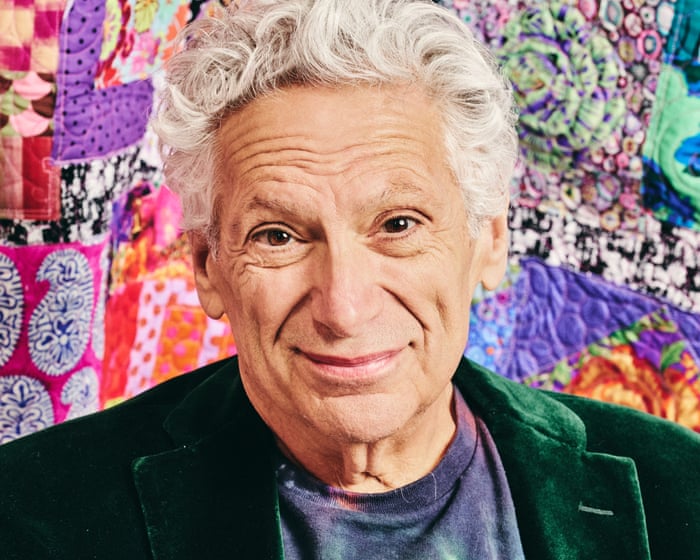
As soon as I walk into Cotton Candy Fabrics, a quilt store in Connecticut, I hear Harvey Fierstein’s unmistakable raspy voice. The walls are lined with bright fabrics, and colorful quilts hang from the ceiling. On any given day, you’ll probably find the 73-year-old five-time Tony winner here, surrounded by a chatty group of crafty women and gay men.
Fierstein started quilting in 2009. He says he was partly inspired by his love for the cable TV show Simply Quilts, but also by the Names Project AIDS Memorial Quilt. It was going to be displayed in Washington, DC, and he wanted to make panels for two close friends who had died from the disease. He’s been very productive ever since. He shows me photos of his creations on his phone: an LGBTQ+ rights quilt with pink triangles, yellow Stars of David (the “Jewish badge”), and skeletons giving Nazi salutes; Fierstein with his two dogs; some horny, phallic trees he dreamed about; and an even more explicit nude portrait of a young man (apparently an Amazon delivery driver).
“I donate them, but I don’t sell them,” he says. “In fact, this morning I got a note from a Broadway casting director asking, ‘Could you donate a quilt for my charity this year?’ I wrote back and said, ‘Could you call me in for a job?'”
Many people know Fierstein as the Broadway legend who broke through with his semi-autobiographical play (and later film) Torch Song Trilogy, starred in the musical Hairspray, and wrote the book for classics like La Cage aux Folles and Kinky Boots. Others first heard his gravelly voice through his 90s voice work—in Mulan and The Simpsons—or enjoyed his comic supporting roles in films like Mrs. Doubtfire and Independence Day. More recently, you might have seen Fierstein taking a stand against Trump’s attacks on LGBTQ+ rights and artistic freedom. As he put it on Instagram last year, “I have been in the struggle for our civil rights for more than 50 years only to watch them snatched away by a man who actually couldn’t care less.”
Fierstein isn’t performing much these days, “simply because there hasn’t been anything all that interesting to do,” he says. “I’ve been offered a few things—and everything I’ve read just bored the shit out of me.” Instead, he keeps busy with 10-hour days, either writing or quilting—or writing about quilting for a book he’s working on. There’s a new off-Broadway production of La Cage aux Folles coming in June, starring Billy Porter. But before that, a revival of Kinky Boots has just opened in London, starring Strictly‘s Johannes Radebe.
Adapted from the 2005 British movie (with music by Cyndi Lauper), the story follows a man from Northampton who revives his father’s struggling shoe factory by partnering with a drag queen to make boots for the underserved drag queen market. It premiered in Chicago in October 2012 to great acclaim, won six Tony awards, and has been performed around the world ever since. Why does he think the show still resonates today?
“Well, because it’s so human,” Fierstein says. “What I love most about Kinky Boots is that a lot of times men get dragged to see musicals—heterosexual men—and they sort of put up with it and enjoy it or whatever. But Kinky Boots, women love it, but it’s for men.” Ultimately, he says, it’s a show about fathers and sons and the challenge of reconciling your parents’ expectations for your life with your own. “Women understand that, but men don’t talk about that stuff.”
Fierstein grew up in Brooklyn, New York, in a Jewish household with a “very strong family”—him, his father (a handkerchief manufacturer), his mother (later a school librarian), and his brother.Harvey Fierstein and his older brother Ron (who also served as his longtime manager) grew up in a family where his mother loved taking everyone to Broadway shows. In his room, Fierstein would belt out show tunes, pretending to be leading ladies like Mary Martin, Ethel Merman, and Chita Rivera.
He accidentally came out to his parents when they found nude photos he had taken of two friends posing on his mother’s bed. During the argument that followed, his mother said she was angry that they had “raised a queer,” that she couldn’t trust him, and that he had broken her heart. But his parents never told him to stop being gay. There was hardly any discussion, he says—just a kind of unspoken acceptance.
As a child, Fierstein was self-conscious about his weight, especially his “boy boobs,” which he would tape up with bandages. When did he finally feel comfortable in his own skin? “Never,” he says. “I think anyone who acts is a chameleon who never really feels comfortable with themselves… they’re much more comfortable hiding inside a character.”
Nobody judges you as harshly as you judge yourself. I don’t think that’s just a gay thing. It takes a lot of work to love yourself.
Fierstein went to art school and then to Brooklyn’s famous Pratt Institute, where he studied ceramics. As a teenager, he would hang out in New York’s West Village gay scene. It was a time of social unrest (Fierstein wasn’t at the Stonewall riots in 1969, but he was among the crowds the next day) and a time of casual, anonymous sex. When I ask if he ever felt any shame about sex, he replies without missing a beat: “You mean not being good at it?” He grins, then shrugs apologetically. “I don’t know what that means.”
Why does he think he was able to avoid the self-loathing that can affect many gay men? “But heterosexuals are self-loathing too,” he says. “It’s kind of a lesson you learn. Nobody judges you as badly as you judge yourself. I don’t think that’s just a gay thing. It takes a lot of work to love yourself.” He expected to grow up and experience the same life milestones as his straight peers—a long-term relationship, a family. “It wasn’t until I stepped out into the larger world that I found out people didn’t believe that or understand that.”
By the time Fierstein graduated in 1973, he was deeply involved in the underground theatre scene, having appeared in many plays, including Andy Warhol’s Pork. Fierstein’s signature gravelly baritone voice emerged early in his career—partly from overdeveloped false vocal cords, partly from permanent damage caused by screaming too loudly on stage.
His big break came in 1982 with Torch Song Trilogy, a series of plays he had been writing and starring in since 1978, which were eventually combined into a single, four-hour epic about a Jewish drag queen navigating gay life and love. The story drew from his own life—his drag queen persona, casual sex, romantic heartbreak, and his relationship with his mother—and the play became a symbol for the gay rights struggle at the time.
Fierstein was promoted as one of the first “openly gay” writers to achieve commercial success with an “openly gay” play. Torch Song Trilogy ran for an exhausting three years on Broadway and earned him Tony Awards for Best Play and Best Lead Actor in 1983. Along with his follow-up, a musical adaptation of the French play La Cage aux Folles, Fierstein became the buzzy new writer in town.
Around this time, he was interviewed by TV journalist Barbara Walters, who grilled him about life as a gay man. Fierstein’s cleverly worded responses—delivered with class—heArt and charm gave the interview a long life on social media. When Walters asks him, “What’s it like to be a homosexual?” he smiles and answers, “What’s it like to be a heterosexual? I don’t know, I’m just a person.” Later, he tells her, “Ten percent of the world is gay, so you have to stop with the ‘this is a sickness, this is an abnormality’ — this is a normal thing that has existed throughout human history.”
“I was surrounded by sick people, and politicians were calling it a gay disease … they were talking about putting us in camps.”
In the summer of 1982, however, as Fierstein puts it, “AIDS hit us like a tsunami.” He lost many friends, ex-lovers, and boyfriends during the epidemic. He says he doesn’t have survivor’s guilt. “I had enough friends who lived through it with me. But yeah, it was horrible to watch. I mean, imagine having dinner with someone and then finding out they took their own life that night.”
It was a terrible time all around, he recalls. “I was surrounded by sick people, and politicians were calling it a gay disease … they were talking about putting us in camps, like Trump is doing now [to suspected non-US citizens]. That’s the heterosexuals. That’s the first thing they think of: lock everyone up. They don’t think about dealing with the problem. Human beings are the problem.”
View image in fullscreen: Fierstein posing for a portrait in New York in 1977. Photograph: John Kisch Archive/Getty Images
Does he dwell on that period of his life? “I go on with my life, but you think about it all the time,” he says. “I have friends’ ashes buried in my backyard, you know? It’s hard.”
How we made … Harvey Fierstein and Antony Sher on Torch Song Trilogy
Read more
Through the late 80s and 90s, Fierstein had a successful film and TV career, appearing in a number of Hollywood blockbusters, often in comic supporting roles (including Independence Day and Mrs. Doubtfire), or lending his gravelly voice to animated characters (the hot-tempered bruiser Yao in Mulan, an unforgettable cameo as Homer’s assistant Karl in The Simpsons). Despite early success and attempts to launch a TV sitcom starring Fierstein, his onscreen career never took off like it did on Broadway. Which of his film roles does he look back on most fondly? “None,” he whispers, “I couldn’t care less.”
He admits he feels some affection toward Mrs. Doubtfire, though, in which he plays Robin Williams’s brother, a makeup artist. Williams had asked Fierstein to do it after watching him get booed off stage at San Francisco’s Castro Theatre because of a poorly thought-out “lesbian fashion show” skit he had quickly put together at a benefit organized by Lily Tomlin (Fierstein had arrived thinking he was just doing introductions). Williams found the whole thing hilarious. “I did Doubtfire because Robin wanted me to do it. And I was thrilled to do it because I loved him so much.”
View image in fullscreen: Matt Cardle, Johannes Radebe, and Courtney Bowman at the curtain call for a gala performance of Kinky Boots at the London Coliseum in March 2026. Photograph: Dave Benett/Grant Buchanan/Getty Images for Kinky Boots the Musical
As Fierstein’s career took off, he developed a problematic relationship with alcohol. He never drank at work, but as soon as he got home he would start, and then make destructive “drink and dial” phone calls. By 4pm he would be blackout drunk. “[I was] just checking out,” he says. “Just not being there.” At his lowest point, in 1996, Fierstein attempted suicide. It was the wake-up call he needed to seek help, from both professionals and friends. “I’ve been sober for 29 years,” he says.
There was something of a comeback in 2002, when Fierstein took on the role of diva laundress Edna Turnblad in the Broadway adaptation of Hairspray.He won another Tony Award for Best Actor in a Musical. He says the role was a personal milestone: “There’s this sort of myth that when you get sober, it takes five years to get your marbles back.”
If there’s one role Fierstein is most proud of, it’s probably playing Tevye in the 2004 Broadway revival of Fiddler on the Roof, which he joined in 2005. “But that would be true of anyone who plays Fiddler on the Roof,” he says. “It’s one of those roles you’re just so proud you got to do.”
[Image: Fierstein presenting at the Grammy awards in New York in 2003. Photograph: Timothy A Clary/AFP/Getty Images]
In the decade that followed, Fierstein worked on many successful Broadway adaptations (Newsies, Kinky Boots), original plays (Casa Valentina, Bella Bella), and teleplays (The Wiz Live!, Hairspray Live!), all while performing on stage. Does he still do much drag? “Not at all.” Does he miss it? “Oh my gosh, you’d have to pay me. A lot.” He did revive Torch Song Trilogy in 2018, though, which accidentally showed how far the LGBTQ+ equality movement had come. “When we first did it [in 1981], gay people would hide coming in… sort of embarrassed or scared. When they did the revival, they came in like they owned the place.”
In 2025, Fierstein received a lifetime achievement award at the Tonys. “It was very touching,” he recalls. “You do go back over, especially, your relationship with the Tony awards. On the other hand, and I say this with love, they didn’t broadcast any part of my speech.”
Why does he think that happened?
“Not my business. Could I guess?” He remembers the controversies around his earlier acceptance speeches: when Torch Song Trilogy won Best Play in 1983, writer and producer John Glines made history – and caused a stir – by thanking his “lover” and producer Lawrence Lane. The next year, when Fierstein won Best Book of a Musical for La Cage aux Folles, “They stood on stage and said: ‘No one repeat the embarrassment of last year.’ So I got out there and I thanked my lover.”
His acceptance speech for this year’s award was gracious and emotional. He thinks the organizers were worried about what he might say, “because of Trump and how much the world hates him. Which I wouldn’t do out of respect for the evening. In my mind, just being an openly gay man-slash-drag queen, getting these kinds of awards is enough of a statement.”
“Trump attacks free speech. He attacks the free press. He attacks America’s allies. His only allegiance is to himself.”
Not that he’s held back when it comes to speaking out against injustices, most recently about Trump’s leadership, including his ban on drag performers at the Kennedy Center in Washington DC in February 2025. In response, Fierstein said on Instagram: “He attacks free speech. He attacks the free press. He attacks America’s allies. His only allegiance is to himself – the golden calf. My fellow Americans, I warn you – this is NOT how it begins. This is how freedom ENDS!” When the center’s Trump-appointed interim director Ric Grenell (who is gay) stepped down this March, Fierstein posted on Instagram that he was “moving on to ruin something new” under the “auspices of our… warmongering Maga fool Prez.”
[Image: Fierstein with his dogs BoBo and Charlie, plus one of his quilts, at Cotton Candy Fabrics. Photograph: Bryan Derballa/The Guardian]
At the end of the interview, I’m shown around the store a bit more. Fierstein and the group tell me that quilting is an art form where you’re almost always making something meaningful for someone else. He hopes his (potential) book on quilting will help inspire people.
How we made … Harvey Fierstein and Antony Sher on Torch Song Trilogy
Read more
“The idea is that I try something…”Every day is a chance to learn something new and try something different,” he says. “Some of it will be great, and some of it will be terrible. But go out and have fun. There’s no one stopping you. Do something with yourself, whatever it is.”
Kinky Boots is at the London Coliseum until 11 July.
In the UK and Ireland, you can contact Samaritans for free at 116 123, or email jo@samaritans.org or jo@samaritans.ie. In the US, call or text the National Suicide Prevention Lifeline at 988, chat online at 988lifeline.org, or text HOME to 741741 to speak with a crisis counselor. In Australia, the crisis support service Lifeline is available at 13 11 14. For other international helplines, visit befrienders.org.
In the UK, Taking Action on Addiction provides links to various support services. In the US, call or text SAMHSA’s National Helpline at 988. In Australia, the National Alcohol and Other Drug Hotline is at 1800 250 015; families and friends can get help from Family Drug Support Australia at 1300 368 186.
Frequently Asked Questions
Here is a list of FAQs based on Harvey Fiersteins quote about Kinky Boots addiction and survival
BeginnerLevel Questions
Q What did Harvey Fierstein say about getting sober
A He said When you get sober it takes five years to get your mind back He was talking about the long slow process of healing the brain after addiction
Q Is it really true that it takes five years to feel normal after getting sober
A Its not a hard rule for everyone but its a common experience Many experts agree that it can take several years for your brain chemistry and thinking patterns to fully recover
Q Why does it take so long for your mind to come back
A Addiction changes the way your brain works It takes time for your brain to heal from the damage rebuild its natural chemical balance and learn to think clearly without the substance
Q What does getting your mind back actually mean
A It means your memory focus emotional control and ability to solve problems return to a healthier more stable state You stop feeling foggy anxious or impulsive all the time
Q Did Harvey Fierstein say this in relation to Kinky Boots
A Yes He was discussing the themes of the musical which is about acceptance and resilience He connected his own survival story to the shows message of overcoming hardship
Advanced Deeper Questions
Q Is the five years Harvey Fierstein mentioned a medical fact or just his personal experience
A Its a mix of both Research shows that significant brain healing happens in stages often taking 25 years for full cognitive recovery Fierstein was using his own journey to illustrate that timeline
Q What are the specific stages of mental recovery after addiction
A Generally The first year is about physical detox and acute withdrawal Years 23 focus on emotional regulation and repairing relationships Years 45 involve deeper cognitive repairlike memory planning and impulse control returning to baseline
Q How does Kinky Boots relate to the idea of survival and addiction recovery