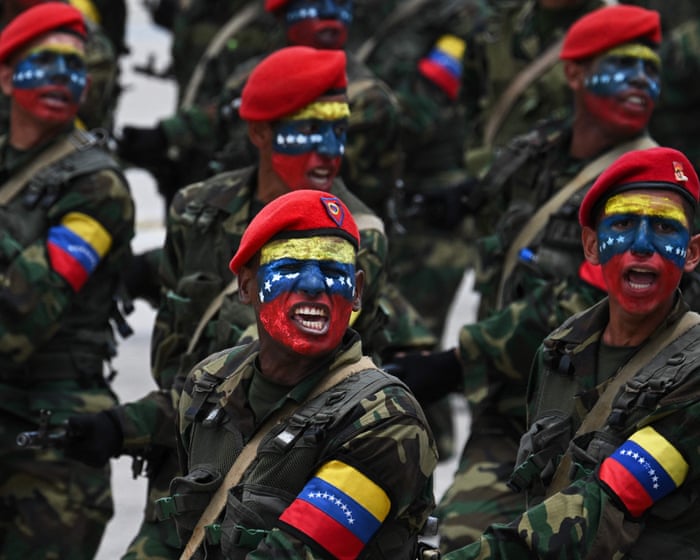
Nicolás Maduro is driven from office by a massive popular revolt, but the Venezuelan military takes to the streets, turning its guns on the civilians who overthrew him.
A palace coup forces Venezuela’s authoritarian leader into exile, sparking a bloody power struggle among members of his crumbling regime.
Maduro or a key ally is assassinated by a U.S. “decapitation” strike, but as foreign soldiers seize Caracas and key airports and ports, left-wing insurgents tighten their grip on the country’s mineral-rich hinterlands, and regime loyalists launch guerrilla-style attacks on oil refineries and pipelines.
These three scenarios were all considered six years ago during U.S. government “war games” designed to predict what a post-Maduro Venezuela might look like if the South American dictator were overthrown by an uprising, a palace revolution, or a foreign attack. None of them ended well.
“You’d have prolonged chaos … with no clear way out,” said Douglas Farah, a Latin America expert whose national security consulting firm participated in those 2019 strategy efforts.
In all three discussion-based simulations, the upheaval triggered a fresh wave of refugees across Venezuela’s borders with Colombia and Brazil, as citizens fled clashes between rival rebel groups or foreign occupiers and loyalist troops.
“Everyone wrestling with this issue is sort of hoping that you could wave a magic wand and have a new government [in Venezuela],” said Farah. “I think the reason it hasn’t happened is because people sat down and thought: ‘Wait a minute. What the hell are we getting ourselves into?’”
Venezuelan politicians working to end Maduro’s 12-year rule reject claims that his downfall would inevitably plunge their country into a maelstrom of bloodshed and retribution.
María Corina Machado—the Nobel laureate and leader of the political movement widely believed to have defeated Maduro in last year’s presidential election—called claims that Maduro’s exit could push Venezuela into violence similar to Syria’s civil war “utterly unfounded.”
“Venezuela is a country with a long democratic culture and a society that is set on recovering that democracy,” she told the Guardian in Oslo on Friday after slipping out of her country to receive the peace prize.
Miguel Pizarro, another opposition leader, dismissed the suggestion that Venezuela is doomed to become a South American version of Iraq, Libya, or Haiti if Maduro is toppled. “The truth is that Venezuelans made their decision [in last year’s election] … it was Venezuela’s greatest ever social consensus.”
Allies of Donald Trump—who has spent recent months escalating pressure on Maduro with a massive military deployment, deadly strikes on boats in the Caribbean, and the seizure of an oil tanker—also downplay the dangers of a possible U.S. intervention.
But many experts and South American diplomats are skeptical things will go so smoothly, regardless of how Maduro’s removal comes about.
“If there’s a popular uprising, the military is probably going to be very defensive, very violent, and reactionary to the protests on the street. [You’ll have] a lo…Farah warned that in such a scenario, Colombian guerrillas—including the National Liberation Army (ELN) and dissident factions of the Revolutionary Armed Forces of Colombia (FARC)—could potentially join the conflict in support of Venezuela’s nominally left-wing regime. He believed a coup could create a “huge vacuum of power,” with rival armed groups fighting to take Maduro’s place. “You might have four different people saying, ‘OK, now I’m in charge,’” Farah said.
If foreign troops were deployed, they would likely seize control of major cities and key infrastructure like ports and airports. However, they would face the risk of asymmetric attacks from government loyalists or Colombian rebels, along with a drawn-out struggle to reclaim gold mining regions already under ELN influence. “[Defeating them is] a long-term proposition that would require a lot of money, a lot of troops, and probably some casualties,” Farah noted.
Whatever unfolded, Farah worried that post-Maduro Venezuela would likely descend into “a huge mess that would last a while.” “None of this is going to be resolved in three weeks. You’re talking years,” he said.
Farah is not alone in fearing that sudden political change could have devastating consequences for the oil-rich South American nation. Last week, the chief foreign policy adviser to Brazil’s President Luiz Inácio Lula da Silva cautioned that upheaval in Venezuela could turn the region into a Vietnam-style “war zone.”
Juan González, the top Latin America official in the White House under Joe Biden, also expressed concern about the potential for violent retaliation. “I have this recurring dream about Venezuela … of Maduro getting dragged through the streets like Benito Mussolini,” González said, referring to the Italian dictator who was captured and executed in 1945. “You just never know what the trigger is … [Muammar] Gaddafi was very much in power until he wasn’t,” he added, alluding to Libya’s former leader, who also met a brutal end.
González hoped a negotiated solution could still be reached despite rising tensions. “Negotiations are long and hard fought and require compromise. But history shows us that they’re the most effective way to actually promote a transition,” he said. He warned that toppling Maduro wouldn’t necessarily lead to improvement—in fact, “it could actually get worse,” especially if a regime hardliner like Interior Minister Diosdado Cabello, who oversees Venezuela’s repressive security forces, were to succeed him.
Farah suggested that a temporary power-sharing agreement might help prevent Venezuela from fracturing violently between rival factions. But achieving that would require difficult choices, possibly including granting immunity to “massive human rights violators” and offering Maduro safe passage out of the country along with some form of protection from prosecution for alleged crimes against humanity.
There were signs the opposition might be open to such compromises. Last week, the Washington Post reported that Machado’s opposition believed only a “limited purge of top Maduro officials would be necessary” once he was gone.
Yet many alternatives were even grimmer. Farah feared that if security collapsed after Maduro’s fall, Washington might be tempted to hire mercenary groups and private military contractors rather than commit U.S. troops directly.Security forces clashed with protesters during an opposition rally in Caracas in 2017. Photograph: Carlos García Rawlins/Reuters
“[That] brings you closer to an Iraqi-style scenario, where multiple non-state groups are operating on the ground without anyone’s control,” Farah warned.
“If the situation deteriorates, that’s one of the options they will consider,” he predicted, “and it would be very damaging.”
Additional reporting by Camille Rodríguez Montilla in Oslo.
Frequently Asked Questions
Of course Here is a list of FAQs about reported US military simulations exploring scenarios for the removal of Venezuelan President Nicolás Maduro based on public reporting and analysis
BeginnerLevel Questions
1 What are these military simulations people are talking about
They are hypothetical classified wargames conducted by the US military and intelligence agencies They use complex models to explore what if scenarios like the potential consequences of a forced change in Venezuelas government
2 Did the US actually plan to invade Venezuela
No Conducting simulations is a standard practice for military preparedness and understanding risks It is not a plan for action These exercises are done to explore a wide range of global possibilities not just those being actively considered
3 Why would the US even simulate something like this
Governments run simulations for all kinds of potential global eventseven unlikely onesto understand risks avoid surprises and inform policy Its a way to stresstest assumptions and prepare for various international crises
4 What were the main disastrous outcomes the simulations predicted
The reported outcomes generally included a complete collapse of the Venezuelan state a severe humanitarian crisis worse than the current one a fractured military leading to widespread violence and a prolonged costly instability that could draw in other regional powers
Advanced Detailed Questions
5 Beyond invasion what specific scenarios were likely simulated
While details are classified analysts suggest scenarios like supporting an internal coup a foreignled military intervention a sudden collapse of the government or a contested transition following Maduros death or capture The focus is on the aftermath and unintended consequences
6 Why do all the simulations reportedly end badly for Venezuela
Because Venezuela is already in a deep political economic and humanitarian crisis The simulations suggest that forcibly removing the central figure of a regime without a clear and unified successor plan would shatter the remaining institutions leading to warlordism mass displacement and a power vacuum
7 What are the regional implications highlighted in these simulations
The primary concern is a massive refugee crisis overwhelming neighboring countries like Colombia and Brazil It could also trigger regional conflicts disrupt global oil markets and create safe havens for transnational criminal organizations and armed groups
8 How do these simulations actually influence US policy
They provide stark evidence