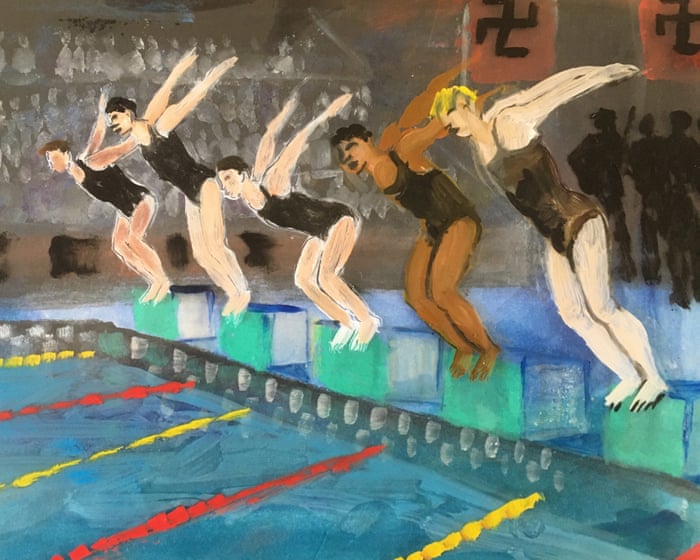
“My father would have loved for me to swim competitively. I was in a club when I was young, but I always started a little bit late in races—so I had no chance of winning.” French animation director Florence Miailhe chuckles about her swimming career ending before it began. Happily, the same isn’t true of filmmaking. At 70, she may have come late to her first Oscar nomination, in the animated short category; but the work in question—the passionate and richly textured Papillon (Butterfly), about world-record-holding French-Jewish swimmer Alfred Nakache—gives her every chance of taking the prize.
Miailhe isn’t sure why Nakache—whom her parents met while they were in the resistance—came to mind again in the mid-2010s. “Frankly, I don’t know why my memory was working like that. Maybe because I was thinking of my father,” she says. Memory flows through Papillon, which is swept away on surging tides of reminiscence as Nakache bathes for the final time at Cerbère on the Spanish border (where he died of a heart attack in 1983).
He plunges through the waves and downward, stirring up the sediment of the years: growing up in Algeria, he overcomes his early fear of water, meets his wife Paule as he rises through competitive swimming’s ranks, takes part in the 1936 Berlin Olympics, and is stripped of his citizenship in Vichy France before ultimately being sent to Auschwitz. Hand-animated by Miailhe on sheets of glass directly under the camera, with each frame superimposed over the last, it’s an almost physical baptism in oils, pastels, and sand, diving headlong into trauma and renewal.
Raised in Toulouse, where Nakache settled during the Second World War, Miailhe actually had swimming lessons with his brother, William, on holiday along the Mediterranean coast. The champion’s ostracism has sad contemporary echoes for the director, who is also Jewish. “For a while now in France, this idea that we can deprive a group of their nationality, because they belong to another community or religion, has come back,” she says on a Zoom call from New York, where she is promoting Papillon to Oscar voters ahead of the ceremony on March 15. With scraped-back black hair and bold red spectacles, the oval-featured Miailhe pleasingly syncs with the two-tone decor at the Sanctuary hotel on 47th Street.
In her eyes, sport is a heightened arena for highlighting such issues: “Irrespective of whether he was Jewish or not, what interested me was how even being a champion isn’t enough to prevent that discrimination.” A consensual silence existed around Nakache in the postwar period when he returned without his wife and daughter from the concentration camp—not least imposed by the athlete himself, who, like so many others, did not want to speak about his experiences. By the 21st century, he was largely forgotten, apart from a handful of pools bearing his name. But the recent success of Léon Marchand, trained like Nakache by the Dauphins du Toec club, has rekindled interest in the history of Toulousain swimming, says Miailhe.
Behind this humanistic story, which is natural Oscar territory, lies Miailhe’s formidable technique. After initially following her mother, the painter Mireille Glodek-Miailhe, into the static visual arts, she was encouraged by experimental animator Robert Lapoujade to explore the possibilities of motion. With almost no French animation schools in the 1980s, he urged her to jump right in—which she literally did with the 1991 short Hammam, which wafts Picasso-esque abstraction out of bathhouse vapors.
Water seems to be her element.She has closely observed the movement of water to achieve the range of effects seen in Papillon: “It’s not a scientific study, but something more sensual and sensitive. What interests me is showing how it’s never the same and always changing.” For instance, she adds an extra layer of oil above the painted currents and swells to create a three-dimensional sense of refraction or distortion, or mixes real soap bubbles into her paint to enhance the froth and churn of the water.
Her work embraces happy accidents—even though, by painting live in a single frame that evolves in front of the camera, she risks bigger errors that could ruin entire sequences. Miailhe values the risky and, in an age of advancing AI, deeply personal nature of her craft. “It’s very difficult and stressful,” she says. “But I like the challenge.”
Papillon—which shares a producer with the 2024 Oscar-winning animation Flow—was more of a high-wire act in this sense than her first feature, the 2021 refugee fairytale La Traversée (The Crossing). In that film, the backgrounds were kept entirely separate from the foreground figures. For The Crossing, an international team across four locations produced the 57,600 drawings required, compared to just four women for Papillon. Yet relying on others brings its own difficulties, such as uncertainty about her collaborators’ ability to rework the paint and salvage sequences that go wrong: “I know how demanding I can be with myself and whether I can judge if something is working or not, or when to start over.”
If she wins the Oscar, Miailhe won’t leave room for accidents—happy or otherwise. The nomination came as a shock, but she already has a general idea for her potential speech: “Why I wanted to make this film originally and how it speaks to today.” She is keenly aware of the country where she would be speaking, as well as the parallel between Nakache’s fellow swimmers walking away from the pool in protest at his exclusion and current discussions about boycotting the 2028 Los Angeles Olympics. But the real prize shines brighter than any statuette. On that, she is clear: “It’s important to speak up about human rights and to try to live with integrity.”
This article was amended on 24 February 2026. An earlier version stated that Léon Marchand was trained by Alfred Nakache at the Dauphins du Toec club; it should have said both swimmers were trained at the club.
Frequently Asked Questions
Of course Here is a list of FAQs based on the news about French animator Florence Miailhe
FAQs About Florence Miailhe Her Oscar Nomination
BeginnerLevel Questions
1 Who is Florence Miailhe
Florence Miailhe is a highly respected French animator and film director known for her unique painterly style of animation
2 What film is she nominated for
She is nominated for the Academy Award for Best Animated Short Film for her work on The Affairs of the Art
3 Why is this nomination such a big deal
At 70 years old this is her firstever Oscar nomination highlighting a long and dedicated career that is finally receiving this toplevel international recognition
4 What is her animation style like
She is famous for creating animation that looks like moving paintings often using techniques like painting on glass or using pastels and oils directly under the camera
5 What is The Affairs of the Art about
The short film is a darkly comedic story about two siblings and their obsessive peculiar passions exploring how family and artistic drive are intertwined
Advanced CareerOriented Questions
6 What does her quote I enjoy the challenge refer to in her work
It refers to the immense technical and artistic difficulty of her chosen animation method Painting framebyframe is slow physically demanding and requires constant problemsolving which she finds motivating
7 What are the main benefits of her painstaking animation technique
The benefits are a completely unique textured and emotionally powerful visual style Each frame is a piece of art creating a dreamlike immersive quality that is impossible to achieve with standard digital animation
8 What are common challenges or problems with this style of animation
TimeConsuming It can take years to produce a short film
Physical Demand It requires incredible patience and manual dexterity
Impermanence Paint can smudge and the original artwork is often altered forever in the process
Funding Its harder to secure financing for such a laborintensive process compared to faster digital methods
9 Can you name other notable works by Florence Miailhe
Yes her feature film