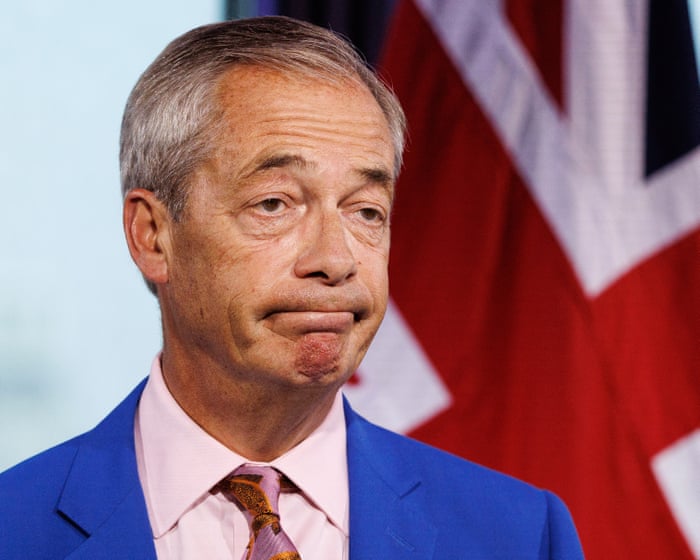
For Nigel Farage, a year that had been going pretty well took a turn for the worse when the Guardian revealed he'd received an undeclared £5 million gift from a crypto billionaire. Just ten weeks later, he's been pushed into what might be one of the biggest gambles of his political career.
That gamble probably isn't about his role as an MP. Farage won over 45% of the vote in Clacton in 2024, and this heavily Reform-friendly constituency was always likely to re-elect him, even before all the other parties said they'd step aside in a by-election they've dismissed as a publicity stunt.
Instead, the risk is that Farage comes across as self-indulgent, entitled, and petulant. And since he seems set to face a lineup of novelty or fringe candidates with no serious opposition, he might just look foolish.
For years, much of Farage's appeal was that he seemed like someone you'd enjoy having a pint with. But if the person on the next bar stool launched into a 15-minute rant of self-pity and victimhood on the scale of Farage's video address on Tuesday afternoon, you'd soon be thinking about moving to another part of the pub.
Before finally getting to the news that he was resigning as an MP to trigger a "people versus the establishment" by-election, Farage's statement was a long list of complaints, often petty ones. People were judging him for accepting the "lottery win" of a £5 million gift from crypto billionaire Christopher Harborne; his safety was at risk; the media was persecuting him; his daughter had been approached by broadcasters.
So what's going on? The main motivation seems to be an attempt to regain control of the political narrative, which has slipped away from Farage since the Guardian uncovered the £5 million from Harborne—a sum that's been described since as an unconditional gift, money for security costs, and a reward for delivering Brexit.
Since the news broke, three things have happened, all deeply uncomfortable for Farage. First, the persistent questions about who funds his lifestyle, and his difficulty answering them, have made Farage—by his own standards—something of a recluse. Weekly, freewheeling press conferences have been replaced with choreographed video statements and occasional broadcast interviews.
Second, media organizations have been motivated to dig deeper into Farage's often complex finances, including the exact number of homes he owns, and most recently his reliance on the long-time hanger-on and convicted criminal George Cottrell.
Finally, there's the scrutiny from parliamentary authorities. The standards commissioner is looking into whether Farage should have declared the money from Harborne, as well as—according to Farage on Tuesday—whether he needed to declare the help from Cottrell.
There's a growing assumption in Westminster that, given the size of the Harborne sum, Farage could face a Commons suspension long enough to trigger a so-called recall petition, where a by-election is called if at least 10% of the local electorate demands one.
Farage will know that calling his own by-election doesn't stop this. Parliamentary rules are clear: if an MP leaves the Commons, a standards investigation pauses, but it resumes if and when they're re-elected.
The calculation seems to be that if Farage wins convincingly, he could push back against a recall attempt—or if one did succeed, then campaign on a version of the slogan used by Leave campaigners for a possible second Brexit referendum: tell them again.
Such a path was always full of political traps. For all that Farage comes alive when he campaigns, for perhaps the first time in his career he has to face questions he's uncomfortable with and may not fully know how to answer. Why did Harborne give him so much money? What was it spent on? How many homes does he own? Can a self-styled man of the people really live on the generosity of wealthy and sometimes shady friends?
And now it seems likely he'll face all this scrutiny alone, with Labour, the Conservatives, and the Liberal Democrats all refusing to stand against him.The Conservatives, Liberal Democrats, Greens, and Restore Britain have all announced they won't field a candidate in a by-election they've dismissed as a pointless spectacle—the Nigel Farage show. Instead, they say they'll focus on the by-election that would follow if a recall petition is triggered.
For Farage, the logic behind his move seemed clear. He'd be back in the spotlight, openly promoting Reform policies and stealing media attention from Andy Burnham, who had hoped to spend the summer running his own events without much interruption.
But now that the other main candidates have dropped out, the spotlight is relentless. A man who once again hoped to claim the backing of the British people now seems trapped in a farce of his own making. This increasingly wealthy and powerful career politician wanted to once again tell the public, "I'm the outsider." Instead, he's in danger of becoming the punchline.
Frequently Asked Questions
Here is a list of FAQs generated based on the topic of the article Farage is likely to win in Clacton but can his credibility survive by Peter Walker
BeginnerLevel Questions
1 Who is Nigel Farage and why is he running in Clacton
Nigel Farage is a prominent British politician and a key figure in the UKs departure from the European Union He is running for Parliament in the Clacton constituency in Essex because it is a strongly proBrexit area where he is expected to win a seat after several failed attempts elsewhere
2 What does it mean that he is likely to win in Clacton
It means that based on local polling the areas strong support for Brexit and his personal popularity there he is the clear favorite to win the seat in the general election Its considered a safe bet
3 What does credibility mean in this context
It refers to whether people will continue to trust him take him seriously and believe his promises The question is whether winning the seat will actually hurt his reputation
4 Why would winning hurt his credibility
Because he has been a political outsider and a disruptor for decades Once he becomes an actual Member of Parliament he will have to deal with boring daytoday politics compromise and take responsibility for real decisions This can make him look less like a rebel and more like a typical politician
AdvancedLevel Questions
5 The article is by Peter Walker What is his main argument about Farages dilemma
Walker argues that Farage faces a paradox He is almost certain to win the Clacton seat but the very act of becoming an MP could destroy the antiestablishment outsider image that is the foundation of his political appeal He can no longer just complain from the sidelines
6 How does the history of the UK Independence Party relate to this question of credibility
UKIP which Farage once led famously struggled when it actually won seats in Parliament Its MPs often lacked discipline made embarrassing gaffes and failed to form a coherent opposition This history suggests that moving from protest movement to governing body is very difficult for Farages style