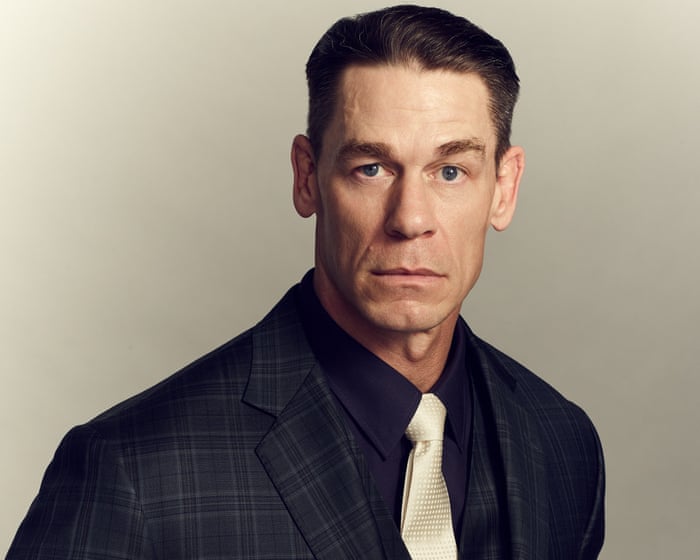
Musím přiznat, že jsem byl nervózní z setkání s Johnem Cenou. Z wrestlera WWE se stal herec a vybudoval si působivou hollywoodskou kariéru hraním idiotů – schopných idiotů s opravdovým srdcem, ale stejně tak hlupáků. Cena však rozhodně není žádný hlupák; hlupáci se z pokorných začátků nevypracují k tomu, aby se stali odpovědí své generace na Hulka Hogana nebo The Rocka. Bude ten Cena na mé obrazovce ten skutečný? Nebo něco bližšího komiksovým postavám, které tak dobře hraje: naivní, hloupý a mající v oblibě záměrná nedorozumění?Okamžitě je jasné, že to není žádný velké dítě. Dokonale přesný, vítá mě s velkou formálností, jak se sluší na muže, který debutoval ve filmu v titulní roli ve filmu The Marine. Během minuty bez vyzvání prohlásí, že „jednou z mých základních hodnot je respekt.“ Cena, 49, se mnou mluví jménem filmu Matchbox: The Movie, filmového spin-offu značky autíček Mattel pro Apple TV. Po 45 minut je štědrý, vtipný, lichotivý a nepolapitelný, aniž by byl kdy vyhýbavý. Je skutečně radikální, že muž postavy mrazicího boxu – který teprve nedávno odešel z wrestlingu po 26 letech – je tak uvolněný ohledně toho být směšný. V době takových radostných online siláků, jako jsou Trump, Musk a Andrew Tate, je jeho svalnaté kouzlo vítané.John Cena je firemní člověk. Slovo „loajalita“ se objevuje často, o všem od jeho přátel doma až po wrestling až po samotné USA. Obdivuhodné, bezpochyby. Ale Cenova loajalita ho přivedla do některých nepříjemných pozic a na 20 minut nás náš dobrosrdečný rozhovor o spolehlivosti, disciplíně a o tom, co to znamená vděčit za vše něčemu většímu než vy sám, nasměroval na kolizní kurz s jednou z nejvíce zdiskreditovaných postav moderní zábavy.Zobrazit obrázek na celou obrazovkuProblémy s autem … John Cena ve filmu Matchbox: The Movie. Fotografie: Jasin BolandV lednu 2024 Vince McMahon, všemocný předseda a generální ředitel WWE, rezignoval z organizace a její mateřské společnosti TKO Group Holdings po sérii obvinění ze sexuálního napadení a čekajících soudních sporů, které učinily jeho pozici ve společnosti, kterou celý život budoval, neudržitelnou. Poslední kapkou byla žaloba podaná bývalou zaměstnankyní WWE Janel Grant, která tvrdí, že ji McMahon sexuálně napadl a nutil k sexuálním aktům během jejího působení ve společnosti, posílal explicitní snímky s jinými muži bez jejího souhlasu a předával ji dalším – v jednom případě, uvádí žaloba, aby pomohl získat wrestlera, kterého společnost doufala podepsat. McMahon všechna obvinění popírá a v červnu bylo soudní řízení mezi ním, WWE a Grantovou dobrovolně všemi stranami převedeno z federálního soudu do důvěrné soukromé arbitráže.McMahon byl Cenovým mentorem a kromě sponzorování jeho kariéry mu poskytl druhou rodinu uprostřed kočovného cirkusu wrestlingu 00. let. „Nemám žádnou vinu ani hanbu ohledně svého přátelství a svého vztahu s Vincem McMahonem,“ říká a rychle následuje: „očividně to dáte do [svého] článku.“ Má samozřejmě pravdu. Zvláštní není to, že předvídal tuto linii dotazování – je to to, že Cena zaujal tak jednoznačný postoj tváří v tvář něčemu tak potenciálně škodlivému. Je slyšitelně hrdý na toto spojení a kochá se představou, že se drží svých zásad tváří v tvář tomu, co nazývá „bouří“. „Je v pořádku milovat někoho, když není dokonalý,“ říká.Cena se narodil ve West Newbury v Massachusetts v roce 1977 jako jeden z pěti chlapců v domácnosti, která počítala každý dolar. Jeho babička a dědeček žili v přilehlém domě. „Bylo tam hodně ‚Jak zaplatíme účty, jak udržíme světla svítit?‘“ říká Cena. Uctíval filmové akční muže té doby – Schwarzeneggera, Stalloneho, Willise – ale také miloval hip-hop, což z něj na předměstí Massachusetts dělalo terč šikany. Kulturistika byla odpovědí a toIt also works as an origin story – the boy bullied for dressing like a white rapper, who grew up to become an icon for the next generation of suburban youth. Still, when I bring it up, Cena is quick to correct the emphasis: the bullying wasn't the point; his response to it was. "I didn't treat hostility with hostility," he says. "I got bullied for the way that I dressed, so I dressed more outlandishly." The muscle was a visible deterrent. "I'll just project a physical sense of: Man, I don't want to press my luck with that guy," he says. After college, he drove to California in 1999 with about $500 to follow Schwarzenegger's playbook to bodybuilding glory. He worked on the shop floor at Gold's Gym in Venice Beach for six dollars an hour, and for a stretch, slept in the back of his 1991 Lincoln. A wrestler who worked out at Gold's steered him towards the industry and in 2000 he made his debut in WWF (now WWE) as The Prototype, a robotic character whose deliberate speech was a clear nod to his idol Arnie. He was paid $250 a week "which meant I spiralled into debt". To Cena's credit he understood that the short-term loss had the potential to lead to long-term gain. "I've been pretty astute at understanding when luck arrives," he says. View image in fullscreen Lord of the ring … John Cena at a WWE event in Toronto in 2024. Photograph: WWE/Getty Images What followed was a 24-year stint as a WWE superstar, a period Cena describes without irony as "service". "You can't fake that," he says. "If you're in the business of bullshit, somebody's going to see through it." He stumbled on a character that stuck: a jersey-wearing, battle-rapping white kid from Massachusetts, who literally went by the name John Cena. Despite some distrust from fans – over his general clean-living, wholesome persona – and fellow wrestlers who initially ostracised him for not engaging in the hard-boozing that was par for the course, the gimmick worked. In fact it was so successful that it led to the slightly odd ongoing situation where Cena doesn't own his own name. "John Cena is who I am as a human being," he says, "and there is a company – WWE/TKO – that has invested hundreds of millions of dollars in the intellectual property of the character John Cena. And rightfully so; they have earned their share of ownership of that." In Cena's words he read and understood the agreement and he thought it was fair. However, the lingering sense that a career at the top of WWE requires a deal with the devil prevails (Dwayne Johnson only got his own moniker, "The Rock", back in 2024, and now sits on the board of TKO). But Cena explicitly rejects the idea that he has had to make sacrifices along the way. "I prefer to use the word choice … When we say yes to something, we say no to everything else." In effect, he gave up his name for the rare chance to live his dream. And for more than a decade he did. Cena was beloved throughout the 2000s and early 2010s primarily as an avatar for a certain brand of flag-waving, white masculinity that was firmly in tune with the climate of post-9/11 America but is maybe less so now. Donald Trump was a recurring presence in WWE during this period, memorably shaving McMahon's head after besting him at WrestleMania and even "buying" flagship brand Raw as part of the pair's staged rivalry. The DNA of today's toxic masculinity can be seen in the WWE's Attitude era: Muslim performers were painted as would-be terrorists; female wrestlers, known as "divas", were sexualised, fighting in "bra and panties" matches; and scandals around steroid abuse and traumatic head injuries were raised in lawsuits. double quotation mark Rather than trying to take the reins of a movement or be the poster child for something, I'm just trying to be me The miracle of Cena's career is that the man who spent a dFor a decade, he was the straight-faced embodiment of American masculinity—and it turned out he was equally good at mocking it. After a few underwhelming action and sports roles, Judd Apatow cast him against type in the 2015 romcom Trainwreck, where he played a musclebound hunk whose attempts to be threatening just sound homoerotic. Then, as the pumped-up Peacemaker—first in the superhero movie The Suicide Squad (2021), then in the comedy spin-off series named after the character—Cena struck a balance between serious man and silly goose that would be hard to pull off without a healthy dose of self-awareness. That quality was on full display in his small but charming turn as a merman in Barbie, a commitment to the bit that was all the more admirable given his agents tried to talk him out of the role.
Matchbox, his latest film, is a vague attempt to recapture Barbie's magic in the more contained format of a traditional action comedy. Cena admits he felt relieved when he read the script and found the cars were "so far down the list of things they were doing with the IP." He plays Sean, an undercover operative whose entire life is a performance. When I wonder aloud whether the part hits close to home, he eagerly connects the dots himself: "How does someone who thinks they're always being watched act in a public place? That I got a little bit of familiarity with."
Cena's onscreen persona is an intriguing model of masculinity: the strongman remade as softie. What's more, his wall-to-wall presence in the childhoods of millennial men makes him a far more credible advocate of positive manhood than a Joe Rogan or a Jordan Peterson. But he is reluctant to take on that mantle. "Rather than trying to take the reins of a movement or be the poster child for something, I'm just trying to be me," he says, before offering his own diagnosis of why so many people are in the business of selling a personal vision of masculinity. "The appetite for a certain kind of manhood is just supply and demand," he says. To the people clamouring for it, "my advice would be: go get it."
Perhaps Cena's lack of desire to be cast in that role is emblematic of why it would suit him. The system, he says, "is real fragile … if I say I'm going to be the showcase of masculinity and the supply-and-demand chain pivots in five minutes, I'm shit out of luck." He is keen to underscore how much he "loves the United States and admires its military force that makes the vow to, under the ultimate sacrifice, protect that piece of paper that says 'We the People'. To me, that's extremely heroic."
Cena's own heroism came into question in 2021 when, while promoting Fast & Furious 9, he referred to Taiwan as "a country." The Chinese audience took offence, and he filmed a contrite apology in Mandarin, a language he had been learning for six years in an attempt to grow the WWE's presence in China. In the US, the grovelling video read less as an apology than a capitulation to the weight of China's economic might. The fan backlash was so intense that he told James Gunn he'd understand if he had to be fired from Peacemaker. He takes full responsibility for the episode. "Just because you know the language doesn't mean you know the culture," he says, admitting, "I got way too overconfident. I thought I was the smartest guy in the room." Part of what frightened him was the very real possibility of "the termination of employment that I love." The same reflex toStaying loyal to the brand has taken him to countless events in Saudi Arabia without complaint. "WWE speaks a universal language of diplomacy," he says. "So when you ask, 'Hey, the thing you're part of sometimes gets criticised for what it does as an organisation – is that hard?' Of course it is, especially when you believe in that organisation."
For a man who prides himself on saying yes, it's telling what he has repeatedly turned down. Cena doesn't want children, and his reasoning fits his sense of discipline: they would demand too much of him. From 2002 to 2015, he was home "about 15 days a year, and even now it's maybe 70," he says. "If I said yes to children, I'd have to say no to everything else." His engagement to fellow wrestler Nikki Bella – his co-star on the reality show Total Bellas – ended in 2018, largely over whether to have kids. Cena, who'd had a vasectomy, offered to reverse it, but the relationship ended soon after.
"I really enjoy my life," he says. Cena has granted more than 650 Make-a-Wish wishes, more than anyone else alive. He sees his ability to do so much for the charity as directly tied to not having children. "If I had a family of my own, I wouldn't have those 650 moments … I'm flying with just my partner on this one." Cena married Shay Shariatzadeh, an Iranian Canadian tech product manager, in 2020, after they met in Vancouver while he was filming. They'd only been together a year, but he's said he would have proposed after three months. "I have a loving connection that people don't see," he says. "I don't need the world to know me completely as a person."
Wrestling With Trump review – the president gets an almighty smackdown! Read more
He remains under contract with WWE as a "brand ambassador", a sign of his gratitude to the company, but also an unfinished transition back to ordinary life. Next, he'll star in One Attempt Remaining, a comedy from Kay Cannon (director of Blockers and writer-producer of the Pitch Perfect series). He plays one half of a divorced couple forced to team up with his ex to track down the lost password to a crypto account worth millions. While Dwayne Johnson has become a brand bigger than his wrestling fame, you get the feeling Cena will never fully escape his WWE persona – his screen roles echoing the exaggerated version of himself he's been playing since 2002.
Maybe that's what it means to be a company man: not an empty suit or a servile mouthpiece, but someone so completely committed to the brand that it's simply who he is. Present, punctual, polite and businesslike. The job is done, and it's back to the gym.
Matchbox: The Movie premieres on Apple TV on 9 October.
Frequently Asked Questions
Here is a list of FAQs based on the article about John Cenas Hollywood success and his loyalty to Vince McMahon
Beginner Questions
Q What is this article about
A It explains how wrestler John Cena became a successful Hollywood actor and why he stays loyal to Vince McMahon the man who runs WWE
Q Who is John Cena
A He is a famous professional wrestler who has become a major movie star He is known for his Never Give Up attitude
Q Who is Vince McMahon
A He is the chairman of WWE the biggest wrestling company in the world He hired Cena and made him a star
Q Why is it surprising that Cena is a successful actor
A Many wrestlers try to become actors but fail Cena has beaten the odds and become a real Hollywood star
Q What does Its OK to love somebody when theyre not perfect mean here
A It means you can still be loyal to a person even if they have flaws or make mistakes Cena supports McMahon despite any controversy
Intermediate Questions
Q How did John Cena conquer Hollywood
A He started with small roles worked very hard and showed he could be funny and charming He took roles in comedies like Trainwreck and action movies like Fast Furious He also learned to make fun of himself which made people like him
Q What are some of Cenas biggest movies
A Trainwreck Blockers Bumblebee Fast Furious 9 The Suicide Squad and Peacemaker
Q Why does Cena refuse to abandon Vince McMahon
A Cena believes in loyalty McMahon gave him his big break and made him a millionaire Cena feels he owes McMahon everything and wont turn his back on him
Q What are the benefits of Cenas loyalty
A It shows he is a man of his word It keeps his relationship with WWE strong It also gives him a safe home base while he acts in movies
Q What are the common problems with this kind of loyalty