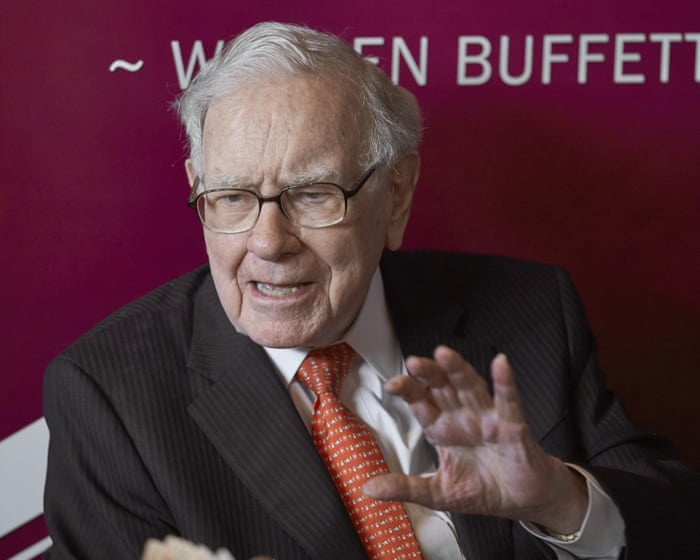
Warren Buffett, the billionaire investor set to retire at the end of 2025, has long entertained and educated shareholders of his Berkshire Hathaway conglomerate with his insightful annual letters detailing the company’s performance.
Since 1965, he has kept investors informed as Berkshire transformed from a “struggling northern textile business” with $25 million in shareholder equity when he took over, into an empire now valued at over $1 trillion.
Here are some of the most memorable quotes from the departing Sage of Omaha.
For capital allocation, the world was his oyster
Last year, Buffett described buying Berkshire Hathaway as a mistake, writing: “Though the price I paid for Berkshire looked cheap, its business—a large northern textile operation—was headed for extinction.”
This led to Buffett’s capital allocation strategy. It took time for him to realize that he and his team faced no institutional constraints when deploying capital; the only limitation was their ability to understand a potential acquisition’s future.
In his 1982 letter, Buffett explained that “what really makes us dance” was buying 100% of good businesses at reasonable prices—a task he admitted was “extraordinarily difficult.”
Pay cash
One hard-earned lesson for Buffett and his investors was to use cash, not shares, for acquisitions.
A key moment in this learning process was his decision to pay 272,000 Berkshire shares for the reinsurance company General Re in 1998. He later called this “a terrible mistake,” adding: “My error caused Berkshire shareholders to give far more than they received (a practice that—despite the biblical endorsement—is far from blessed when you are buying businesses).”
Why a ‘bisexual’ approach to investing pays off
Readers of Buffett’s 1995 letter were treated to a memorable explanation of his two-part investment strategy: taking stakes in “wonderful” public companies while also trying to buy similar businesses outright.
This dual approach offered a key advantage over investors who stuck to just one method, Buffett wrote, quoting Woody Allen: “The real advantage of being bisexual is that it doubles your chances for a date on Saturday night.”
On fear and greed…
In 1986, Buffett coined his most famous investing advice: be fearful when others are greedy, and greedy only when others are fearful.
Noting that he saw no stocks offering the “grand-slam home run” opportunity of being cheap, well-managed, and economically sound, Buffett said epidemics of fear and greed would always occur in investing, though timing them was difficult.
On the perils of acquisitions
Buffett believes most deals harm the acquiring company’s shareholders and is puzzled why buyers even consider projections prepared by sellers.
In 1994, he suggested many CEOs lack discipline in using spare capital due to a “biological bias” toward “animal spirits and ego.” He wrote: “When such a CEO is encouraged by his advisers to make deals, he responds much as would a teenage boy who is encouraged by his father to have a normal sex life. It’s not a push he needs.”
When the tide goes out, you see who’s been swimming naked
Berkshire’s insurance business, Geico, has been central to its growth over the decades. Its float—customer money held until needed for payouts—typically comes at a very low cost and can be used to fund investments.
Berkshire’s super-catastrophe (super-cat) insurance business has also been profitable, though it has faced challenges.Berkshire Hathaway faced significant losses when disaster struck. In 1992, Hurricane Andrew cost the company $125 million, roughly equal to its super-catastrophe premium income for that year. However, other insurers fared even worse in what was then the largest insured loss in history. As Warren Buffett noted, Andrew wiped out several small insurers and exposed the inadequate reinsurance protection of some larger companies. He famously remarked, “It’s only when the tide goes out that you learn who’s been swimming naked.”
Buffett has also been a vocal critic of derivatives, which he called “financial weapons of mass destruction” in his 2002 letter. He warned that derivatives were time bombs, posing latent but potentially lethal dangers to both market participants and the broader economic system. This warning proved prescient during the 2008 financial crisis, when the interconnectedness of large financial institutions—a “frightening web of mutual dependence”—helped trigger the meltdown. Buffett likened the risk to avoiding venereal disease: “It’s not just whom you sleep with, but also whom they are sleeping with.”
He argued that this complexity effectively guaranteed government bailouts for major derivatives dealers in times of trouble, leading to what he called the “first law of corporate survival” for overleveraged CEOs: “Modest incompetence simply won’t do; it’s mind-boggling screw-ups that are required.” Despite his criticism, Berkshire itself was party to 251 derivatives contracts at the time, which Buffett justified as being “mispriced at inception, sometimes dramatically so.”
Buffett’s long-term strategy aims to outperform the S&P 500 by maintaining ample reserves to deploy during market downturns, when valuations fall and opportunities arise. He describes his approach as dreaming big and being prepared for economic storms, which he believes will “briefly rain gold.” In his 2016 letter, he promised that when such downpours occur, “it’s imperative that we rush outdoors carrying washtubs, not teaspoons. And that we will do.”
On management, Buffett emphasizes centralized financial decision-making at the top, coupled with significant delegation to the leaders of Berkshire’s various businesses. He prefers seasoned managers, joking that “you can’t teach a new dog old tricks.” Shareholders in the 1980s became familiar with Rose Blumkin, or “Mrs. B,” a remarkable entrepreneur who fled Russia, built a Nebraska furniture store into a $100 million-a-year business from a single location, and sold most of it to Berkshire for $55 million as she approached her 90s. Buffett happily reported her 100th birthday in 1993, quipping, “The candles cost more than the cake,” and noting her promise to attend his own 100th birthday. Sadly, she passed away at 104, after retiring at 103—a fact Buffett still cites to any Berkshire manager considering retirement.
Regarding succession, Berkshire investors have received regular updates on plans for a post-Buffett era. Since 2005, the board has identified several potential successors. In his 2007 letter, Buffett described the candidates as “young to middle-aged, well-to-do to rich,” all motivated to work for Berkshire for reasons beyond compensation.I have reluctantly given up the idea of managing my portfolio after I die—letting go of my hope to give new meaning to the phrase “thinking outside the box.”
Frequently Asked Questions
FAQs Be Fearful When Others Are Greedy and Greedy When Others Are Fearful
Understanding the Quote
What does this quote actually mean
It means you should be cautious and avoid following the crowd when everyone is overly optimistic and buying into investments at high prices Conversely when panic sets in and everyone is selling in fear thats often the time to look for buying opportunities
Who said this and why is it important
This is a famous quote from legendary investor Warren Buffett Its important because it encapsulates a core principle of value investing going against emotional herddriven market behavior to make rational longterm decisions
Is this just about stocks or does it apply to other investments
While famously applied to the stock market the principle can apply to any asset class where crowd psychology drives prices to extremes
Applying the Principle
How do I know when others are greedy
Look for signs like a sustained market boom with little volatility excessive media hype about cant lose investments people borrowing heavily to invest and historically high valuation metrics
How do I know when others are fearful
Signs include a sharp market decline or crash constant negative headlines high volatility investors moving money to safe assets like cash or bonds and widespread predictions of further doom
Does this mean I should always do the opposite of what everyone else is doing
Not exactly It means you should be skeptical of the prevailing emotion The goal is to act based on a securitys intrinsic value not its popularity Sometimes the crowd is right for a period but extremes of emotion usually lead to mispricing
Whats a realworld example of this
During the 200809 financial crisis widespread fear caused stock prices to plummet Investors who were greedy and bought quality companies at those lows were rewarded handsomely in the subsequent recovery Conversely during the 1999 dotcom bubble greedy investors buying overhyped tech stocks at peak prices suffered major losses
Common Challenges Misconceptions
Isnt this just timing the market which is supposed to be impossible
This is a common confusion The quote is