For nearly 40 years, Mako Nishimura never lost a fight. She told me this as if it were as obvious as night following day. Nishimura is just five feet tall and slight in build. She is also likely the only woman ever to become a full-fledged yakuza—a member of Japan’s feared and strictly ruled criminal underworld. She must have beaten many male gangsters. How, I asked her, did she do it? “First the legs,” she said, hands clasped, keeping the calm demeanor of a village priest. “You cut him down with a club or a plank of wood.” Then you get to work.
Nishimura’s relaxed attitude toward violence—and speaking with her, you suspect it goes deeper than that—first caught the attention of yakuza members in 1986. At the time, she was a 19-year-old runaway and former juvenile prison inmate living in Gifu, a city near Nagoya. One night that year, Nishimura got a phone call. A pregnant friend named Aya was in trouble. Nishimura grabbed a baseball bat, ran down the street, and found Aya surrounded by five men. When one of them kicked Aya in the belly, Nishimura yelled for her friend to run, then went after the attackers with her bat.
By the time the police arrived, the attackers were covered in blood and Nishimura had fled. She went into hiding 170 miles away in Tokyo. Two weeks later, when she returned to Gifu, a local man approached her in a nightclub. He was a member of the Inagawa-kai, one of Japan’s largest organized crime syndicates, and he wanted her to join. Nishimura was already in a biker gang called the Worst, who raced and robbed while dressed in the white jumpsuits of wartime kamikaze pilots. She was also getting deeper into serious crime—running sex workers, extorting local businesses, and selling and using large amounts of methamphetamines. The Inagawa-kai man didn’t have the right energy, Nishimura thought. She turned him down.
Still, yakuza life appealed to her. It offered respect, protection, and above all, the chance to make big money. A few days later, another yakuza sent for Nishimura. His name was Ryochi Sugino, and he ran a Gifu affiliate of one of Japan’s largest yakuza groups. Sugino was a convicted murderer, but he was also charismatic and, somehow, fatherly. Nishimura trusted him. “He had this aura,” she said.
At age 20, she and an underboss shared sake at the gang’s downtown Gifu headquarters. This ritual, called sakazuki, formalized Nishimura’s entry into the yakuza and established her loyalty to Sugino until death. Now, as the saying went, if Sugino told Nishimura a crow was white, she would have to agree. She was proud of her new identity, she told me. “Everything that was yakuza-like, I would do.”
Some of the men taunted her for being a woman. But they also appreciated the business she brought in, running girls and meth around Gifu. Unlike members of Italian mafias, who kick a cut of criminal profits up through a strict hierarchy, yakuza operate more like franchises. Members pay a monthly tribute to trade on the syndicate’s threat of violence.
When Nishimura joined, the yakuza were thriving. Unlike many organized crime groups around the world, the yakuza didn’t see themselves as outsiders. They had long been part of the system, growing powerful with the state rather than against it. They claimed a connection to feudal-era samurai and helped plunder Asia on behalf of imperial Japanese forces. By the mid-20th century, their image as patriotic criminals had been further polished by yakuza-owned movie and manga studios.
By the 1980s, when Nishimura became a member, the yakuza didn’t just traffic guns, drugs, and women. The gangs ran casinos, golf courses, and high-rises, and extorted money from publicly traded companies by threatening to disrupt their operations. The largest yakuza syndicates were worth hundreds of millions of dollars and were active on the stock market, with operations from Hawaii to Ho Chi Minh City.
But as Japan’s economy changed, so did their fortunes.After the economic bubble burst in the early 1990s and a series of scandals revealed the cozy ties between organized crime and politics, the Japanese public increasingly demanded that the police crack down on the gangs. These days, after years of tougher laws and competition from international and tech-savvy crime syndicates, the yakuza are widely seen as a fading force.
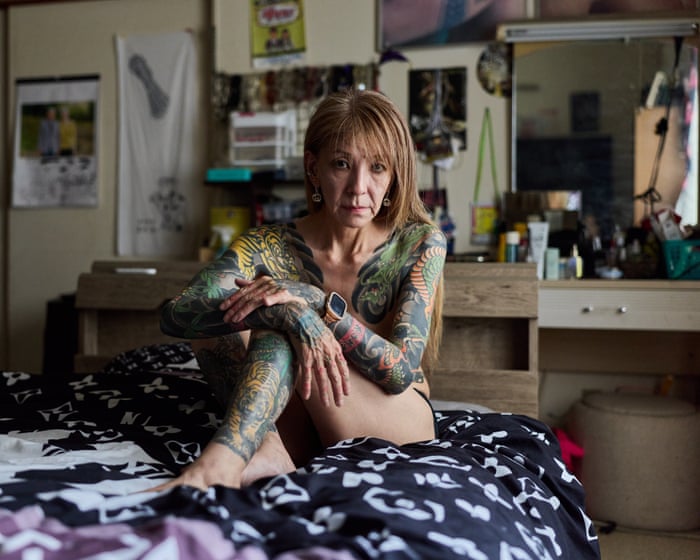
Nishimura is no longer a member. She lives in a small, ground-floor apartment near Gifu’s train station, surrounded by plants and photos of her two sons. Because of her criminal past and drug addiction, she has mostly watched their adult lives from a distance. When we met over three days last autumn, Nishimura, now 59, wore her hair in a dyed-blond ponytail pulled through a rhinestone-studded baseball cap, paired with a white denim jacket and skinny jeans. The most visible signs that she was once a yakuza are the vivid tattoos that spread onto her neck and hands, and the missing little finger on her left hand.
Nishimura has no desire to become a feminist icon. “I was a man,” she told me. “I had to behave like a man.” Still, she says she feels ashamed of her decades of crime—much of it targeting women—and she is trying to add redemption to her story. She has written a memoir about the highs and lows of life in the mob, and works for a charity that helps former yakuza leave the gangs for good. As the fortunes of Japan’s historic underworld decline, Nishimura hopes this new chapter in her life might also bring her own family back together.
As a child, Nishimura loved the stories yakuza told about themselves—especially the daring rebels played by stars like Ken Takakura and Bunta Sugawara, who lived by a code: protect the weak and fight the strong. For Nishimura, that meant rebelling against her father, a strict civil servant whose parenting style, as she remembers it, involved beating his children and throwing them half-naked out into the cold. Anything from bad grades to slouching could lead to a beating. “Hard work,” he told Nishimura and her two younger brothers, “never betrays you.”
By age 14, Nishimura had joined a group of so-called “delinquents,” smoking cigarettes and skipping class. It was a “fresh experience,” she writes in her memoir, a “time of liberation and freedom.” But when she bleached her hair blond, it enraged her father. He shaved her head, and she went to school the next day with her head wrapped in a towel.
From then on, Nishimura became a habitual runaway, sleeping in cars or under the eaves of temples. She renamed herself Mako, meaning “the devil’s child,” and got the first of hundreds of tattoos that now cover almost her entire body. Some she did herself with a stick and poke—including the ones on her thighs, which hurt the most. “I can endure pain,” she assured me.
At 17, after a few months in juvenile detention for drug possession, Nishimura joined the Worst, one of hundreds of bōsōzoku (literally “speed tribe”) biker gangs across Japan. Yakuza often recruited from biker gangs, and it wasn’t long before a 40-year-old yakuza noticed Nishimura and introduced her to Sugino.
When Nishimura’s mother, Hiroko, found out that her daughter had gone from juvenile detention to becoming Japan’s only female yakuza, she showed up at the gang’s headquarters in Gifu. It wasn’t hard to find: yakuza have registered offices, logos, and even employee of the month awards. “Please take care of my daughter,” Hiroko begged Sugino. But Nishimura now had a second family—one that, she felt, accepted her for who she really was.
For the first two years as a Sugino-gumi yakuza, Nish…Iimura went through a kind of trial period, ticking off a list of daily chores that could include cooking (her colleagues especially liked her potato salad), cleaning, laundry, working the front desk, or walking the boss’s two Akita dogs. One of them, according to legend, had killed four animals on his own, so he was fittingly named Dog Killer Maru.
The Sugino family also taught Nishimura how to shake down businesses and spot corrupt cops and politicians. (During the 1980s, a newspaper reported that a yakuza group in Gifu kept a sitting member of Japan’s parliament, the Diet, on retainer as an “adviser.”) Nishimura used drug money to start a sex work business, then put the profits into slot machines. She gave some of the money she made to her older brother, a struggling truck driver who had also dabbled with the mob. She lifted weights, learned karate, and spent a lot on tattoos, including designs worn by the legendary crime boss Kenichi Shinoda.
One of the yakuza’s most profitable areas was the sex industry. Nishimura would deliver women to Watakano, a half-square-mile island 75 miles south of Gifu, nicknamed Prostitute Island. Pimps might pay advances for good-looking girls, so Nishimura looked among Gifu’s women in debt or hooked on drugs for potential moneymakers.
Once, according to her memoir, just as Nishimura was about to close a deal for one of them—a young meth addict named Reiko—the girl ran away. Nishimura tracked her to Osaka, Japan’s second-largest city, and paid a yakuza member to kidnap her again. Nishimura drove the terrified girl back to Gifu in her Mercedes, adding travel expenses, food, and drug costs to her debt. “You’ll have to clean up after yourself,” Nishimura told her.
Nishimura then drove Reiko to a ferry terminal, where they boarded a rundown fishing boat, and Nishimura handed the girl over to a Watakano yakuza. Years later, Nishimura ran into the girl. She had paid off her debt, but she was empty-eyed and didn’t recognize Nishimura at all. Nishimura knew she had played a part in Reiko’s suffering. But, she said, “If you are a yakuza, if you don’t do these sorts of bad things, you can’t really rise or become better.”
Rivals often called Nishimura the “little man.” She remains either the only woman or one of two to have performed the sakazuki ceremony. (There is a woman in Osaka who may have done it before Nishimura, but she refuses to talk about her past.) Nishimura is the “exception that proves the rule” of the yakuza’s strict patriarchal culture, according to Martina Baradel, an Oxford University academic and author of Yakuza Blues and 21st Century Yakuza. (In the early 1980s, the widow of the leader of Japan’s largest yakuza syndicate, the Yamaguchi-gumi, took over while her husband’s chosen successor was stuck in prison. But she never performed sakazuki.)
Sometimes Nishimura would make small compromises to the underworld’s patriarchy—like answering the phone at the Sugino-gumi front desk in a deeper voice. But she insists that no one ever made a sexual move on her or treated her as anything other than a fellow member. Nishimura’s biggest threats came in other forms.
As her profits and status grew, Nishimura’s personal life fell apart. Alcohol had never agreed with her, and she hadn’t enjoyed huffing paint thinner with her biker friends either. But meth was different. It kept her alert and high, like her hair was standing on end, she said. The Sugino-gumi banned drug use, but Nishimura’s small apartment welcomed a rotating group of gangsters and users, who sat around injecting meth.
It wasn’t long before Sugino found out about the gang’s addiction problem and ordered Nishimura to apologize on their behalf in the yakuza way: by cutting off a finger.She cut off the tip of her little finger. Nishimura pinned the finger between a short sword and the ground, then stepped on the blade. But the sword slipped and cut her finger diagonally. So she did it again, cutting it off at the next joint. Then she went to a nearby hospital, where the staff filed down the exposed bone, trimmed the bloody stump with nail clippers, and stitched it up. After that, she returned to headquarters and handed the gruesome remains to her boss. Seeing how calmly she had done it, squeamish members later came to Nishimura to have the same done to them. She did it gladly, often for a fee.
Now 21, Nishimura had long lost contact with her father. Her mother, Hiroko, stayed in touch, meeting her wayward daughter in secret, giving her money, and hoping the family would one day reunite. But when police raided Nishimura’s apartment, they found methamphetamine, and a judge sentenced her to two and a half years in prison for possession. While inside, she studied business law and learned financial con artistry from a fellow inmate.
When Nishimura was released in 1990 at age 24, she was met at the front gate by a yakuza guard of honor, driven to gang headquarters, dressed in a suit, and handed a million yen—about £4,700 today. The ceremony, known as demukai, “was an important rite of passage for the yakuza member,” according to an anthropological study from that time. “It was a symbol that the state’s rehabilitation efforts had failed.”
In prison, Nishimura had managed to get clean, but after her release she started using meth again. She was known for her toughness, but inside, the drug had wrecked her. She grew paranoid and suffered hallucinations. “I was worn out,” she writes. “Shadows looked like people; running water sounded like a human voice.”
By the end of the 1980s, the yakuza had lost their status. For decades, Japan’s gangs had a reputation as outlaws who stole from the rich, made up of burakumin, a low-ranking social class historically stuck with “dirty” jobs like butchery and undertaking. But a series of high-profile scandals revealed that the bosses were living lavish lifestyles and corrupting politicians. Fed up with their influence and gang violence, the public turned against them.
Even the yakuza film genre, so popular with Japanese audiences in the 1950s and 1960s, had changed. The glorifying stories gave way to newer films, like Boiling Point in 1990, which made fun of their thuggery. In 1992, a film called Mob Woman showed a female lawyer who successfully stood up to the yakuza. After it was shown, three gangsters attacked the director, Juzo Itami, and slashed his face with knives.
View image in fullscreen: Members of the yakuza organization Yamaguchi-gumi attend a memorial service for their leader, Masahisa Takenaka, in Kobe, Honshu, in 1988. Photograph: AP
Itami recovered, but the Diet still passed an anti-yakuza law that banned them from stock market involvement, collecting protection money, and working as loan sharks. The law—similar to the 1970 US Racketeer Influenced and Corrupt Organizations (RICO) Act—allowed authorities to label yakuza as “violent groups,” making it possible to seize their assets and property.
It wasn’t just about lost honor or prestige. The yakuza had ridden high on an economic miracle that took Japan from postwar ruin to the world’s third-largest economy. But the bubble burst in 1990, wiping 60% off the value of Japan’s Nikkei stock index and devaluing the yen. The yakuza lost huge investments in global megaprojects, while foreign gangs pushed them out of drug and sex markets they once dominated.
At its peak in the 1960s, the yakuza claimed to have more than 184,000 members in 5,000 syndicates—far more than the Italian and Italian-American mafias combined. According to police records, by the mid-1990s, yakuza numbers had dropped to about 90,000.Gangs from China, Vietnam, and even Russia began moving into the yakuza’s home territory. “The day when Japan is run by the world’s gangsters,” wrote the Sunday Mainichi magazine in 1992, “may not be far off.”
In 1995, when Nishimura was 29, she met a member of a rival gang at a yakuza dinner party in Gifu. He was 15 years older than her and already in a relationship. They started an affair, and six months later, Nishimura became pregnant. Motherhood changed her almost overnight. “I never thought I would die for anyone,” she said. “But when I had children, I started to think I could die for them.”
Nishimura’s lover was out on bail when they met, and he was arrested again while she was pregnant. She couldn’t control the courts, but she promised herself she would quit meth for good. She cut off contact with her colleagues from the Sugino-gumi and stopped going to their usual hangouts. Her father had died a few years before her child was born, but Hiroko came to Nishimura’s house every day, enjoying her first grandchild. Hiroko and Nishimura even went shopping together, like a normal mother and daughter. In some small way, Nishimura felt, the baby would make up for the pain she had caused her own parents.
When the boy’s father got out of prison, a year after his son was born, and refused to leave the yakuza, Nishimura left him and moved from Gifu to Kasugai, a city closer to Nagoya and the village where she grew up. But motherhood didn’t offer the excitement of organized crime, and for years, she writes, “life seemed to stand still.”
When her son was in his last year of nursery school, his father asked to try the relationship again, and Nishimura agreed. They moved into an apartment together in Gifu, and for a while things were good. But Nishimura couldn’t keep office jobs or work at a local nursing home. When employers saw her tattoos or missing finger, they would find a way to reject her.
Nishimura’s hands. Photograph: Shoko Takayasu/The Guardian
She went back to crime—first running a massage parlor, then getting meth in Tokyo and selling it by the kilo. “I was impressed by how easily meth could be turned into money,” she writes. “One drug deal could bring in several times the profit of a month’s honest work.” At age 39, Nishimura gave birth to her second son. Unlike her father, she didn’t beat her children, but she was surprised at how strict she could be. “You understand the reason behind that strictness,” she told me. “My father was right.”
All this time, Nishimura had avoided her old yakuza colleagues from the Sugino-gumi. Instead, she took on the role of a gangster’s wife, cooking and cleaning for her partner’s men at their Gifu headquarters, even though she was the main breadwinner. She and her partner fought, she says, sometimes violently. According to Nishimura, one time she hit him and he responded by throwing a kitchen knife at her.
Nishimura stayed off meth, but instead took prescription tranquilizers, eventually downing an entire sheet of 10 pills each day. She started dealing meth from her home, and the police arrested her. They let her go after 10 days, having searched the apartment and found nothing but shipping labels. But one day in 2014, when she was 48, Nishimura was hospitalized after taking enough pills to paralyze her. It was “like I was tied to the bed,” she writes.
When she was released, she reached out to her old yakuza friends. But time hadn’t been kind to them either: Nishimura’s closest former colleague was an alcoholic, and the gang was broke. Yakuza once swore never to harm or extort ordinary citizens, but they were now involved in the kind of online romance scams Nishimura believed were beneath them, including those targeting elderly people. “The responsibility to fight bullies and help the weak,” she told me, seeming to forget her own cruelties, “is the core of yakuza thinking. If it’s not…””Yeah, I don’t like that.” Not long after, she left the gang for good.
The fate of Nishimura’s former gang in Gifu mirrored the decline of the yakuza across Japan. The 1992 anti-yakuza laws had limited some of their operations, but companies and individuals still paid them to extort or intimidate others. So in 2011, Tokyo banned all financial dealings with them. Not only were yakuza cut off from their main source of income, but members couldn’t buy cars, open bank accounts, or even register a SIM card. The promise of a flashy gangster lifestyle was gone, and their numbers dropped sharply.
One story from recent years shows how far the yakuza have fallen. In February 2020, when a COVID-19 outbreak stranded the Diamond Princess cruise ship in Yokohama for a month, members of a local yakuza group offered to clean the infected vessel. “People like us should do the dirty work,” said a high-ranking member. His offer referenced the yakuza’s mythical origins among the low-caste burakumin. But it was also a bid for good publicity: by then, there were fewer than 30,000 yakuza, and one of their bosses was offering to clean up a ship’s decks. (Japan’s government turned down the offer.)
Today, Japan’s criminal underworld is dominated by small, informal groups called tokuryū—a police term for gangs without the strict hierarchies or structures of yakuza syndicates. Many run their crimes online, offering so-called yami baito, or shady part-time jobs, through social media to recruit scammers for romance and crypto fraud.
Foreign gangs that once worked as hired muscle for the yakuza are now key players in Japan’s sex and drug trades. These gangs are “very flexible,” says Tadashi Kageyama, a senior managing director at risk advisory firm Kroll. “They partner up with Chinese gangs, Vietnamese gangs, and the Russian mafia,” he told me. Modern organized crime is highly digital, says Wolf Herbert, an academic based in Kobe. “And the old yakuza? They don’t even have a smartphone.”
Japanese police today arrest fewer than half the number of foreign nationals they did 20 years ago. Still, foreign gangs have become a useful target for Japan’s resurgent far-right. Prime Minister Sanae Takaichi said in November that “members of the public feel anxiety and a sense of unfairness due to illegal acts committed by a small number of foreign nationals.” Criminal monopolies—especially those like the yakuza in its heyday, which had a strong grip on the police and judiciary—tend to be less violent than an underworld split among several smaller gangs. Even Nishimura suggested to me, “Maybe it’s safer with the yakuza around than with others.”
By 2016, Nishimura had split from her partner. But partly because of her drug addiction, he got custody of their sons. Even her mother stopped visiting. Nishimura drifted through a series of dead-end jobs, wondering if she would ever see her children, her mother, or her brothers again. She was alone, without even the down-and-outs from her former gang for company. And then she met Satoru Takegaki.
Takegaki had been a yakuza enforcer for 32 years, a tough guy close to the Yamaguchi-gumi boss. But over time, he grew disillusioned: money was tight, and newcomers ignored the sense of honor and tradition he believed should define yakuza life. When a boss’s son was shot dead in a dispute, Takegaki left the Yamaguchi-gumi entirely. In theory, there are ways to retire from the yakuza. But his former colleagues didn’t accept his departure. They shot up his house, so he installed CCTV cameras and slept with a sword by his side.
Soon after, in the city of Himeji, he founded Gojinkai, an NGO helping other yakuza leave the criminal life. By 2020, when Nishimura first met Takegaki, he was often quoted in the media predicting the yakuza’s end.her downfall. She started visiting the Gojinkai office once a month, joining Takegaki and other former yakuza to clean the streets. She writes that it was “wonderful to see such a bigshot from the past taking the initiative to pick up trash.” Nishimura couldn’t leave her criminal past behind, which left her poor, alone, and without a job. But Takegaki inspired her. “If he can do it,” she thought, “so can I.” (I couldn’t reach Takegaki for comment, but he told a Telegraph reporter in 2021 that the yakuza would be extinct “in 50 years, maybe less… They’ll be like ninjas—just stuff from movies and legends. Gone.”)
Gojinkai aimed to solve a big problem for anyone trying to leave the yakuza and enter the legal economy. Authorities still consider them members for five years after they leave, which means they can’t open bank accounts, can’t find jobs, and are more likely to go back to the underworld. Ex-yakuza “are stuck in a grey zone,” says Herbert. “So there’s no way for them to escape the criminal world.”
View image in fullscreen
Nishimura and her mother, Hiroko. Photograph: Shoko Takayasu/The Guardian
Working with Gojinkai gave Nishimura a sense of purpose. After the pandemic, Takegaki let her open a branch just minutes from her old gang’s headquarters in Gifu. She helps former members find housing and drug rehab, and gets some of them jobs at a local demolition company. “I want people to know that no matter what you’ve done in the past, you can still face the future,” she said. “And you can get yourself together.”
Helping others recover felt like a small way to make up for her past. But Gojinkai was an unpaid job: Nishimura was still barely getting by financially, and she missed her two boys, who were now young men. She knew her oldest son had become a champion kickboxer in Tokyo, and she surrounded herself with pictures of his achievements. But she was poor and lonely. Above all, she wanted her family back.
The Kogane shrine in Gifu is a complex dedicated to Shinto, Japan’s native, animist faith. Some version of the shrine has stood in the same spot for almost 2,000 years, though it’s been destroyed and rebuilt through many national disasters, from an 1891 earthquake to Allied firebombing campaigns. Shinto has also become a key part of Nishimura’s new life after the yakuza. And on a chilly Sunday morning last October, she invited me to join her at Kogane, where she paid her respects alongside a priest in white robes.
Nishimura’s younger brother and mother joined us on the visit. Hiroko is even smaller than her daughter, with rosy cheeks and short, graying hair. She had kept her occasional visits with Nishimura a secret over the years. But in December 2024, alongside author Martina Baradel, mother and daughter sat together in the family home for the first time in decades—making sure to do it while Nishimura’s younger brother was at work. In the spring of 2025, mother, daughter, and brother met at a cafe in Gifu. They talked for three hours. “We had to cry,” said Nishimura.
She apologized for the years of pain she had caused her brother. He, too, is missing a little finger: he says he was only a yakuza for a short time and went back to driving trucks after a year. He talked about their childhood, about how Hiroko would fight their father, telling him not to be so hard on the kids. When Nishimura stopped coming home around age 14, “it was hell,” he said. By the time of the reunion, he and his sister hadn’t seen each other in more than twenty years.
Years of secrets and occasional contact with her children had taken a toll on Hiroko. “I missed them,” she said, bursting into tears. She was “anxious, worried about what they would do.” Nishimura, sitting across from her, wiped away a tear of her own.
Nishimura meets occasionally with her older son, who is now in his late 20s. His younger brother isn’t ready yet. For now, Nishimura kNow she knows that reuniting with Hiroko and her brother will have to be enough. “I’ve realized how important family is,” she told me.
She shrugged, maybe a little uncomfortable with the sudden emotional moment, then offered a rare hint that being a woman had actually protected her in her life of crime. “If I was a man,” she said, “I’d have been killed already.”
Hiroko beamed. “I didn’t even dream” that she would ever share a moment like this with her kids. “I’m so happy,” Hiroko added, tears streaming down her cheeks. “Every day I was thinking about her,” she said, pointing at Nishimura, the prodigal daughter, her painted hands wrapped around a coffee cup, “because she’s so cute!”
Frequently Asked Questions
Here is a list of FAQs about The Devils Child The Rise and Fall of the Only Female Yakuza written in a natural conversational tone with clear answers
Beginner Questions
1 What is The Devils Child about
Its a true crime story about the only woman ever to lead a Yakuza clan in Japan It follows her journey from a troubled childhood to becoming a feared boss and then her eventual downfall
2 Who is the main character
The main character is a reallife woman often identified by her nickname The Devils Child or her real name Nishimura Kiyoko She was the boss of the Yamaguchigumis Kodokai faction
3 Was she actually the only female Yakuza boss
Yes she is widely recognized as the first and only woman to rise to the rank of oyabun within a major Yakuza organization in modern Japanese history
4 How did she become the boss
She took over after her husband the previous boss was killed The clan elders initially resisted but she proved herself through extreme violence loyalty and ruthless business tactics
5 Is this a movie a book or a documentary
It exists in multiple forms There is a popular Japanese film a book and several documentary segments The story has been adapted across different media
6 Why is she called The Devils Child
The nickname comes from her reputation for extreme cruelty and a complete lack of mercy She was known to personally torture and execute rivals and even her own members to maintain control
Intermediate Questions
7 What made her rise possible in such a maledominated world
Several factors the Yakuzas code of loyalty to the previous boss her willingness to use violence more brutally than men and a power vacuum in the clan She exploited the honor system to demand loyalty
8 What was her main criminal business
Like most Yakuza she was involved in protection rackets loan sharking and drug trafficking However she was also known for innovative scams like extorting corporations through fake stock