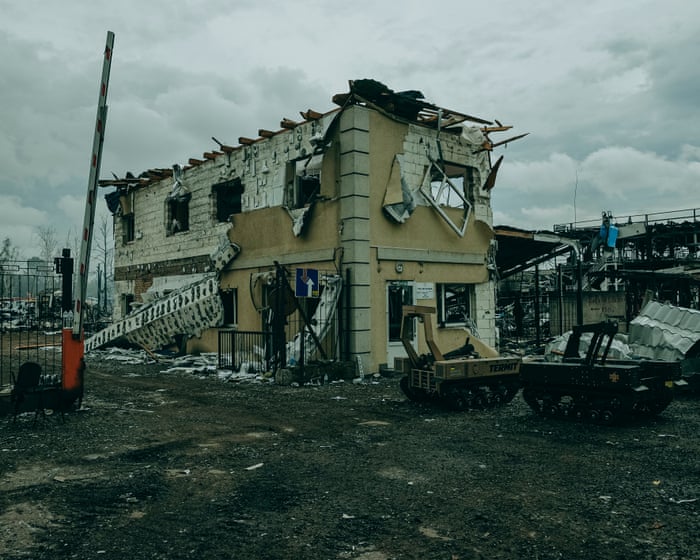
It’s been a day and a half since a Russian jet-powered drone hit an ammunition depot in Myla, a village about 15 miles from central Kyiv. Volodymyr, a 61-year-old security guard, leads visitors from his family’s badly damaged home—its roof blown off and back windows shattered—through the garden toward the impact site, about 300 meters away.
The garden, like many in Ukraine’s villages and suburbs, is a large plot of land. But today the greenhouse is wrecked, a vegetable patch is blackened and crunches underfoot, and several meters of grapevine have been destroyed. Even so, Volodymyr finds two surviving bunches of grapes to hand to the Guardian.
It’s a remarkable act of generosity, especially since his family has no electricity or water after Thursday night’s prolonged bombing. The death toll rose by one on Sunday, reaching 38, and four more people are still missing. The incident has quickly raised questions about why ammunition was stored so close to people’s homes.
In the yard in front of the garden, Vira, 65, knows who’s to blame. “Those who set up the depot here are at fault. There are people here—this is a village. You can’t keep something like that here,” she says. She and her son Serhii hid for hours in a small bunker by the side of the house, waiting out what witnesses said were 30 to 50 explosions that lasted about six hours after the initial strike at 8pm.
Serhii says they had no idea ammunition was stored in their village. “I thought it was humanitarian aid that was stored there.” Now the family faces a cleanup that will be costly and difficult, starting with almost nothing. He’s charging his phone from a car battery using a converter—that’s all the power they have.
Serhii adds that once the explosions died down, they found a missile shell from a Grad rocket launcher on their property, along with “several mines and cluster munitions.” Those have been removed by the cleanup team, though a burnt-out box of bullets, freshly discovered in another part of the semi-collapsed ceiling, still sits by the front door waiting for collection.
Volodymyr’s tour continues out back. A grass line, basically a track, has been marked through the woods beyond the garden, between blackened patches where fires burned. There’s smoldering, even flames in places, more bullets and boxes of bullets, and then, on the right, unmistakably, a detonated anti-tank mine.
Finally, the woods open up to reveal a warehouse site, much of it bombed out—an open area of destruction. A sulfurous smell lingers, and explosions can be heard periodically, though they may be controlled detonations. The emergency services’ cleanup work is being paused at lunchtime because there’s another drone threat overhead.
Volodymyr was on guard duty at a lumber yard near the ammunition store on the night of the bombing. He survived the initial strike unharmed and headed straight home, but feels a guard’s duty to return. “I’ve been coming back and forth for two days to see these ashes,” he says.
Thirty of the dead were from a care home close to the ammunition store, the location of which is now under criminal investigation by Ukraine’s intelligence service. But this isn’t the first attack of its kind in recent weeks. There have been other Russian bombings of poorly placed ammunition dumps, as Moscow aggressively targets warehouse sites while Ukraine does the same.The fact that this recently happened in Ukraine is not lost on Liudmyla, whose adult daughter was in a house just a few doors away when the Shahed drone struck. Her home is also badly damaged, with windows facing the warehouse blown in. Liudmyla recalls that a similar incident occurred in early July on the edge of Kyiv.
View image in fullscreen
Liudmyla near her damaged house. Photograph: Julia Kochetova/The Guardian
“Look at what’s going on here. Everything’s smashed to bits right here. Vyshneve [the site of the earlier incident, nine miles to the south-east] wasn’t enough for them, and there was more elsewhere too. No, they’ve dumped all this right by people’s vegetable gardens, right on their doorsteps,” she says, warning that munitions are still scattered around, not yet cleared up.
Nine people were killed when a munitions store was hit at Vyshneve, and 280 homes were damaged. Two people have been detained on suspicion of allowing weapons to be stored in an inappropriate place after that incident, but as the Ukrainian president, Volodymyr Zelenskyy, said on Saturday, something similar has happened again.
It’s a grim repeat at a time when Kyiv is already facing increased attacks from Moscow, with harm to civilians from strikes on food stores and logistics warehouses on the rise. When pressed on who is to blame for the deaths and destruction at Myla, Liudmyla gives a twofold answer.
“Putin! Who else? And those who set up the depot here.”
Frequently Asked Questions
Here is a list of FAQs based on the article title and topic written in a natural clear and concise tone
General Questions
1 What is this article actually about
Its about the anger and frustration felt by Ukrainian villagers when they discover that Ukrainian military units are storing weapons ammunition or equipment near their homes The villagers fear that this makes their villages prime targets for Russian strikes
2 Why are the weapons being kept near villages in the first place
Usually its for logistical reasons The military needs to disperse its equipment to avoid it being destroyed in one big attack They use forests farm buildings and empty lots near villages because they offer cover and quick access to the front lines
3 Isnt it safer to have the military nearby
Many villagers dont see it that way While it might offer a sense of protection the reality is that Russian forces target known military positions If a missile or drone hits that ammo depot the shrapnel and secondary explosions can destroy the entire village
4 What does Everythings been blown to pieces refer to
Its a direct quote from a villager describing the aftermath of a Russian strike on a weapons depot located near their homes It refers to the physical destruction of houses and the complete loss of personal belongings
Questions About the Conflict Safety
5 Are the villagers angry at the Russian army or their own military
The article highlights that their immediate anger is directed at their own military command They feel that the Ukrainian army is endangering them by storing weapons there They understand the war but they feel the military is being reckless with their lives
6 What are the villagers asking the military to do
They are begging the military to move the weapons further away from residential areas They want a buffer zone between the ammo and their homes so if something does get hit they arent in the blast radius
7 Is this a common problem in Ukraine
Yes its a significant and recurring issue As the front lines shift and the war drags on the military uses whatever space is available However this has led to numerous complaints and even protests in some communities
8 What happens to the villagers after their homes are destroyed
Many are left with nothing They are forced to evacuate with just the