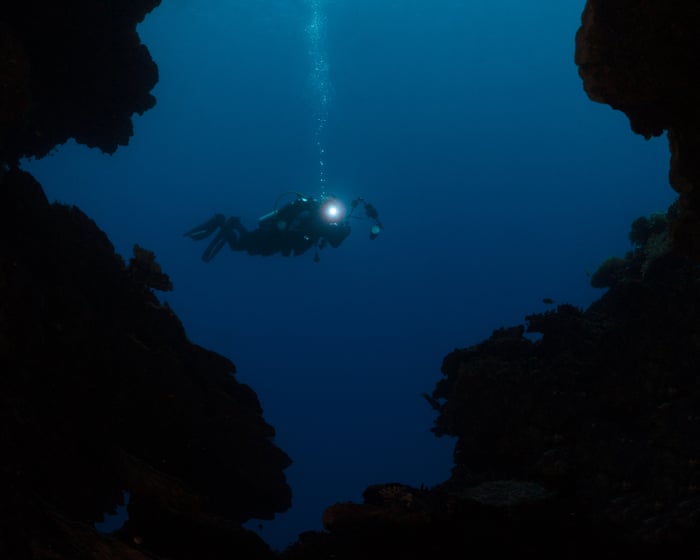
The diving tragedy in the Maldives—which killed four Italian divers inside an underwater cave, followed by the death of a Maldivian navy diver—has renewed warnings from experts about the risks of cave diving without proper training, planning, and specialized equipment.
On Thursday, the Divers Alert Network (DAN), which coordinated the complex search and recovery operation at the Dhekunu Kandu dive site in Vaavu Atoll, announced that all the divers’ bodies had been recovered.
The victims were identified as Monica Montefalcone, an ecology professor; her daughter Giorgia Sommacal; marine biologist Federico Gualtieri; researcher Muriel Oddenino; and diving instructor Gianluca Benedetti. Benedetti’s body was recovered earlier outside the cave.
Mohamed Mahudhee, a member of the Maldivian national defense force, also died in the tragedy from decompression sickness after taking part in a recovery mission.
After initial attempts by the Maldives National Defence Force, DAN sent a specialized rescue team to the site. It included Finnish cave diving experts Sami Paakkarinen, Jenni Westerlund, and Patrik Grönqvist.
Working with Maldivian authorities, the team recovered all the bodies during several long dives over multiple days, using closed-circuit rebreathers, underwater scooters, and extensive backup equipment.
Investigations into the circumstances of the fatal dive by Maldivian and Italian authorities are still ongoing. But diving experts are already calling for stricter adherence to established cave-diving safety protocols.
Experts have also stressed the need for greater awareness of the many factors involved, including proper training, equipment setup, and even the diver’s mindset.
Speaking to the Guardian, Jonathan Volanthen—one of the British cave divers who helped rescue 12 schoolboys from a flooded cave in Thailand in 2018—says cave diving carries risks that are fundamentally different from open-water diving.
The highly experienced Volanthen says cave divers cannot make a direct ascent in an emergency.
“If something goes wrong, you can’t simply head to the surface because there’s usually something preventing that… Quite often in caves, it’s very easy to swim in somewhere and then find you’ve stirred up some silt,” Volanthen says.
The combination of not being able to ascend to the surface and having poor visibility on the way out makes it “much more difficult to get out” if a diver runs into trouble, he says.
Adding depth to the situation, he says, makes the dangers even worse.
“The deeper you are, the more air you use, or the more gas, depending on what you’re breathing… Depth generally means an increase in danger,” Volanthen says. Divers must carefully manage their gas supplies to ensure a slow ascent and reduce the risk of decompression sickness.
“Pressure [from depth] creates a situation where gas dissolves into the bloodstream, and that means you have to ascend slowly,” he says.
Edd Sorenson, an American cave diving expert who has led more successful cave diving rescues than anyone else in the world, explains a common misunderstanding about caves.
“Caves are not dark. Everyone thinks they’re dark… They’re devoid of light. Your house at night is dark… When your light goes out [in a cave], there’s nothing,” Sorenson says. “You don’t see a reflection, your eyes don’t adjust to it.”
As a result, divers can lose all sense of space and direction: “That’s why we learn to always have a continuous guide line to the surface.”
Sorenson also emphasizes a pIn cave diving, there’s a philosophy called “redundancy” — having multiple independent backups for every critical system. “We carry at least two tanks for your two regulators, and we follow a three-light minimum rule. If we’re going a long way, we’ll bring even more. We need two computers,” he says, referring to the devices that track depth, time, and ascent rate. “We have to have two writing devices — dual, redundant everything.”
He also emphasizes anti-silting techniques that cave divers should use, because the common flutter kick used in open water can quickly reduce visibility in caves. “If you get too close to the bottom, you’ll stir up the sediment. With a flutter kick, you can go from crystal clear water to zero visibility in the blink of an eye,” Sorenson explains.
Instead, cave divers use a frog kick. “Our movement is horizontal or slightly upward from horizontal,” Sorenson says.
With decades of technical experience, Volanthen and Sorenson both stress the importance of training and knowing your limits. “If you’re properly trained by a reputable instructor and training agency, you’ll understand the limits,” Volanthen says. “Hopefully, you can make good decisions — whether that means going into a cave or not.”
Sorenson warns that experience can also create false confidence. Often, he says, when people become divemasters or instructors, “they think they know it all. But a bad idea is still a bad idea.”
“If they go beyond their training, experience, and knowledge limits, they’re playing Russian roulette. Cave diving is a very, very safe sport with good training. Without it, it’s very unforgiving.”
Beyond technical skill and proper gear, experts say human factors and mindset are crucial in diving decisions.
Cristina Zenato, a cave diving instructor based in the Bahamas with over 4,500 cave dives and more than 80 kilometers of guide lines laid across different cave systems, warns against demonizing cave diving as a discipline, despite its technical complexity.
She says the underwater environment — “an alien place for us” — demands respect. “Is cave diving potentially dangerous? Absolutely. So is being two meters below the surface, because we’re not aquatic animals.”
In addition to proper training, human factors and mindset are critical, Zenato says. “You can be super well-trained, but I’ve sat at the water’s edge and said ‘not today,’ and then driven back in the car, wondering if I made the right call. And usually, when you question yourself, you know it’s the right answer,” she says.
Frequently Asked Questions
Here is a list of FAQs about the dangers of cave diving inspired by the tragedy in the Maldives
BeginnerLevel Questions
1 What happened in the Maldives that made the news
A tragic cave diving accident occurred where several divers died The incident highlighted how quickly things can go wrong in an underwater cave specifically that you cannot always swim straight up to the surface to escape danger
2 Why cant you just swim up to the surface if something goes wrong
In a cave you are inside a tunnel or chamber with a solid rock ceiling above you To reach the surface you have to find the way back through the caves entrance not just go up
3 What is the main danger of cave diving compared to regular ocean diving
The biggest danger is getting lost or running out of air while trying to find your way out There is no direct access to the surface so you cant make an emergency ascent
4 Is cave diving the same as snorkeling or scuba diving in the open water
No Snorkeling and openwater scuba diving let you swim straight up to the surface Cave diving is a technical sport that requires special training equipment and planning because you are trapped in an overhead environment
IntermediateLevel Questions
5 What does overhead environment mean in diving
It means there is a solid barrier between you and the surface If you need to go up you will hit the ceiling not air Wreck diving inside a ship is another example
6 What are the most common causes of death in cave diving
The most common cause is running out of breathing gas This often leads to panic which causes divers to make bad decisions like trying to swim up which is fatal in a cave
7 What is a siltout and why is it dangerous
A siltout is when a diver kicks up fine sediment from the cave floor turning the water completely cloudy You can lose all visibility making it impossible to see your guideline or the exit
8 Why do cave divers always use a continuous guideline
The guideline is a permanent or temporary rope tied at the entrance It is the only reliable way to find your way out when visibility is zero Never letting go of the line