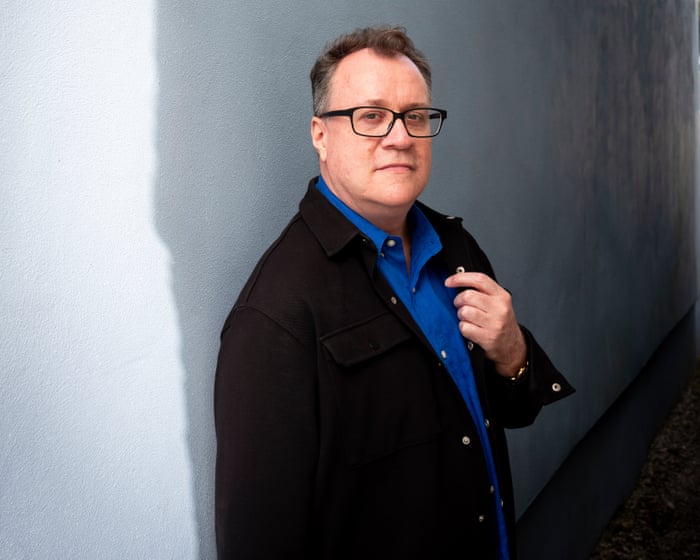
Russell T Davies prefers to look on the bright side. When a gang of bus conductors gay-bashed him, he said, “People have been beaten up far worse than me, that was just a bit of a thumping in the street.” When the production schedule of his dystopian drama Years and Years forced him back to work within days of his husband’s death, he said, “Writing was a nice escape.” Even a story about his “tough” father calling him “yesterday’s man” after he first left as showrunner on Doctor Who ends with a cheerful: “I knew I wasn’t.” It’s easy to see how he’s earned a reputation as the most affable man in TV, if not the world. So why has he taken to keeping a kitchen knife by his front door, “ready to use”?
“I’m called a paedophile and a groomer online by people like [Father Ted creator and anti-trans activist] Graham Linehan, and now people believe what they read. People believe it when they’re told the Earth is flat,” he says. His support for trans rights has resulted in years of death threats and “groomer” smears, which he used to brush off. “But the online world is becoming the real world. People have worked out my address, and one person turned up at my house. If you believe a paedophile lives here, it’s not the maddest thing in the world to come and get me. I’ve been saying for years that our rights are paper-thin, and here we are. What scares me is that I can’t see an end to it. Nothing is going to unseat these tech barons – it will require some sort of revolution to stop them. So for the first time in history, hatred is being monetised by an algorithm.”
Davies, 63, is the great chronicler of queer British life, having made his name with the groundbreaking (and jaw-dropping) Queer As Folk in 1999. The show followed the lives of three gay men in Manchester, and was a surprise hit, but not without its provocations. The Daily Mail wrote that, “Any nation which allows this … [is] hell-bent on destruction.” Among the controversies was its depiction of a one-night stand between Stuart, 29, and Nathan, 15. In today’s climate, where accusations of grooming are regularly levelled at gay men, would he still write such an inflammatory storyline? “I would,” he says. “Although it’s slightly different these days – because in 1999 Nathan would’ve been in school under section 28 [a law banning the ‘promotion’ of homosexuality], meaning that he had no one to talk to. I was trying to say, ‘This is what’s going to happen.’ Of course, Nathan wants to get fucked, and he’s got no one to talk to about it. People say: ‘Oh my God, he was 15, that’s illegal.’ It’s a drama!”
View image in fullscreenAidan Gillen and Craig Kelly in an episode of Queer as Folk, 1999. Photograph: Channel 4
View image in fullscreenThe Queer as Folk cast and crew, Canal Street, Manchester, 1998. Photograph: Courtesy of Russell T Davies
We’re meeting to discuss The Queerest of Folk, a galloping memoir of Davies’s life as Britain’s most celebrated showrunner. He’s previously criticised the new generation of TV writers for prioritising positive representation over good storytelling – his own interest lies in the nuances. His most recent drama, Tip Toe, about a simmering feud between neighbours on opposite ends of the political divide that boils into a horrific act of violence, upset some viewers by including a gender-critical character, Stephanie. What inspired her? “I think it’s important to hear all voices. Years and Years and It’s a Sin both had lead gay characters who were Tory voters – if you watch most dramas you’d think those people don’t exist. I know people who are gender critical. The whole argument is so polarised that to some people the fact that she’s gender critical means she might as well be a murderer, which is just nonsense. There aThese are people with genuine concerns, and those concerns need to be discussed. Where is the debate?” Another character, Melba, gives a powerful monologue about the state of LGBTQ+ rights, with a brief reference to “women who are furious, and with good reason.” What did he mean? “He’s saying that maybe he agrees with a gender-critical view on women’s sports. We left it vague, but why assume that no camp gay man would ever say that? Why is it a surprise? I could walk down Canal Street right now and find you a right-wing drag queen. It’s important to show that. Showing those complexities is kind of my job.”
Davies is a giant of television — and in real life too. His 6ft 6in frame fills the doorway of his Swansea home, where he greets me with genuinely open arms. Inside, I’m pleased to find the TV is on; he famously never turns it off, even when he goes out (“My new one turns itself off automatically. I really resent that”). It keeps humming away in the living room while we talk at his dining table, which has a ceramic Tardis on it and an original Peanuts cartoon illustration looking down from the wall — a rare splurge that cost him £2,000. His parents, both classics teachers, were the same, leaving the TV on even when they had guests.
Davies was three when he watched William Hartnell regenerate as the Doctor. “That episode is missing from the BBC archives, but it’s burned into my head.”
Despite their “awe” at television, Davies could never quite bring himself to admit to his father that he wrote for it full-time. “My mum said never to tell him I didn’t have a normal nine-to-five job, because he would just nag me about it and never understand. So until his death he never knew.” In 1991, when Davies quit his job as a children’s TV producer to pursue writing, he didn’t tell his dad, Vivian. “When I’d have dramas on television that I’d written, he’d ask, ‘When did you do that, then?’ And I’d say, ‘In my spare time.’” Vivian was blind for the last 25 years of his life, which could make him quite “angry and lead to moments of nastiness that didn’t become him” (hence the “yesterday’s man” comment). One consequence of his blindness was that Davies’s mum had to narrate the action of Queer As Folk to him. Davies prefers not to dwell on this. “Can you imagine her having to describe rimming? I think I gave it to them on Christmas Eve.”
His first memory is from when he was three and a half, watching the original Doctor Who, William Hartnell, regenerate. “Someone told me the other day that you don’t have strong memories before the age of six, but that’s not true. That episode is missing from the BBC archives, but it’s burned into my head.” It was an origin story in more ways than one; his biggest triumph came when he successfully lobbied the BBC to relaunch Doctor Who after a 16-year hiatus (today, I notice that even his shower has a toy Dalek in it). During his first stint as showrunner, from 2005 to 2010, it became the No 1 show on British television. In June 2009, he decided to leave on a high and moved to Los Angeles, where he was commissioned to write Cucumber (about a middle-aged man confronting his gay shame) for Showtime, but turned down offers to rewrite Skyfall and work on a George Lucas Star Wars project. He later turned down another writing job on a little show called Succession.
Then in 2011, Davies’s partner of 12 years, Andrew Smith, began having “hallucinations of an Edwardian lady smiling at him sarcastically.” These turned out to be symptoms of a stage four brain tumour, and Smith was initially given just 18 months to live. In a 2007 interview, Davies had said his focus was on his work, adding: “If I’m writing, I would walk over [AndreIf he had a heart attack, it would happen in his partner’s body. But when Smith fell ill, the opposite proved true. The couple moved back to the UK, and Davies quit his job to become Smith’s full-time carer. “I surprised myself. Before that, I would have thought I couldn’t do it—I’d hire nurses, bring people in, outsource it all. But when it actually happens, you realize you don’t want a stranger looking after him.”
Davies with his late partner, Andrew Smith. Photograph: Courtesy of Russell T Davies
Despite the initial prognosis, Smith lived until 2018. Davies continued working from their home in Manchester—moving Cucumber from Seattle to Canal Street and winning best writer at the Bafta Cymru awards for A Very English Scandal, among other projects—but rarely left Smith’s side. “We were together for 20 years, but when I think of him now, I think of the last eight years,” he says, his Welsh boom softening. “Until then, we’d never really lived together. From 2011 onward, the memories are vivid. I remember almost every day. It’s strange, because there’s intimacy in a life-or-death situation. There was honesty. He lived much longer than expected, so every year after that became a joy.”
After Smith’s death, Davies writes that he spent eight years sitting at home. In practice, this meant completing Years and Years, a surprise return as showrunner on Doctor Who, and writing the Royal Television Society award-winning It’s a Sin (about the AIDS crisis), the Helena Bonham Carter-starring biographical miniseries Nolly (about another of his early obsessions, Crossroads star Noele Gordon), and Tip Toe, among other ventures. Despite these professional highs, Davies admits that “it was a little bit monastic.” Then his optimism rallies again. “But I’m happy watching the telly. It was quiet, but that was fine.”
Last year, this relative quiet was broken when Davies met Oliver Cole, a 27-year-old model, on Instagram. “I normally ignore DMs, but I looked at his photos and thought, ‘Oh, hello!'” he hoots. “We DM’d each other for about three months. Not sexting. I didn’t think it was anything like that, because of his age. But he was such a nice man that I thought I’d have dinner with him. It turned out to be far more than that. He’s lovely.” Cole has since become Davies’s third ever boyfriend. “Isn’t that mad?”
I’m curious how Davies’s friends reacted to their 36-year age difference. “They were all very polite. I’m absolutely certain that behind my back, some of them were saying: ‘What the hell?’ But then they met him. He’s quite extraordinary. He’s Australian, and they tend to be quite tough and ahead of the game and know what they think. I was dreading what [Davies’s long-term producer] Nicola Shindler might think. Then she met him and said: ‘Oh! I get it, he’s lovely.'”
Did Smith encourage Davies to meet someone else after his death? “He’d be really happy. His doctor was at another hospital when the final scan results came in saying he was going to die. She phoned me and said: ‘I can come to the hospital tomorrow and tell him, or you can.’ Actually, I was honoured to tell him. I thought it was better coming from me than anyone else. And this shows how lovely he was—when I told him, the first thing he said was: ‘I feel sorry for you.’ I found that extraordinary. Nobody knew me better than Andrew, and I think he’d be sad to think of me on my own.”
Davies divides his time between houses in Manchester and Swansea, replicas of each other, with the same crockery and Pantone colour mugs (today’s choice is yellow). He’s “saved like a miser” since the early 90s, when he was told it was impossible for writers to make money. This nest egg allowed him to care for Smith during the years when he couldn’t work.It didn’t work, but even today he struggles to spend. “I’m still miserly. If I like a shirt that costs £20, a voice says: ‘Can I afford that?’ I get paid a nice wage, but I’ll see something online I like for £30 and think: ‘That’s too much!'” In the late 90s, he went out on Canal Street every night of the week – he met Smith in Cruz 101 nightclub 10 minutes before closing – but these days he’s happiest writing, or in front of the TV, and has a dread of parties. Kate Bush invited him for dinner during his first stint on Doctor Who, but he’s yet to fix a date.
In January, Cole persuaded Davies to take his first holiday in 14 years, to New York. “It was lovely,” he smiles. “Although I’m not a natural traveller, I can’t bear airports, they’re horrible.” Last November, Cole posted a video of himself in the Tardis. Is he a Doctor Who fan? “He is, but that takes about five minutes of conversation; it’s not like we sit there discussing [show antagonist] the Rani. When it became a relationship, I reported it to the bosses at Doctor Who, in case anyone tried to say I was abusing my position by going out with a fan.” At its height, the show was drawing a record 13 million viewers, which I suggest represents quite a wide dating pool of fans. “And there’s not many you’d go out with,” he laughs. “You know that’s true!”
If Davies is ribbingly dismissive of some of the show’s more rabid fandom, then the feeling has become mutual. Twenty-one years after he rocketed Doctor Who to unprecedented heights, his most recent time as showrunner was polarising, with some fans criticising convoluted story arcs and anti-climactic plot resolutions. In June, his exit left the show at a perilous juncture. A Disney+ partnership with the BBC ended after two seasons of disappointing ratings, and the show is now off air while production of future series is put out to competitive tender.
Was he wounded by the reaction? “I’m not personally wounded by that,” he says. “I thought it was a shame. And maybe I wonder if I should have done something different. Except I fucking love what I did!” He erupts into guffaws. “I work really hard on my shows, and I genuinely love them. I think there are waves of hatred, and maybe in a few years it’ll be more appreciated. But it’s appreciated by ME!” What does he think it would take to save the show? “Part of the problem is that there seem to be spasms and ruptures and cuts at the BBC. My worry is that there’s nobody there to champion it. You need a producer saying: ‘What about Doctor Who? What about Doctor Who? What about Doctor Who?’ every single day. That’s gone. In 2005, I made it exactly like a 9pm ITV drama, with a lot of the rhythms of everyday life. That concept has gone now, so maybe it’ll end up as a vertical drama [clip shows designed to be watched on a smartphone] with a cliffhanger every two minutes? When it returns, it should be part of whatever the rest of telly is doing.” He won’t be drawn on who he should be the next Doctor. “I’ve made the mistake of saying so-and-so would be good, and the next thing you know, journalists are at their door.”
He spoke to Harvey Weinstein about financing. “He could’ve solved all our problems, but I couldn’tHe couldn’t even stand a phone call with the man. ‘He gave me the shivers.’
For now, Davies remains a free agent, and it would be naive to try to predict his next move. After the success of Queer As Folk, he immediately alienated part of his gay audience by making a romcom, Bob and Rose, in which a gay man falls in love with a woman. When It’s a Sin broke streaming records, he followed it with a miniseries about Noele Gordon’s sacking from Crossroads in 1981 — hardly timely. In 2015, after the ratings success of his first four series of Doctor Who, the head of BBC drama commissioning paid him a home visit. Davies used their interest to make his version of A Midsummer Night’s Dream, starring Elaine Paige. He spoke to Harvey Weinstein about providing extra financing, but got the creeps. ‘I should have been running after the money — he could’ve solved all our problems — but I couldn’t even bear a phone call with the man. He was just baleful, he gave me the shivers. My producer Faith Penhale, who was on the call, might as well not have been there. She had the schedules, the budgets — and he just dismissed her.’
While his reputation now gives him some creative freedom, Christmas 2017 found Davies in a position where the BBC had initially turned down Years and Years, while It’s a Sin had originally been rejected by the BBC, ITV and Channel 4 (one executive asked if Davies knew Elton John and suggested he might turn it into a musical). He says he’s fond of a Tolstoy quote: ‘The revolutions have to keep on happening.’ Only, ‘I looked it up the other day and there’s no record of him saying that, so maybe I made it up!’ Does he feel that he kicks doors open only to watch them close again? ‘You know those slow pneumatic hinges that close automatically? I think that’s what happens. They “hisss” closed slowly.’
His ideas gestate for years — decades even — before they’re committed to the page in a flurry (he first had the idea for It’s a Sin more than 30 years ago; one Doctor Who script was written over a weekend). Unusually, his first draft is often his final draft. Bonham Carter has said of Nolly: ‘It’s the only time I’ve ever been involved in something where the script I read ended up immaculately on the screen. Not one thing was cut, not one thing re-ordered.’ Davies recently hit upon a fresh idea and sent the first script to his producer, only for her to remind him that he’d already pitched it to her back in 2018. After the operatic trauma of Tip Toe, he’s hoping to give this one a happy ending. ‘I’m very excited. These are strange days for telly, so I hope it gets made.’ And if not? ‘I’ll write something else.’ The revolutions will keep happening.
The Queerest of Folk: A Life in Television by Russell T Davies, published on 8 October by Transworld at £25. To support the Guardian, order your copy from guardianbookshop.com
Frequently Asked Questions
Here is a list of FAQs based on the article about Russell T Davies
Who is Russell T Davies
He is a famous British TV writer He is best known for bringing back Doctor Who in 2005 and for writing dramas like Queer as Folk and Its a Sin
What is the article about
It is a personal interview Davies talks about his life dealing with the death of his husband his fears and his strange experiences with fans
What does the title One person showed up at my house mean
It refers to a story Davies tells about an intense fan The fan traveled to his house and knocked on his door
What does he say about intense fans
He finds them scary He mentions that some fans feel they own him or his characters He says this kind of attention can feel like a threat
What happened when the fan showed up
Davies says a man came to his house It was unsettling because it crossed a line from being a fan to invading his personal space
Why does he keep a knife by the door
He does it because he is afraid He says he has received threats and feels a need to protect himself in his own home
Is he actually scared all the time
It sounds like he is very cautious He mentions a specific fear that makes him keep the knife but he also lives a normal life The fear is real but he manages it
What does finding love after loss mean in this context
Davies husband Andrew Smith died in 2018 The article talks about how Davies dealt with that grief and eventually found a new partner
Who was Andrew Smith
He was Russell T Davies husband They were together for many years before he passed away from a brain tumor
How did Davies cope with his husbands death
He talks about the deep sadness of losing a partner He says it was a very dark time but he eventually found a way to move forward
Did he think he would find love again
It seems he wasnt sure But he did find a new partner He talks about how surprising and wonderful it was to feel love again
What is the fear mentioned in the title
It is the fear for his physical safety It is the reason he keeps a knife by the door