The noise had been building since the early ’80s, but 1986 was the year thrash metal truly broke—erupting like a pimple on a teenage metalhead’s fuzzy chin. Slayer, Megadeth, and Metallica all released landmark albums, with Metallica graduating from small rock clubs to a string of arena dates supporting Ozzy Osbourne. While these California bands would forever alter the course of rock music, a group of like-minded teenagers were carving their own path 5,500 miles away from the genre’s epicenter.
What Kreator, Sodom, Destruction, and Tankard—the “big four” of German thrash metal—lacked in finesse and professional polish, they made up for with sheer, unbridled aggression. Faster and meaner than most of their American counterparts, these bands set a new benchmark for brutality, unwittingly influencing the next generation of death and black metal musicians.
“It was always more rough and violent,” says Destruction’s vocalist and bassist Marcel “Schmier” Schirmer, describing Germany’s early approach to thrash. “We never tried to be the best musicians—we tried to write songs that punched hard. On English heavy metal albums, it was always the first song on the album and the first song on the second side of the vinyl that were the fastest tracks. We’d listen to those and say, ‘Why isn’t there an album with just those songs?'”
In response, 1986 saw the release of sophomore albums from Kreator (Pleasure to Kill) and Destruction (Eternal Devastation), while Sodom unleashed their debut LP, Obsessed by Cruelty.
Formed in 1982, Sodom was conceived as an escape from a seemingly predetermined career in Gelsenkirchen’s mines. “My father didn’t want me to be a musician,” says vocalist and bassist Tom “Angelripper” Such. “When I stopped working in the coalmine, he was disappointed, saying, ‘You can’t make money with this music.’ It wasn’t until Agent Orange came out in 1989 that I got a regular paycheck.”
Kreator, founded in Essen against a backdrop of coalmines and shuttered steel factories, landed a record deal based on a rough demo. “We spent most of our time rehearsing in a school basement,” says vocalist and guitarist Miland “Mille” Petrozza. “When we recorded Endless Pain in 1985, we’d only played a couple of shows in youth centers. It was only after Pleasure to Kill came out that we started touring.” While their friends in Sodom saw Gelsenkirchen’s mines as a trap, Mille suggests Essen’s industrial heritage offered certain opportunities. “All the coalmines were used for cultural events,” he says. “We rehearsed there; I saw bands like Bad Brains there. It was a place of creativity, with a lot of theater, art, and music.”
While Kreator and Sodom’s relative proximity fostered competition, camaraderie, and cross-pollination, Destruction were on their own in the small town of Weil am Rhein. “Everything was so conservative and religious that we were trying to break out,” says Schmier. “Music was a gate through which we could escape and forget about everything. There were six of us who were the first heavy metal fans in our town, and we formed a little metal scene. It meant we could create something unique.” Schmier and his friends connected with Kreator in Essen, Tankard in Frankfurt, and Iron Angel in Hamburg to book gigs. And while life as a metalhead in Weil am Rhein might have been lonely, Destruction walked the walk from the very beginning. “A guy from our label said it’s not the music, it’s th”The image sells the records,” says Schmier. “He was right, of course, but we didn’t know it—we really looked like that. I went with my bullet belt and everything to my grandfather’s funeral, and my father freaked out. He was like: ‘Take this shit off, you’re embarrassing me in front of the whole village!'”
With no local precedent for what they were doing and facing widespread ridicule from the German music press, the bands had to learn on the fly. Exposure to more experienced overseas bands helped the young thrashers survive. “Slayer taught us how to drink,” laughs Schmier, recalling Destruction’s time supporting the band on their Hell Awaits tour. “We learned a lot of bad things from them.” Their music was also fueled by bands like Venom (“their Welcome to Hell album was the spark to the powder keg,” says Angelripper), Judas Priest, and early hardcore acts like Minor Threat, Dead Kennedys, and DRI.
The thrash metal scene of the decade was filled with references to nuclear Armageddon and the threat of total destruction. While American thrashers raged against potential annihilation, their German counterparts had a constant, looming reminder of Cold War politics right on their doorstep. “Of course it impacted us,” says Mille, reflecting on living in a Germany divided by the Berlin Wall. “I couldn’t pinpoint how because it was very unconscious, but it was always present.” The strict, censorial regime of the GDR meant there was little crossover between rock scenes on either side of the wall, though all three bands received enough intermittent fan mail to know their music was being smuggled into the East.
“We knew what was going on in the West, but we had hardly any contact with musicians there,” says Peter “Paule” Fincke, drummer of the prominent GDR metal band Formel 1, whose sole album, Live Im Stahlwerk, was also released in 1986. Older and more experienced than the West German thrashers, they discovered heavy metal through illicitly obtained albums from the New Wave of British Heavy Metal. “It was immediately clear that this was our thing,” says Paule. Recorded fittingly at a former steelworks and featuring German-language renditions of Judas Priest and Iron Maiden songs, the live LP is bursting with energy.
After meeting Iron Maiden when the East Londoners toured Poland, Paule recalls being captivated by the band’s visual spectacle as much as their music—something he and his bandmates were eager to bring to Formel 1’s live shows. “My graphic designer and I designed a castle courtyard, complete with battlements and staircases, which we then had built,” he says. “In East Germany, bands had to own everything themselves; there were no rental services, so we hauled tons of equipment across the country. I still feel sorry for our four technicians.” The band went on indefinite hiatus in the late ’80s when several members applied to leave the GDR, with Paule now performing with Silent Running.
While Formel 1 didn’t last to see the wall come down, in 1990 Kreator became one of the first Western metal acts to play in East Berlin. Despite this, the ’90s proved challenging due to the rise of grunge and later nu-metal. Like thrash bands worldwide, Kreator, Sodom, and Destruction experimented with new genres and lineups while watching record sales decline. However, they all found a renewed sense of purpose in the 2000s, thanks to a classic thrash revival and bands like Mayhem, Immortal, Morbid Angel, and Cannibal Corpse acknowledging the power of Teutonic thrash.
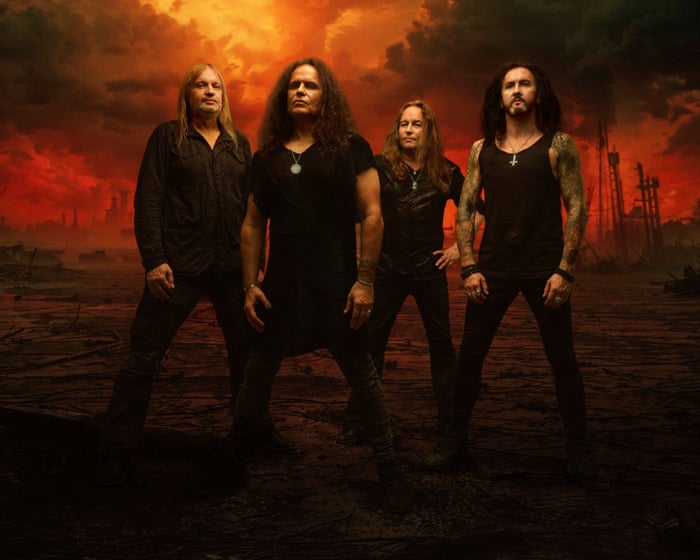
Today, Sodom is in a temporary hiatus as Angelripper takes time to hunt, enjoy life, and work on multiple reissue projects. Meanwhile, Kreator has recently been the subject of a documentary and a book.Co-authored by Mille, their 16th album, Krushers of the World, announces a massive tour. Destruction have already played shows in Japan, Thailand, and China this year, and are about to head to the U.S. to tour with fellow thrash bands Overkill and Testament. As for the future? The state of the world suggests they’ll have plenty of fuel for the genre’s furnace for years to come. “I wish I could write, ‘my god, there’s so much peace on this planet, I can’t write lyrics anymore,’ but that will never happen,” says Schmier. “I guess we’re doomed to keep writing about how messed up the world is.” Kreator will tour Europe with Carcass, Exodus, and Nails from March 20th to April 25th. Krushers of the World is out now via Nuclear Blast Records.
Frequently Asked Questions
Of course Here is a list of FAQs about the topic We built a castle on stage complete with battlements How 1980s German thrash bands pushed metal to new extremes
Beginner General Questions
Q What is German thrash metal and how is it different from American thrash
A German thrash metal is a specific aggressive branch of heavy metal that emerged in the 1980s While sharing speed and intensity with American bands like Metallica and Slayer the German sound is typically more clinical precise and often colder or more apocalyptic in its atmosphere
Q What does the quote We built a castle on stage refer to
A Its a famous quote often used to describe the ambition and theatricality of German thrash bands particularly Helloween They didnt just play music they created massive fantastical stage shows and concept albums that felt like epic stories pushing metal beyond just raw aggression
Q Which bands are the most important from this scene
A The Big Four of German thrash are Kreator Sodom Destruction and Tankard For the more melodic and epic side Helloween and Running Wild are essential Accept though earlier and more traditional heavy metal was a massive influence
Q Why was the 1980s German scene so influential
A It proved that extreme metal could be both brutally aggressive and highly technical intelligent and thematic They took the raw energy of punk and early metal and fused it with complex song structures dark politicalsocial commentary and fantasy themes influencing death metal black metal and power metal globally
Advanced Detailed Questions
Q How did the German political climate influence the music