“I don’t talk to mainstream media,” says a young man in an Arsenal shirt. I’ve just asked what brought him to the latest protest against housing asylum seekers in Thetford, Norfolk, and his disdain is clear as he goes to warn other protesters of the Guardian’s presence. This isn’t exactly the unity promised by the flyer advertising today’s march: “Everyone welcome: families, friends, dogs. Including the media.”
The protest is planned as a two-mile march from Thetford’s market square to RAF Barnham, a site just over the border in Suffolk, which is due to house asylum seekers while they go through the system. It’s the latest part of a campaign that has lasted the whole summer. Banners line the square, the largest one simply describing why people are gathering here today: “Thetford and Barnham says no to asylum seekers.”
Some of the protesters are from Thetford, others from further away, but mostly from Norfolk or Suffolk. I’ve been visiting Thetford in the weeks before the protest, and while the reasons protesters give vary, many say it comes down to numbers. How can this site house 1,250 people when the nearest village has a population of only 600?
Some say the country can’t afford to keep housing asylum seekers while they wait to be processed, or that there are simply too many coming in, or that we don’t know who they are. Asylum seekers are referred to by some here as “boat people” and “invaders”. The idea that Britain has lost control of its borders isn’t new. But new theories still pop up. At a protest the week before the march, one attendee suggested that people may be being sent intentionally from Iran. “They say that they are sending some of the terrorists over to the UK and we have no idea who comes off the boats,” a protester, David Goulty, told me. “There’s no control on who comes into the country.”
In opposition, Labour criticised the Conservative policy of housing asylum seekers on military bases. But in October last year, now in government, it changed course. The sexual assault of a 14-year-old girl by a resident of the Bell hotel in Epping, Essex, had prompted months of angry local protests against housing asylum seekers in hotels. Keir Starmer announced that military bases would be used once again.
Labour was clear about why it made this U-turn: “We know that communities don’t want asylum seekers housed in hotels, and neither does the government, and that’s why we are determined to fix the mess we’ve inherited by getting a grip on the issue and committing to close every single asylum hotel, saving the taxpayer billions of pounds.”
Typically of Starmer’s time as prime minister, the people he was trying to appease with this policy responded: “Thanks, we hate it.”
Now, the Home Office is actively working to expand or open five sites, two of which are already active. MDP Wethersfield, a former RAF airfield in Essex, houses 800 asylum seekers, but could increase its capacity to more than 1,200. Crowborough training camp in East Sussex plans to increase its numbers from 350 to 540; a volunteer vigilante patrol group has been set up in the area to “protect” locals from migrants. Three large military sites are being readied with a reported capacity of 1,250 each: MOD Bicester in Oxfordshire; RAF Linton-on-Ouse in North Yorkshire; and RAF Barnham.
Much of the classic sitcom Dad’s Army was shot in Thetford, including the external shots of the episode that ends with the show’s most famous joke: “Don’t tell ’em, Pike!” The Guildhall on the market square, where the protesters gather to start the march today, was often used as a backdrop.
The Dad’s Army museum is on the other side of the Guildhall. One of the protesters is an 80-year-old US air fA former soldier who believes the UK should adopt Trump-style immigration policies. He spots a group of tourists on a Dad’s Army walking tour and invites them to join the march. It’s obvious they’d rather keep hearing stories about Jones, Mainwaring, and Pike.
Across the square, Anwar Noor, 63, is serving ice cream from his truck to people gathering for the march. Noor came to Thetford from Kenya in the 1980s and worked at the Thermos factory for 17 years before losing his job when it shut down. (Thermos moved production to Asia in 2000. Other big employers, like the plant that processed Danepak bacon, have also closed since then, costing hundreds of jobs.) Noor started another business, a scrapyard, before moving into the ice cream trade a couple of years ago as he eased into semi-retirement.
View image in fullscreen
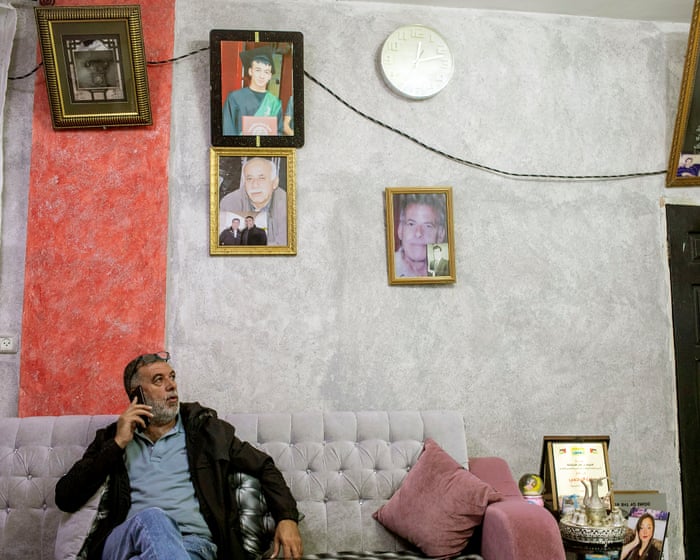
Anwar Noor, a local ice cream seller, says blaming asylum seekers is ‘all wrong’. Photograph: Harry Murray/The Guardian
You could argue that Thetford is East Anglia’s hub of integration. In 1903, it elected the UK’s first black mayor, Allan Glaisyer Minns, who was born in the Bahamas and trained as a doctor at Guy’s hospital in London. There’s a well-established Portuguese community, gathered this morning at a café near the square, sipping bottles of Super Bock beer while a very loud wildlife documentary about porcupines plays on TV. They moved here in large numbers in the 2000s, after big East Anglian farming businesses, including turkey giant Bernard Matthews, set up recruitment offices in Portugal.
There’s also a statue of Duleep Singh, the last maharaja of the Sikh empire, who was exiled to Britain from Punjab and became a favourite of Queen Victoria, living at Elveden Hall just over the Suffolk border. His son, Prince Freddy Duleep Singh, became a scholar of Norfolk life and gave Thetford the Ancient House, a building thought to date from around 1490, which still serves as a public museum.
But, as Ian Jack wrote in 2007 during a visit where he admired Thetford’s growing Portuguese community while noting the town was already anxious about immigration statistics: “To compare Prince Freddy with the immigrant ham-slicer or turkey-gutter is of course ridiculous.”
View image in fullscreen
Most people on the march were from Norfolk or Suffolk. Photograph: Harry Murray/The Guardian
There had already been tensions around immigration when Jack visited. In 2004, as New Labour’s second of three terms was winding down, Thetford ranked at the top for deprivation and child poverty while coming bottom for skills and education. That summer, after England lost to Portugal in the European Championship quarter-finals, the Red Lion pub on the market square was surrounded by over 200 hooligans, trapping about 120 people – mostly Portuguese – inside. They threw bottles and stones at the building, smashed windows, and tried to break in. Police called in reinforcements from across Norfolk, and several officers and pub customers were reportedly cut by flying glass. It took more than two hours before those inside could leave.
The Red Lion, now a Wetherspoons, feels calmer today. It sits on the edge of the market square, which, in the sunshine, feels like a piazza with added pints. Yet Noor, as he hands out ice creams, says he can understand why people are angry. “You probably noticed as you walked through town how many shops are closed, post offices gone. All the banks are gone. You can see the centre hollowing out.” Noor says he understands local frustration and has never faced racism in Thetford. But he believes blaming asylum seekers is “all wrong. We’re all in the same boat.”
At times this August, what’s happened in this small Norfolk town has felt significant, risking another summer of unrest in England, following events in Southport in 2024 and Epping in 2025 that sparked protests nationwide.
At the start of this month, the adSome houses in multiple occupation (HMOs) used to house asylum seekers in Thetford had their addresses leaked. This led to crowds of vigilantes targeting the properties on 4, 5, and 6 August.
During the second night of unrest, hundreds of people gathered outside a terrace house on Clover Way in the Fairfields estate, which was built in the 1970s. Some threw rocks and eggs, smashing an upstairs window, while others tried to get inside. Over these days of disorder, police officers were spat at, one was hit by a rock, and another was bitten. According to police, some vigilantes even entered a property, forced out a resident, and stole their mobile phone.
View image in fullscreen
One of the homes attacked during the nights of violence in Thetford this month. Photograph: Christian Sinibaldi/The Guardian
More than 20 people were arrested on suspicion of various offences, including racially aggravated public order, inciting racial hatred, conspiracy to commit aggravated burglary, possession of cocaine with intent to supply, possession of cannabis, and driving without insurance.
On the day of the Thetford to Barnham march, I visit Clover Way. The house that once housed asylum seekers is easy to spot because dried egg yolk still remains on the windows, almost three weeks after the eggs were thrown.
One of the neighbours comes out for a cigarette. She tells me she had to flee to a friend’s house across the road on the night the crowds came; since losing her husband last year, she lives alone. She suggests I speak to her neighbour, John Finch, 91. He says the people who sold the house that was besieged were initially going to sell it to a family, but a company offered more money and outbid them.
View image in fullscreen
‘These people have been failed,’ says Terry Jermy, the MP for Thetford. Photograph: Harry Murray/The Guardian
On the night the protesters arrived, the crowds stood on Finch’s flowerbeds and trampled his plants. He saw the chaos from his window but decided to go to bed. “I slept through it,” he says. He was in the RAF police branch serving in Cyprus when Greek Cypriots and Turkish Cypriots started firing at each other. “I’ve seen worse.”
When the disturbances went viral online, it brought infamy to this quiet street. The next day, film crews arrived, along with people keen to see the newly famous house covered in egg. “There were a lot of people coming,” says Finch. “They were coming in cars and stopping and just looking at it. And I think: it’s an empty bloody house, for Christ’s sake.” He shrugs. “Perhaps it was the highlight of their life.” Thankfully, after those three ugly nights, the violent disorder in Thetford fizzled out. But the anti-asylum protests continued.
The first protest against using RAF Barnham to house asylum seekers was in June 2026. Now, every Sunday, they happen like clockwork at 2pm. The week before the march from Thetford town centre to RAF Barnham, I visit the protest camp at the military base.
I park on the dry grass verge and walk towards the protest, noticing a makeshift shed offering drinks to protesters for whatever they can afford. A shirtless fortysomething man with a tan greets me and asks if I want a drink. Clinton Warner grew up across the road from the site and knows its history. He runs a used-car company and each weekend he moves his stock out of the way so there’s parking space for the protesters.
Warner tells me a contract worker, tasked with servicing the sewers on the RAF Barnham site, gave him a tipoff about the plan to house asylum seekers there. He decided to blow the whistle. “They were asked to recommission it, so the contractors knew about it seemingly before the councillors,” he says. “We put it online.”
View image in fullscreen
‘It doesn’t matter whether you’re left or right wing. This is not what it’s about’ … Terry Curtis, one of the protest movement’s organisers. Photograph: Harry Murray/The Guardian
RAF Barnham has been used in many ways over the years. It haIt has long been a logistics hub for the RAF, and during World War II it was used to store mustard gas and munitions. After the war, Churchill commissioned it to hold nuclear bombs, and the mustard gas stored underground was largely forgotten. Warner recalls being warned: “Do not remove wildlife from these ponds, do not pick the lilies, do not take the flowers, leave everything as it is, because it’s all hazardous.”
Using sites like Barnham to house asylum seekers isn’t just controversial among concerned residents. Two years ago, the UK parliament’s home affairs select committee noted that using large military sites for asylum housing had “generally proved more costly to deliver than hotel accommodation.” Military sites cost more because they often need significant refurbishment and are frequently in poor condition.
When it comes to the asylum issue, the UK government rarely learns from parliament’s published findings. Instead of responding to the evidence, it seems stuck in a reactive cycle, eager to appear tough on the issue.
“In policy discussions, there’s concern that some asylum accommodation could act as a pull factor,” says Nuni Jorgensen, a researcher at the Migration Observatory at the University of Oxford. “Politicians often claim hotels are a pull factor because people imagine they’re fancy hotels, and that’s why they come to the UK. But the evidence on that is not very clear.” That hasn’t stopped politicians like Reform UK’s Nigel Farage from exploiting the idea. Jorgensen adds, however, that there is strong evidence showing larger sites harm asylum seekers’ wellbeing.
No one in Thetford who spoke to the Guardian expressed support for asylum. Photograph: Harry Murray/The Guardian
When it comes to housing, asylum planning generally comes down to three options. Hotels are cheaper for housing many migrants in one place. HMOs seem good for integration and infrastructure, but are limited by high house prices. Then there are military sites, which are notoriously difficult to adapt for this purpose.
Hotels are easier to find than HMOs, says Jorgensen, but they “have been linked to very poor mental-health outcomes among residents,” as conditions are often cramped, unclean, and isolating. Historically, the Home Office preferred dispersing asylum seekers to neighbourhood HMOs. “They tend to be cheaper than hotels. They tend to produce the best wellbeing outcomes for asylum seekers. The problem is they are very hard to find in some areas.”
The failure of the hotels policy and concerns about private management of HMOs are among the reasons large military sites have been used.
It’s clear these sites are controversial. Along with the volunteer vigilante patrol group in Crowborough, a village near RAF Bicester has symbolically voted to leave the UK over the policy. The use of military sites for asylum housing has, in a way, united left and right in opposition, but for very different reasons. Human rights campaigners say the sites amount to a form of “open-prison camp,” while Reform UK compares them to holiday camps.
On my first visit to RAF Barnham, I meet Terry Curtis, 40, one of the protest movement’s organisers. He says he was at the HMO protests in early August but left “when things escalated … because that’s not what we’re here for.” He claims the police were heavy-handed, mentioning that a woman on a mobility scooter was pepper-sprayed. No one I spoke to who was at the HMO protests seemed to consider how frightened those living in the affected properties must have been.Schools and the healthcare system are failing us. People are frustrated and looking for someone to blame.
Photograph: Harry Murray/The Guardian
Curtis moved to Thetford from south London when he was 15 and still supports Millwall. You can hear London accents all over Thetford. In the 1950s, the town had a population of 5,000. By the end of the 1960s, because of overspill from the capital, it had more than tripled to 17,000. During that booming decade, new towns were often called “pram towns” because so many babies were being born, and Thetford was the fastest-growing town in the country.
The Abbey estate was the last to be built during that period of rapid expansion. In 1968, it was opened by Labour’s housing minister, Tony Greenwood, who described the design as “exceptional.” Today, the estate is the poorest area of Thetford and was one of the sites of the violent protests in early August. Regeneration plans were announced in 2019, but they were deeply unpopular with many residents and were scrapped by Reform UK when they took over Norfolk County Council in May. This was part of a wider Reform UK surge across the county, except in liberal, urban Norwich.
Curtis says he knows what it’s like to go through hard times: “I’ve been homeless myself … I’ve been in hostels.” He says the movement isn’t linked to any political party, but that seems like a stretch. Local Reform UK politicians mix with the protesters each week, including councillor Scott Hussey, a former Sun journalist who has moved back to his hometown and appears fully committed to the anti-immigration agenda.
View image in fullscreen
Protesters outside RAF Barnham. Photograph: Harry Murray/The Guardian
It’s clear that the rise of Reform, and Rupert Lowe’s Restore Britain, in East Anglia has boosted movements like these. Reform UK now runs the county councils in Norfolk, Suffolk and Essex, in each case unseating the Conservatives, while Restore-backed candidates won all 10 seats they contested in the May 2026 local elections.
“I feel like we’ve got more inequality than we have equality these days,” says Curtis. “Everybody should be treated the same. And, unfortunately, we’re not. Everything’s going up. Prices are going up. Taxes are going up. But, yeah, people are able to come over here, you know, on boats, seek asylum and then get a home, get a house, get what they want – fed, gas, electric, all paid for by the government, which is ultimately the taxpayers. Personally, I think we should close the borders to everybody. Get our own country sorted first.”
A failure of political communication, along with the rise of social media that rewards extreme content, has made the anti-asylum narrative in UK politics overwhelming. This isn’t lost on Terry Jermy, the Labour MP who represents South West Norfolk, the constituency that includes Thetford.
Some MPs parachute into a constituency with barely any knowledge of it. Not Jermy. He worked his way up through local politics, from town councillor in 2008 to mayor in 2016, before giving Liz Truss her Portillo moment in 2024, when he unexpectedly won the seat from the former prime minister.
View image in fullscreen
Photograph: Harry Murray/The Guardian
Jermy’s family has lived in Thetford for hundreds of years. In his maiden speech, in October 2024, he mentioned that his dad was one of 13 children and his mum had seven brothers. “With nearly 40 aunties and uncles and over 100 cousins, I am sure that I owe at least my first election victory to my grandparents’ love for one another.”
After the HMO attacks, Jermy said the violence was “scaring and terrifying people who live in Thetford, particularly people from minority ethnic communities who are contacting me terrified that they are going to be misidentified as an asylum seeker and attacked.”
Jermy says he can see why the hotels policy had to change – “it’s not a good use of taxpayers’ money” – and isn’t against the use of military bases in principle.But he strongly opposes using Barnham. “I get called a hypocrite when I say Barnham isn’t suitable,” he says. “But if you’ve been to Barnham—the village, not the military base—you’ll see it’s quite small. It’s in the middle of nowhere, and it’ll cost the government a fortune to put in sewage, electricity, and everything else needed to make it work. I suspect once they’ve done the math, they’ll realize the cost-benefit rules it out.”
He points out that Barnham was only ever a backup base for Honnington, a much larger base nearby. Barnham has been empty for a long time, and Jermy says many of the buildings are in poor condition, “so new modular units will have to be built” to house people.
The truth is, like a lot of asylum policy, this plan doesn’t feel very well thought out. Meanwhile, the Home Office’s language has been sloppy to the point of fueling anger, he says. “In the official government factsheet about Barnham, they referred to the people due to be based there as ‘illegal migrants.’ They are asylum seekers. They are waiting to be processed.”
Jermy has raised this with Home Office ministers, but he’s facing an uphill battle with his constituents on a subject that’s confusing at the best of times. “Most people don’t understand the difference between a refugee, an asylum seeker, and an economic migrant. And we’ve got a lot of work to do in this country to educate people about that, but also to talk more positively about immigration and its contribution to society.”
He doesn’t blame local residents for being angry. “These people have been let down,” he says. “They’ve been failed by decades where people don’t shop in town centers anymore and manufacturing is declining. Most local jobs pay minimum wage. Our schools are poor, and our healthcare system is poor. They’re going to be frustrated, and they’re looking for someone to blame. And rather than us, as a Labour government, explaining that it’s greed and austerity driving this, a lot of the language we’ve used—trying to out-Reform Reform—has fueled those concerns.”
At 1:30pm on Sunday, the march from Thetford to Barnham is set to begin. A group of women gathers behind the main banner. The march starts and moves through town. Shoppers stop and stare at the mix of union and St George’s flags.
The protesters pass a golden statue of Thomas Paine, the Thetford-born self-taught thinker, founding father of the US, and author of Rights of Man. The statue glints in the sunshine as Louis Armstrong’s “What a Wonderful World” drifts from a speaker on wheels, pulled by a female protester. The next track is Vera Lynn’s “The White Cliffs of Dover.” As we turn a corner, a horse-drawn hearse, crewed by three funeral directors in traditional outfits, appears out of nowhere, carrying a cardboard coffin with “DEMOCRACY” written on its side.
A handful of people watch the protesters pass. One or two are clapping. I don’t come across anyone who’s openly against the protests, despite talking to dozens of people. It occurs to me later that I didn’t meet anyone who wanted to say anything in support of asylum at all.
Yet the turnout of around 130 people tells its own story. Although the march was billed as a community event, it hasn’t drawn a big crowd. One of the main chants as we leave town is distinctly not family-friendly: “Deport, deport, deport the fucking lot.”
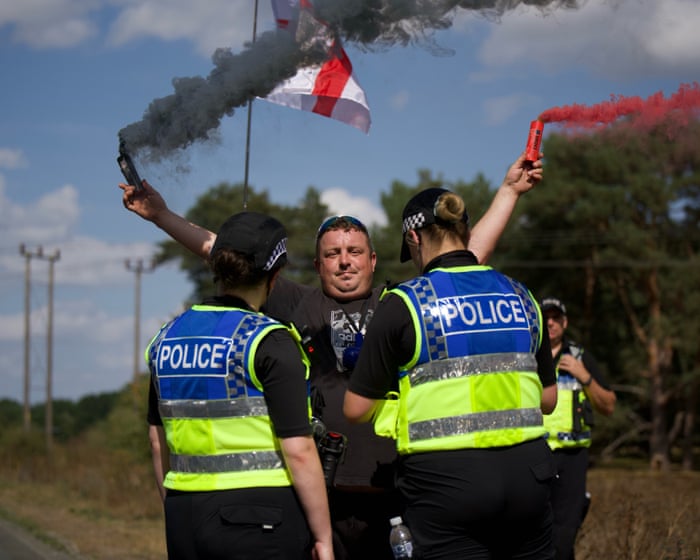
Jermy isn’t here because, although he agrees Barnham shouldn’t be used to house asylum seekers, the protests have drawn support from not only Reform UK and Restore, but also the far-right party Britain First.First. During the protests at RAF Barnham, Jermy says, “there have been speeches on the stage that were basically outright racist and disgusting, and my presence would be seen as condoning that behavior.” We’re on the straight road out to Barnham when the crowd starts cheering for a young man standing on the side of the common, setting off a flare attached to a St George’s flag. Acrid smoke spreads across the march. As two police officers approach him, an accomplice on a motorbike arrives, speeding him off toward a housing estate, to more cheers.
The march crosses the border from Norfolk to Suffolk, leaving Jermy’s constituency and entering the Bury St Edmunds and Stowmarket constituency of his fellow Labour MP, Peter Prinsley. “It’s affecting the whole country,” says Jean Glasdale, 73, who came to the march from just outside Bury St Edmunds. What does she want the government to do? “I want them to deport them,” she says. “I want to be able to walk safely. I mean, they’re not just raping children, they’re raping pensioners like me. I want to feel safe in my own country.”
Talk of rape, amplified and distorted, fills the air at events like this. After we reach Barnham, male speaker after male speaker from Reform UK and smaller fringe parties take turns on the small stage, making ever bigger claims about what rape statistics suggest about migrant behavior, fueling fear about the threat posed by “undocumented, fighting-age men.”
View image in fullscreen: A protester escapes the police after setting off a flare. Photograph: Harry Murray/The Guardian
What’s clear from the statistics is that most rapes are committed by men already known to the victim. But the image of men marauding the countryside and making women unsafe is powerful and heavily exploited. I talk to a 38-year-old woman who lives near RAF Barnham and is at the protest with her small children. She says she’s full of fear about what she sees as the threat from asylum seekers. She’s so scared, in fact, that she thinks they should be held in detention offshore: “The safety of people is paramount. If they’re off the main island – you know, if they’re off, say, Shetland or wherever – it’s another barrier and another bit of protection for us.”
Safety concerns trump talk of specific ideologies – and sometimes reality. “No, there’s no far right,” says Curtis, the organizer. “It doesn’t matter whether you’re left or right wing. This isn’t about that. It’s just about the community – all the communities coming together to feel safe. You know, everybody’s concerned for the safety of the whole area. Because the people who are going to be put here are going to be able to do whatever they want, whenever they want.”
It’s a message that magnifies the threat of foreign-born men. “It’s been going on forever,” says Vron Ware, author of Return of a Native, about the exploitation of these primal fears of rape by “others” and “invaders.” Ware’s book is a reckoning with rural England and opportunists like Lowe and Farage who try to exploit its insecurities.
In the 1980s, Ware was the editor of the anti-fascist publication Searchlight. “I’ve got a poster from an old fascist march in the 70s where someone’s holding a placard that says: ‘75% of rapes are done by immigrants.’ It’s just a trope that never goes away.”
After the march, I ask Curtis how he thought it went. He seems a bit disappointed with the turnout. He says he’s going to take some time off from organizing, which has taken its toll.
I leave RAF Barnham with Harry Murray, who’s been taking photos for the Guardian. We trudge along the side of the road, with articulated lorries rushing past, until we reach a footpath through a field. As we make our way toward town, passing a few cows, I think about how angry everyone is – not just at events like today, but everywhere and all the time – and how draining it feels.
Will the rage blowing through East Anglia eventually die down?Down? I think back to Glasdale, who I was talking to as the march got close to the protest camp. When I asked if she thought the populist party she hands out leaflets for, Restore, could make an impact in the next general election—or even win it—she was very optimistic. “We only have to look at today,” she said. “These people are so… angry.” Do you have a view on the issues this article raises? If you’d like to send a reply of up to 300 words by email for possible publication in our letters section, please click here.
Frequently Asked Questions
Here is a list of FAQs about the situation at RAF Barnham ranging from basic context to more detailed analysis
General Background
Q What is RAF Barnham
A Its a former Royal Air Force munitions depot in Norfolk England Its been disused for years and is now privately owned The site is currently being used to house asylum seekers
Q Why are asylum seekers being housed there
A The UK government has been using former military bases and hotels to accommodate asylum seekers while their claims are processed due to a shortage of standard housing The site at Barnham is one of these temporary accommodation centers
Q Where exactly is RAF Barnham
A Its located near the village of Barnham close to Thetford in the county of Norfolk in the East of England
The Protests Local Reaction
Q What were the protests about
A The protests were a mix of things Some local residents were angry about a lack of consultation from the government and worried about the impact on their small quiet community Other protesters including farright groups were specifically objecting to asylum seekers being housed there at all
Q Were the protests violent
A Yes there were tense and sometimes violent clashes Police were called in to separate rival protest groupsthose against the asylum seekers and counterprotesters supporting them There were reports of flares scuffles and arrests
Q Why did the protests get so tense
A The situation escalated because small local frustration was amplified by national political tensions and the presence of organized activist groups from outside the area The high police presence and the high emotions on both sides created a volatile atmosphere
Q Did the locals support the asylum seekers or the protesters
A The local community was divided Many residents were concerned and wanted the site closed while others formed counterprotests to show support for the asylum seekers and condemn the farright presence Many others just wanted to stay out of it
The Asylum Seekers Operations
Q Who are the asylum seekers being housed there