1. V&A East Storehouse by Diller Scofidio + Renfro, London
At the V&A East Storehouse, the collection itself steals the show. This national museum opens up a world of treasures—from porcelain and poison darts to textiles and tiaras—inviting visitors to get up close. Housed cleverly in the vast hangar that once served as the broadcasting centre for the 2012 Olympics, it feels like an Amazon warehouse packed with global wonders. Here, guests embark on a journey of “curated transgression” through an immersive cabinet of curiosities.
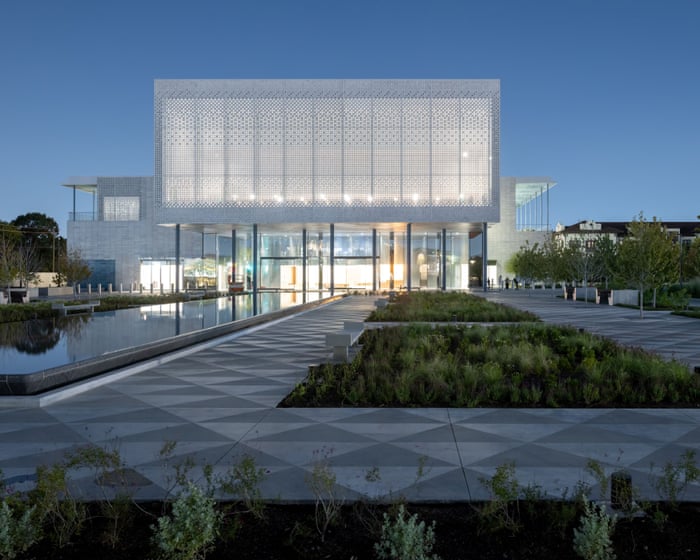
2. Ismaili Centre by Farshid Moussavi, Houston, USA
This new social and cultural centre for Houston’s Ismaili community—open to all—reinterprets Islamic architecture for today. It creates a serene, experience-driven space reminiscent of minimalist art. Beautifully crafted and welcoming, architect Farshid Moussavi describes it as “a renewal rather than a reproduction.” The design thoughtfully explores geometry and space, set within a lush garden landscape.
3. Hans Hollein Transforms, Pompidou Centre, Paris
As the Pompidou Centre closes for a five-year renovation, its final architecture exhibition celebrated Austrian architect Hans Hollein. A postmodern provocateur, Hollein worked across the avant-garde for fifty years, designing everything from jewellery shops to pneumatic structures. He famously imagined architecture reduced to pills that could create spatial and sensory experiences—without the need to build at all.
4. Space House: Squire & Partners, London
Once considered an architectural villain, Richard “Colonel” Seifert was known for monumental office buildings like London’s Centre Point and Tower 42. Now, his unapologetically modernist work is gaining fresh appreciation. The remake of Space House on Kingsway revitalises one of his distinctive “corncob” towers, preserving and restoring 90% of the original structure.
5. The Craft of Carpentry, Japan House, London
The tools and techniques of Japanese carpentry turned the basement gallery of London’s Japan House into a wooden wonderland of chisels, saws, joints, and intricate brackets. The exhibition celebrated master carpenters with almost religious reverence, showcasing the skill behind centuries of timber architecture. Joinery methods bore poetic names like “ant’s head,” “shell mouth,” and “scarfed gooseneck.”
6. Gradel Quadrangles, New College, Oxford, by David Kohn
David Kohn’s wildly eclectic housing for New College, Oxford, mixes influences from Tolkien, Gaudí, and even the Teletubbies. With rhubarb-and-custard coloured stonework, a snaking roof of polygonal scales, and a chubby tower carved with pangolins, moles, and moths, it’s a love-it-or-hate-it design—though students seem to love it. More than just decoration, the carvings highlight these endangered species while adding flair to Oxford’s skyline.
7. Design and Disability at the V&A, London
This vibrant exhibition at the V&A (until 15 February) shows that disability-led design goes far beyond ramps. It features inventive, pleasure-focused creations like self-tightening shoes and a hands-free vibrator, celebrating ingenuity and joy.Designing for disabled people is often approached as a one-size-fits-all, checkbox task. However, this thoughtful exhibition highlights the diverse and expansive nature of the field, with a welcome and overdue focus on designs created by disabled people themselves—who have much to teach us all.
8. Kharkiv Architectural Guide by Ievgeniia Gubkina
Kharkiv has evolved from a Cossack military fortress into a legendary modernist city. Now, it lies in Russia’s line of fire in the ongoing war against Ukraine, with 8,000 buildings damaged or destroyed over the past three years. Completed just two months before the invasion, this “anti-guide book” blends personal reflection with analytical rigor. It keeps Kharkiv’s architectural treasures—including the constructivist masterpiece, the Derzhprom building—alive in people’s minds as a vision for the city’s postwar future.
9. Khudi Bari Prototype Housing, Bangladesh, by Marina Tabassum
In response to climate-driven displacement in Bangladesh, Marina Tabassum collaborated with affected communities to create a practical, affordable modular housing system. The design features a sturdy, resilient bamboo frame with steel connectors, built to withstand wind and water impacts. Corrugated sheet metal roofs simplify transport and maintenance, while facades can be made from locally sourced materials. The entire module can be quickly assembled or taken apart by just three people using basic tools.
10. Intelligens: 19th Architecture Biennale
This edition of the Venice Architecture Biennale, curated by Italian architect and tech enthusiast Carlo Ratti, was a mixed bag—as these events often are. Amid a chaotic array of ideas and installations—from 3D printing with bacteria to the future of space suits—standout contributions were hard to identify. Still, Estonia’s critique of tacky cladding, Poland’s exploration of superstition in architecture, and Bahrain’s argument that climate comfort is a form of social equity all made an impression. —Catherine Slessor
The Best Design of the Year, as Chosen by Designers
Kusheda Mensah x Hem: Palma Pouf
Chosen by Shawn Adams, co-founder of POoR Collective
During Copenhagen’s 3daysofdesign festival, Hem launched a much-anticipated pouf by designer Kusheda Mensah—a significant milestone for the Swedish furniture brand. This marks Hem’s first collaboration with a Black designer, highlighting both Mensah’s rising influence and the brand’s commitment to greater representation in contemporary design. The pouf had already generated buzz for its thoughtful form and cultural relevance, making its debut one of the festival’s most talked-about moments.
Wuka Wearable Hot-Water Bottle
Chosen by Anoushka Rodda, co-founder of Templo Branding Agency
I’d like to highlight the new Wuka wearable hot-water bottle because it reflects how much things are changing in women’s health. Today, there are more practical products that genuinely make our lives easier. I remember wearing bulky, itchy pads and dealing with terrible pain when I first got my period. That’s a far cry from the thoughtful, purpose-driven products available now.
Frances Priest’s Ceramics Collection: Motif | Line | Colour
Chosen by Adam Nathaniel Furman, designer and author
Frances Priest’s new collection of vessels, featured in her solo exhibition at Blackwell House in Cumbria, consists of ethereal columns pinched at the top and bottom. They are adorned with dense, translucent motifs that drift across the ceramic surfaces like the ghostly remains of autumn leaves. The pieces seem to be in motion, yet are so delicate they almost fade into translucency. I’ve long admired Priest’s work, and I promise that anyone who encounters it will be captivated.Anyone who sees her vessels in person will fall deeply in love.
Noah Davis exhibition at the Barbican, London
Chosen by Lewis Dalton Gilbert, curator and creative director of A Vibe Called Tech
I was lucky enough to see Noah Davis’s paintings at the gallery he created, The Underground Museum in LA. What I wasn’t prepared for was the thoughtful design of this exhibition (by studios Freehaus and A Practice for Everyday Life). It brought Davis’s work to life and delicately portrayed his ideas, adventures, and art. I will always sing his praises from the rooftops, but less is said about the power of great exhibition design.
Showtown museum, Blackpool
Chosen by Amber Butchart, curator and fashion historian
I am a huge fan of the seaside, and Blackpool is one of my favourite places. This year I visited Showtown—the museum that celebrates the entertainment heritage of this razzle-dazzle-loving town. It’s a great visit for anyone interested in Blackpool’s rich history of magic, circus, illuminations, and dance, and is especially good for families. The museum’s design allows visitors a glimpse behind the scenes at everything from Punch and Judy puppet shows to the town’s famed drag cabaret, Funny Girls. I am in love with their collection of clown costumes, which includes examples by renowned French costumier Gérard Vicaire.
Alice Gomme’s textile archive at Twos, London
Chosen by Tamsin Clark, director of Tenderbooks, bookshop and event space
For three days in April, the tiny shop space Twos on Hackney Road showed a selection of extraordinary clothing from Alice Gomme’s textile archive for sale. Her collection of rare garments and repaired textiles were found in European rag yards, and viewing these salvaged clothes up close was remarkable. I found myself noticing small details in the wear of a collar or the fade of a pattern. This was an opportunity to look at the overlooked. As Gomme explained in an accompanying publication: “Looking at these pieces helps us connect to the past. Each piece, each repair holds a memory.”
Oríkì: Material Affirmations in Three Acts monograph by Nifemi Marcus-Bello
Chosen by Andu Masebo, product designer
Named Oríkì after the Yoruba practice of praise poetry, the first monograph of Nigerian-born artist Nifemi Marcus-Bello coincided with his solo exhibition at Tiwani Contemporary, Nigeria. The canon of the mainstream design world has long centred on “the West”—its movements, its narratives, and its influence on our collective imagination. In Nifemi’s work, I find a profound significance in his focus on his country of birth. To me, his work signals a shift in the culture: a moment when the eyes of the world are turning toward new centres of creativity, expanding the very idea of where design leadership can emerge, and changing how the history of design will be written in the future.
Le Corbusier executive desk in The Electric Kiln show, London
Chosen by Emma Glynn, creative director, Wedgwood
This lived-in exhibition occupied a building which was once British potter Emmanuel Cooper’s studio and home, now restored, owned, and lived in by curator Rajan Bijlani. Every piece had its own quiet brilliance, from Lucie Rie to Frank Auerbach, but Le Corbusier’s executive desk stayed with me long after. The engineering is so perfectly judged that it grounds the entire space; its calm authority, precision, and purity of purpose are a true feat of design. The remarkable works in this show were so purposefully curated they felt like part of the living space. The whole experience was a privilege—an intimate and inspiring encounter.Ibraaz, a new cultural institution in London, has opened this autumn to great acclaim. Founded by the Kamel Lazaar Foundation—a non-profit organization with roots in Tunisia and across the Middle East and North Africa—it provides a much-needed space in the city for art and ideas from the Global Majority. Housed in a Grade II–listed building in Fitzrovia, redesigned by architect Sumayya Vally, the venue draws inspiration from diasporic spaces in London. Originally built in the early 20th century, the building has served as a synagogue, a residence, a club, and now a cultural centre. It offers a place for artists and thinkers to meet, exchange ideas, and build connections. Ibraaz launched with work by artist Ibrahim Mahama, based on his research into Ghana’s post-independence history, and its upcoming program includes talks, screenings, music, and residencies.
At this year’s Milan Design Week, Loewe captivated audiences with an exhibition of 25 teapots commissioned from leading artists worldwide. One, by Japanese ceramicist Takayuki Sakiyama, looked as if it were poured from soft-serve ice cream. Another, by Spanish designer Patricia Urquiola, resembled a lumpy squirrel, meant to be held by its tail. A third, from Pritzker Architecture Prize laureate Wang Shu, was a mint-green cuboid with a sliced-off corner serving as the spout. These whimsical and puzzling vessels were consistently brilliant, showcasing former creative director Jonathan Anderson’s talent for bringing together contemporary craft. Amid ambitious, large-scale installations at design weeks globally, the exhibition highlighted the enduring value of small, exceptionally crafted objects.
A remarkable public statue by British artist and stonemason Marcia Bennett-Male honors Mary Woolaston. According to legend, Mary was a Black woman who tended a well in 17th-century King’s Cross, known for its chalybeate waters, which she shared as a form of healing. Her story has often been overlooked due to the absence of Black working-class histories. Now, her statue stands in Calthorpe Community Garden in Camden, the former site of the well. Designed to inspire communal healing and remind us of our shared humanity, the work is part of the Black Mary Project, an initiative dedicated to honoring Mary and her legacy.
Architect and sculptor Carlos H Matos created Seat for Surrender for the group exhibition A Stubborn Man and a Hermit Walk Into a Bar, held at Mexican architect and muralist Juan O’Gorman’s iconic 1940s Nancarrow House in Mexico City. Made from plywood boards, the chair captures the socialist and nationalist spirit of O’Gorman’s architecture. Its strength and quiet humor are characteristic of Matos’s creative work.
Frequently Asked Questions
FAQs The Most Innovative Influential Design Architecture of 2025
Beginner General Questions
What does innovative design and architecture even mean for 2025
It refers to the leading trends technologies and philosophies shaping how we build and design spaces and products For 2025 it focuses heavily on sustainability AI integration human wellness and adaptive multiuse spaces
Why should I care about 2025s design trends
These trends directly impact your daily lifefrom how your home or office feels and functions to the sustainability of your city to the products you use They address big issues like climate change mental health and technological overload
Whats the biggest overall theme for 2025
Regenerative Design It goes beyond just being sustainable to actively improving the environment and community Think buildings that clean the air produce more energy than they use and support local ecosystems
Can you give me a simple example of an innovative 2025 trend
Yes Phygital spaces These seamlessly blend the physical and digital worlds For example a smart mirror in your home that acts as a health coach or a public park with interactive ARenhanced art installations
Trends Technologies
How is Artificial Intelligence changing design
AI is becoming a collaborative tool Architects use it to generate thousands of efficient floor plan options optimize building performance and simulate how people will move through a space For product design AI helps create highly personalized user experiences
What is BioIntegrated Architecture
Its the practice of using living materials and designing buildings to function as part of an ecosystem like a vertical forest that houses plants insects and birds
I hear about Circular Design a lot What is it
Its designing with the entire lifecycle in mind Products and buildings are created to be easily disassembled repaired reused or recycled eliminating the concept of waste Think modular furniture or buildings with material passports that list every component for future reuse
What are Neuroinclusive Spaces
These are environments designed with diverse neurological needs in mind eg for people with autism ADHD