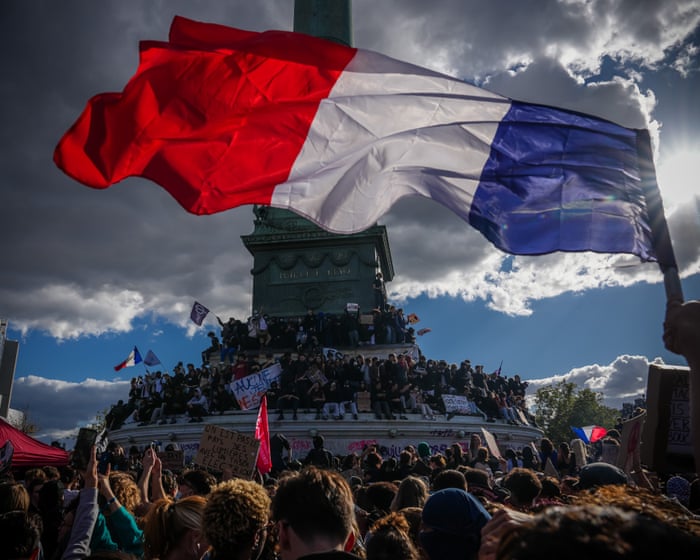
Last Saturday night, the town hall in Limoges, west-central France, was set on fire. By Sunday, images of the blaze destroying a symbol of the French Republic—along with other scenes of unrest across France—were everywhere, but they were being used to tell very different stories about what is happening in Europe. For some, the flames announced a pan-European youth revolt, proof that a single movement was sweeping the continent. Donald Trump, who had already insisted that the French school protests were not about schools but about migration and Islam, urged Europeans to “close the borders.” The mayor of Limoges saw the fingerprints of an alleged ultra-left insurrection.
I lost count of how many mainly right-wing media outlets suddenly contacted me. Most were based in India, China, Singapore and the US. They were looking for voices to validate the idea of a “teen revolt” spreading across Europe, driven by the same grievances and violence. None of these narratives, each serving a different political agenda, adequately explains what is happening. Europe’s protests have different causes, constituencies and demands. Portraying them as a Europe-wide rebellion erases those differences and makes Europe look ungovernable. That picture is a gift to anyone who wants to exploit the unrest.
What set off the protests varies from country to country. In France, the mobilisation began in schools in mid-September, driven by frustration over longstanding failures to address overcrowded classrooms, teacher shortages and dilapidated buildings and facilities. By the time of the huge demonstration on Saturday, public-sector workers had joined, and the grievances had widened to include the cost of living. In Belgium, meanwhile, students have challenged tuition-fee increases in the country’s French-speaking region and demanded additional teaching hours. Greek students have mobilised over housing costs and access to accommodation, while German pupils have protested against the possible reintroduction of compulsory military service.
Look beyond western Europe, and the differences become even more distinct. In Albania, student unrest builds on a pre-existing anti-government mobilisation rather than a standalone youth revolt. In Serbia, students have led nearly two years of largely peaceful protests following the Novi Sad railway station disaster. Their movement centres on demands for an end to corruption, a lack of institutional accountability and political inaction. Now the students are running in this weekend’s election on their own list. This is a battle over power and accountability, and it goes well beyond education or generational frustration.
Italian students may occupy schools and shout slogans in French, but the cross-border spread of images, slogans and tactics does not prove a shared organisation. Rather, 24-hour news coverage can turn separate protests into a single story of youth rebellion, creating—deliberately or not—the illusion of a common movement and programme where neither exists.
Rejecting the idea of a single European youth revolt does not mean denying the existence of a shared generational anxiety. Housing has become increasingly unaffordable, public services are under pressure, and the transition into secure employment is uncertain. Eurostat reports that EU house prices rose by 55.4% and rents by 26.7% between 2010 and the fourth quarter of 2024. The 2026 TUI Foundation Youth Study found that 52% of young people aged 16–26 across seven European countries expected to be worse off than their parents, compared with just 25% who expected to do better. Youth unemployment in the euro area remains substantially higher than overall unemployment. One study of French firms found a sharper decline in permanent hiring among workers aged 21–29 in occupations exposed to artificial intelligence. The European Central Bank cautions that the evidence does not yet establishGenerative AI is being blamed. But the uncertainty itself can create a shared sense of insecurity across national borders. Such anxieties help explain why protests in one country resonate with young people in another, and why images of school sit-ins or street demonstrations can inspire imitation. But they don’t translate into common demands, let alone a coordinated political movement. France’s demonstrations last Saturday exposed another danger: how quickly violence can overshadow a protest’s message. Most demonstrators marched peacefully, but a minority resorted to violence. Their actions should not define hundreds of thousands of demonstrators, just as peaceful protest should not provide cover for criminal acts. What happened in Milan showed how the two can blur. A peaceful cost-of-living march alongside protests over education cuts and race-based reform was followed by looting carried out by hooded, mostly teenage groups organised partly via TikTok. More than 200 were detained, most of them minors, and the march’s organisers disowned them. Defending public order must go hand in hand with accountability for violence and scrutiny of police conduct. But when images of burning buildings and looting dominate coverage, peaceful protest and criminal violence become harder to distinguish in the public mind. A single incident can come to define an entire mobilisation.
The misleading narrative of a pan-European revolt has consequences, because it allows images of unrest to be taken out of their national contexts and presented as proof that a chaotic Europe is ungovernable. This is particularly useful to those seeking to deepen divisions and undermine European democracy: it turns distinct national problems into a sweeping story of European failure. For the radical right, the idea of a continent in flames proves that open societies cannot protect their citizens, hence the call to “close your borders”. For those on the radical left who celebrate every burning building as the dawn of a continental uprising, the flames prove that liberal democratic institutions are beyond repair. Both need Europe to look ungovernable, but neither offers an answer to the disorder it complains about. And both serve the interests of those beyond Europe’s borders who gain from a divided union, from the Trump administration to Vladimir Putin. President Macron had a point when he lashed out at the “stupid” comments of foreign leaders about events in France. AI-generated images of scenes that never took place in France had been circulating, he said. Macron is hardly neutral, but certain forces clearly have an interest in amplifying images of chaos.
Governments should neither romanticise protest nor use violence as a pretext to dismiss legitimate grievances. They must protect peaceful demonstrators, hold perpetrators accountable and address the pressures that leave many young people uncertain about their future. Europe’s democracies will be judged not by how they withstand these protests, but by how they address the distinct grievances behind them and restore confidence in the future. That is how generational anxiety can become a force for democratic renewal rather than fuel for those seeking to portray democracy as broken.
Alberto Alemanno is the Jean Monnet professor of EU law at HEC Paris and the founder of The Good Lobby
France readers Q&A: Guardian Europe columnists Rokhaya Diallo and Alexander Hurst will be live taking questions from our readers about the unrest in France from 1500 BST / 1600 CEST on Friday 23 October. Send your questions by email now to conversations@theguardian.com or post questions in the comments from 0900 BST here.
Frequently Asked Questions
Heres a set of FAQs based on the articles argument about how the recent youth unrest in Europe is being framed
What is the article about
It argues that calling recent youth protests a violent and coordinated uprising is a misleading narrative pushed by Europes enemies to discredit young people and democracy
Who wrote it
Alberto Alemanno a professor of EU law and policy
What events is it responding to
Recent outbreaks of youth unrest and protests in several European countries
Why does the author say Europes enemies want this picture
Because the violent uprising framing makes democracies look chaotic and unstable which serves authoritarian rivals who want to undermine trust in democratic systems
Whats wrong with calling it a coordinated uprising
The author says it lumps together very different mostly spontaneous protests and exaggerates how organized they are
Does the article deny that some violence happened
No It acknowledges isolated violence but argues its wrong to define the whole movement by it
What do the protesters actually want
Mostly things like action on climate change affordable housing jobs and a voice in decisions that affect their future
Why are young people protesting now
They feel their economic prospects are worse than their parents and theyre frustrated that leaders arent addressing longterm problems like climate and housing
Whats the difference between a protest and an uprising
A protest is a public expression of dissent usually peaceful an uprising implies broader revolt often with violence The word choice shapes how people see the movement
Why does the language used in media matter here
Framing shapes public opinion Calling protesters rioters or insurgents makes it easier to justify crackdowns and dismiss their demands
Is youth protest new in Europe
No From 1968 to the antiausterity movements young people have long been a driving force in European protest
Whats a practical tip for reading news about protests
Check whos describing the events and what words they use Ask are they quoting organizers or only officials Is violence described as widespread or isolated
Whats the risk of the enemy uprising narrative
It can justify restricting protest rights alienate a generation from politics and distract from the real grievances behind the protests
What does the author want instead
A