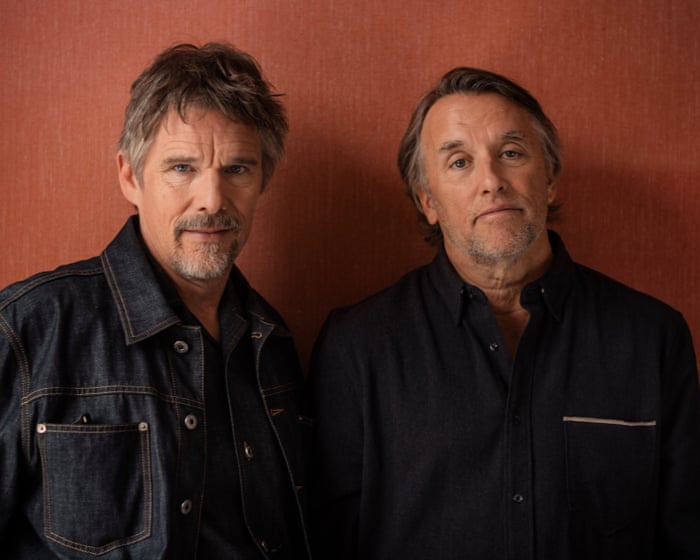
“I like this, it’s good,” Ethan Hawke tells Richard Linklater during a lively conversation that has already jumped from politics to the Beatles to John Huston’s later films. “What’s good?” asks Linklater. “All of this,” Hawke replies, referring to the London hotel suite with its coffee table, couch, and matching armchairs, as well as the entire routine of the international press tour. “I like that we get to spend a couple of days in a room,” he says. “It feels like we’re continuing the same conversation we’ve been having for the past 32 years.”
For Linklater and Hawke, it’s all about the conversation. Both men enjoy talking, and often their discussions inspire a film. They first met backstage at a play in 1993 (“Sophistry, by Jon Marc Sherman,” Linklater recalls) and ended up chatting until dawn. That conversation laid the foundation for what would become Before Sunrise, a romantic film that mirrored their off-screen friendship as it followed Hawke and Julie Delpy wandering through mid-90s Vienna, walking, talking, and sharing kisses. “Yeah, that was the moment. That set the tone,” Linklater remembers. “Meeting Ethan backstage, then flying out to Vienna.”
Blue Moon, Linklater and Hawke’s 11th collaboration, is perhaps their most ambitious project yet—a lavish period drama set in 1940s Broadway. Hawke portrays the heartbroken lyricist Lorenz Hart, drowning his sorrows at a bar on the opening night of Oklahoma! while his former writing partner, Richard Rodgers, celebrates with Oscar Hammerstein. Hart is sharply dressed and quick-witted but barely holding himself together, much like the production itself. Blue Moon was filmed quickly in just 15 days on an Irish soundstage made to look like midtown Manhattan, its glamorous appearance belying its independent origins.
For Hawke, this film was particularly challenging. In previous collaborations, he had essentially played a version of himself or a blend of himself and Linklater, but Hart required a much broader performance. It was as if he had grown accustomed to being a band member and suddenly had to learn a completely new instrument.
“Yeah, you play the drums on this one,” says Linklater.
Hawke nods. “But workwise, that put us in a different position. It felt dangerous. You got a bit naggy. It felt like I was hitting the wall of my talent.”
“That’s the place where you want to be,” Linklater responds.
Hawke isn’t so sure. “Well, you want it when it’s over. Afterwards, my son asked, ‘Was it fun?’ and I said it was like going down a ski slope that’s too difficult. When you land safely, you say, ‘That’s amazing.’ But I’m not sure I would have said it was amazing when I was trying to maintain some sense of grace, when I was trying not to hit all the trees.”
Graceful or not, it’s a striking performance, featuring a flamboyant, old-school physical transformation. Hart was bald and only five feet tall, so Hawke shaved his head and stood in a trench to appear shorter than his co-stars. This gave him a fresh perspective on the world. “Because the world is heightist. It’s ingrained in our culture, it’s in our language. Tall and handsome. Proud and strong. It’s tough when people don’t want to flirt with you. It changes how you see yourself.”
He recalls having an actor friend on set who helped him with sightlines. The friend stood in the trench with his wife nearby, and suddenly she towered over him. “Wow, that’s so interesting,” she said. “I definitely wouldn’t have married you.”Hawke winces at the memory. “Because that’s shocking, right? That this woman he’s been married to for 20 years would be put off by something so superficial. Not his brain, not his talent, not his looks, not his essence. You’re short and you’re bald. That’s not masculine to me.”
Linklater adds, “Yeah, but your wife said that too.”
“Yeah, okay, she did,” Hawke admits with a laugh. The actor has been married to Ryan Shawhughes since 2008. It’s a good marriage; she loves him, though even she has her limits. “It wasn’t the height or the balding that bothered my wife,” he says. “It was the combover. The disguise is always worse than the thing itself. I dyed my hair, very obviously, and then I did the combover. And Ryan came to visit the set one day, looked at me, and said, ‘You know what, I’m leaving. I didn’t marry Larry Hart.'”
Hawke is 55, and Linklater is a decade older. Their films have tracked and mapped their lives, moving from the weightless youthful joy of Before Sunrise to the burdensome adult responsibilities of its sequels (2004’s Before Sunset; 2013’s Before Midnight). The sublime Boyhood was pieced together over 12 years and featured Hawke as a deadbeat Texas dad who eventually straightens up, settles down, and trades his vintage sports car for a family-friendly minivan. And now comes Blue Moon, which is jaundiced, gin-soaked, and pines for a world that’s moved on. It is—dare one say it—their first sad old man movie.
“Uh-oh,” says Linklater. “I think I know what you’re saying here: ‘You’re in the final chapter, buddy.'”
That’s not quite what I’m saying; they have plenty of road left to run. Certainly, Hawke and Linklater have little in common with Hart, a brilliant, raging alcoholic who effectively died in the gutter at 48. If anything, they resemble the duo that outlasted him: they’re the indie equivalent of Rodgers and Hammerstein.
Probably every profession has people like Hart: tortured and talented, and ultimately too much trouble. Sooner or later, something has to give. “I’ve had my own artistic breakups,” says Linklater. “And it’s always for the same reason—addiction. It’s sad, it’s poignant. It’s the worst. But when you’re in a position of responsibility, you have to make a decision for the good of the ship. ‘We’ll send you to rehab, but you can’t stay here; you’ve got to go.'”
The tyranny of an early, sudden death is that it casts a shadow over a life. Hawke began his career acting alongside River Phoenix and Robin Williams. He performed opposite Philip Seymour Hoffman in the 2007 thriller Before the Devil Knows You’re Dead. All three have since been posthumously framed as brilliant, tragic figures. According to Hawke, this was only ever half true. “Because there was nothing tragic about those people,” he says. “If they were sitting here on the couch, you’d see how utterly un-tragic they were.”
It’s Hoffman’s death—in 2014 from a drug overdose—that remains the hardest to process. “To understand Phil, you have to understand how many days he beat addiction,” Hawke says. “Phil had a problem. He lost one day. But he won all the other days, for twenty-something-odd years. I don’t want to say that he had no agency in his death. But it was a difficult period, and he was taking his sobriety seriously. He was on his way to a meeting the day he died.” He shakes his head as if to clear it. “And I know other talented people—less famous—who have been lost the same way.”
“Too much success or too much failure,” says Linklater. “You can react badly to both.”
The secret might be to maintain a nice even keel—or, failing that, to have a regular collaborator to measure your own life against.Technically, Hawke and Linklater don’t need each other. Both have built successful careers on their own—Hawke is part of the profitable Black Phone horror series, while Linklater is set to release his playful black-and-white film Nouvelle Vague, which revolves around the making of Jean-Luc Godard’s Breathless. Yet, it might be this very independence that sustains their healthy and balanced partnership.
“Yeah, my wife said something similar,” Hawke remarks. “She pointed out, ‘Oh, it’s easy for them because they’re on equal footing.’ And she might be right. Status is such a big deal in this industry. There are actor-director dynamics where one becomes hugely successful and feels like they’re doing the other a favor by collaborating, or vice versa.
“Fortunately, life has kept us on an even keel.”
“We both keep brewing ideas,” Linklater adds. “Our modestly successful careers have actually worked in our favor.”
Hawke shrugs. “Well, it does make the friendship smoother. When Ryan said that, I didn’t love how it sounded—I don’t like to see myself as status-aware and prefer to think I can be friends with anyone. But she’s not wrong; it does help.”
Other factors come into play. “There’s the business aspect too,” Hawke explains. “It’s tough for actors; if you’re not in profitable films, people can’t hire you. If my career weren’t seen as successful, it would put Rick at a disadvantage. Even if he likes working with me, he wouldn’t get funding. So I have to handle that part on my own.”
Life is long, and the film industry is challenging. Making independent movies doesn’t get easier—Linklater notes their latest was particularly tough. But he feels energized as he grows older, adding that filmmakers aren’t like athletes who lose a step each year.
Hawke chimes in, “What people lose is idealism and curiosity. The profession can wear you down, make you cynical, and kill that sense of wonder.”
“That’s depression,” Linklater interjects, frowning. “Losing interest, thinking, ‘What’s the point?'”
“Exactly,” Hawke says, almost exasperated. “But you haven’t lost that at all. Look at us, making this little indie movie in just 15 days.” He turns to me. “Many directors Rick’s age and stature would lose interest in working that hard.”
“For no money,” Linklater adds. “They’d say, ‘Wait, this is where I started. Why go back to the minor leagues?'”
“But you’d never see it as the minor leagues,” Hawke responds. “That’s because you’ve never measured success by money. It’s not about the paycheck; it’s about creating meaningful art. That’s why we’re here.” He gestures around the room. “And you know what this is?”
“The major leagues,” Linklater says with a laugh.
Blue Moon will be released in the UK on November 28.
Frequently Asked Questions
Of course Here is a list of FAQs about the Ethan Hawke and Richard Linklater discussion based on the theme It felt risky You became irritable
General Beginner Questions
Q What is this conversation between Ethan Hawke and Richard Linklater about
A Its a discussion where they reflect on their longterm creative partnership the anxieties of making art and the personal changes they went through while working on projects like the Before trilogy and Boyhood
Q What does It felt risky refer to
A It refers to the feeling of vulnerability and uncertainty they experienced when trying new unproven creative ideas like filming Boyhood over 12 years or creating deeply personal dialogue
Q Why does the title mention You became irritable
A It highlights how the stress and pressure of taking creative risks can affect personal relationships and moods even between close collaborators
Q Who are Ethan Hawke and Richard Linklater
A Ethan Hawke is an acclaimed actor and writer and Richard Linklater is a renowned film director They are famous collaborators on films like the Before trilogy and Boyhood
Q What is the Blue Moon they discuss
A They are likely referring to the song Blue Moon possibly in the context of its use in one of their films or as a cultural touchstone that evokes a specific mood or memory for them
Deeper Advanced Questions
Q How does their discussion about influence reflect their filmmaking philosophy
A They talk about influence not as copying but as absorbing art and life experiences to create something new and authentic which is a core principle of their naturalistic filmmaking style
Q Whats the significance of the hairstyle discussion
A Hairstyles often serve as visual markers of time passing and character development in their films Discussing them is a tangible way to talk about aging and transformation
Q What are some examples of the risky projects they mention
A Key examples are Boyhood filmed over 12 years with the same cast and the Before trilogy which relies almost entirely on conversation between two characters with years between each films release