In November, Israeli flags suddenly appeared along a highway in the Palestinian West Bank. More than a thousand of them were placed about thirty yards apart on both sides of the road, stretching for roughly ten miles. They were planted south of Nablus, near Palestinian villages that are regularly targeted by extremist Israeli settlers. I saw the flags the morning after they were put up, while on my way to visit those villages. Their message echoed the ubiquitous graffiti painted by settlers across the West Bank: “You have no future in Palestine.”
Compared to the 70,000 Palestinians killed in Gaza and more than 1,000 in the West Bank since October 2023, the flags are little more than a minor provocation. But they reflect how dominant Israel has become in the West Bank—land recognized under international law as belonging to the Palestinians. During the second intifada, the Palestinian uprising from 2000 to 2005, Israeli settlers would not have risked planting such flags for fear of coming under fire from Palestinians. Not anymore.
I returned to the West Bank last month for the first time in twenty years. In the early 2000s, I had visited regularly as a correspondent for the Guardian, supporting Jerusalem-based colleagues covering the second intifada. That uprising was far more violent than the first, which lasted from 1987 to 1993. The enduring image of the first intifada is of Palestinian youths throwing stones at Israeli soldiers. The second was a full-scale confrontation: Israel attacked Palestinian cities and towns with artillery, tanks, helicopters, and jets, while Palestinians fought back with rifles and explosives. Palestinians ambushed soldiers and settlers in the West Bank, making roads dangerous—especially at night—and terrorized Israel by sending suicide bombers across the border to attack bus stops, cafes, hotels, and other crowded places. More than 3,000 Palestinians and over 1,000 Israelis were killed.
I hadn’t planned to write about my trip to the West Bank last month. But I changed my mind when I saw how much daily life for Palestinians has deteriorated, how dispirited they have become, and how much control Israel and its settlers now wield over the Palestinian population. I expected conditions to be worse, but not this much worse.
I had been invited to a conference at Birzeit University, on the outskirts of Ramallah, organized by Progressive International—a loose coalition of left-wing organizations and individuals worldwide founded in 2020 by, among others, former Greek finance minister Yanis Varoufakis and U.S. Senator Bernie Sanders. The conference on the decolonization of Palestine was jointly organized by Progressive International, the Palestinian think tank Al-Shabaka, and the Ibrahim Abu-Lughod Institute of International Studies at Birzeit. The university’s academics and students have a long history of protest and clashes with Israeli forces, and the campus has been repeatedly raided by Israeli forces over the past two years.
After the conference, a few attendees traveled around the West Bank. I was curious why there had been no Palestinian uprising in the West Bank comparable to the second intifada, in support of their compatriots in Gaza. I also wondered how much support there was for Hamas in the West Bank, and whether anyone believed an independent Palestinian state might be possible in the coming decades. Their responses were varied and complex, but consistent themes emerged. One was how demoralized they have become. The other was how distant the prospect of a sovereign, independent Palestine now seems.
Ramallah, the political, cultural, and economic center of the West Bank, looked cleaner, less chaotic, and in places more prosperous than the last time I was there—not so different from many European cities, with billboards advertising restaurants, specialty chocolate shops, and new gym openings. Young, fashion-conscious Palestinians sat chatting in cafes and bars; according to some of the older generation, they are generallyHowever, this sense of normalcy and prosperity is misleading for two reasons. First, Ramallah is not representative of the wider West Bank. Second, its relatively orderly and calm appearance is partly due to the absence of many villagers from surrounding areas. These farmers used to line the city’s streets selling their produce, but now many find the journey too difficult due to the ever-growing number of Israeli checkpoints and gates, which make travel unpredictable. These obstacles deter not only farmers but also general trade and business across the West Bank.
At the end of the second intifada, the UN reported 376 checkpoints and barriers in the West Bank. Today, that number has risen to an estimated 849, with many established in just the last two years. For Palestinians, discussing checkpoints is as common as talking about the weather in the UK. While an app that shares real-time road information from bus drivers and other users is helpful, it doesn’t guarantee open routes, as I discovered. The occupation has a color code: red metal barriers are usually closed, while yellow ones are open more often. Additionally, vehicles with yellow Israeli license plates can use roads that are off-limits to those with green Palestinian plates.
Israeli military raids into central Ramallah have increased over the past two years. Soldiers arrive in large numbers, make arrests, and then leave. During one raid in August, they targeted currency exchange offices, arrested five people, and, according to Palestinians, injured more than a dozen with live ammunition, rubber bullets, or tear gas.
In a major incursion in 2002, Israel took control of much of the city. Tanks and bulldozers smashed into the presidential compound, reducing much of it to rubble and trapping the then-Palestinian leader, Yasser Arafat, inside. The dimly lit, cramped rooms where he was confined until shortly before his death in 2004 have been preserved as part of an Arafat mausoleum and museum. The ruins of the compound stand as a symbol of defiance from a time when Palestinians were more united and hopeful.
One key difference between the second intifada and today is that Arafat tacitly supported the uprising. His secular Fatah movement fought alongside Islamist groups like Hamas and Palestinian Islamic Jihad, as well as the left-wing Popular Front for the Liberation of Palestine. In contrast, Arafat’s successor, Mahmoud Abbas, elected president in 2005, has resisted pressure over the last two years to start a new uprising in the West Bank. According to polls and the Palestinians I spoke with, Abbas’s decision is unpopular among West Bank residents.
Among the few who support Abbas’s stance is Maher Canawati, the mayor of Bethlehem and, like Abbas and Arafat, a Fatah member. He said Abbas has faced significant criticism. “People wanted him to say, ‘Let’s go fight,'” Canawati noted. However, he believes the president’s caution has been justified. “People in the West Bank understood that this was not the time to do what they did in the first and second intifada. We do not want to give them an excuse to attack us. We are helpless. We are not at the same level as the Israelis,” Canawati explained. “If we decided to launch an uprising, it would give them the green light to retaliate as they did in Gaza.”
From the mayor’s office, you can see the Church of the Nativity, where steps lead down to a grotto revered by Christians as the birthplace of Jesus. In 2002, during the second intifada, Israeli forces besieged the church for 39 days, firing at Palestinian militants who had taken refuge inside. Few tourists today realize that near the steps to the grotto, the bodies of Palestinians killed in the siege were left to decompose. Not that there are many tourists around to notice these days.Canawati, a Christian whose family has lived in Bethlehem since the 17th century, owns The Three Arches, one of Palestine’s largest suppliers of biblical souvenirs. He says tourism has nearly vanished over the past two years.
The problem extends far beyond tourism. The West Bank’s economy is in dire straits, with per capita income down 20% and unemployment stuck around 33%. Compounding this hardship, the Palestinian Authority (PA), which nominally administers the West Bank under Fatah, is widely seen as corrupt—synonymous with embezzlement, shady contracts, and nepotism. Many Palestinians I spoke with were furious that jobs are so often given based on family ties, bribes, or political connections rather than merit.
Examples are easy to find. In Tulkarm, a stallholder called me over to chat. He had been a top university student, earned a law degree, and proudly showed me his Palestinian bar association card. So why was he selling fruits and vegetables? He simply lacked the connections within the PA to start a legal career.
Canawati acknowledged corruption exists but softened the criticism by adding, “like other countries.” Given the deep unpopularity of President Abbas, the PA, and Fatah, I asked how Hamas would fare in a West Bank election. Canawati insisted Hamas would have “no chance,” though almost everyone else predicted it would win. With no national legislative elections since 2006, student council votes at Birzeit University serve as a rough barometer. In the last election before October 7, an Islamist bloc linked to Hamas won 25 of 51 seats, while a Fatah-affiliated group took 20 and another tied to the Popular Front for the Liberation of Palestine won six.
Bringing up the October 7 massacre, in which over 1,200 Israelis and foreigners were killed and about 250 taken hostage, always provoked a strong reaction. Palestinians would angrily ask why use October 7 as a starting point—why not begin with the repeated Israeli airstrikes on Gaza that killed thousands between 2005 and 2023? Most viewed Hamas as part of the resistance, and few were willing to criticize the attack.
One exception was Omar Haramy, director of Sabeel, a Palestinian liberation theology center in Jerusalem. He believes Palestinian civil society’s failure to seriously discuss the massacre is a problem. Speaking near the Jaffa Gate, close to an Israeli police station where he says he was often detained, Haramy suggested that if Palestinians had pressured Hamas earlier, it might have released the children, women, and elderly hostages. “Is this the values we want as Palestinians? To take babies as hostages? For God’s sake. This is not who we are.” He sees political factions as a burden on the struggle for liberation: “They are all complicit, with no elections, with no vision. It’s all sad and messed up.”
The most dramatic change since my last visit is the expansion of Israeli settlements. There are 3.3 million Palestinians in the West Bank, including 435,000 in East Jerusalem. The number of Israeli settlers has jumped from 400,000 during the second intifada to over 700,000 today. But these numbers don’t capture the settlements’ encroaching presence—their suffocating effect as they occupy more hilltops overlooking Palestinian communities, and even set up in their midst, behind walls and barbed wire, often just yards from Palestinian homes, all protected by Israeli soldiers.
During the second intifada, I interviewed the leader of a small settlement in central Hebron, whose population was overwhelmingly…When I asked him about Palestinians, he called them “animals.” Even after I said I would quote him, he didn’t take it back. I’ve never forgotten that casual contempt. But now, it seems mild compared to what’s happening today. Settlers, encouraged by extremists in the Israeli cabinet, are harassing Palestinians more often and more viciously, rampaging through villages without consequence to intimidate and drive them out.
About ten miles from Hebron lies the hillside village of Umm al-Khair, known for violent clashes with settlers. Eid Siliman Hathaleen, a Palestinian Bedouin and community activist from the village, explained that the Bedouins bought the land in 1952, but settlers and the Israeli army have been waging a sustained campaign against them. Palestinian homes are demolished while settlers expand. In October, seven new mobile homes appeared overnight in the middle of the village, and an Israeli order was issued to demolish 14 more Palestinian homes.
The village, like the rest of the West Bank, is under constant surveillance from cameras, military vehicles, and drones. While we were talking, Israeli soldiers arrived. Hathaleen said that just an hour earlier, Israeli peace activists who had come to show solidarity were forced to leave after soldiers declared the area a closed military zone. The soldiers then told us the spot where we were standing was also now a closed military zone.
As Hathaleen argued with young soldiers about the order, a senior officer—heavily armed, wearing a black balaclava and dark glasses—joined us. Frustrated by the exchange, he finally said, “You have four minutes. Go. Goodbye.” Hathaleen, who believed the soldiers came at the settlers’ request, filmed the confrontation on his phone—a potentially risky move that ended peacefully. He shared that his father, Siliman Hathaleen, also an activist against demolitions, died after being hit by an Israeli police truck in 2022. His cousin, Awdah Hathaleen, a consultant on the Oscar-winning documentary No Other Land, was shot dead in the village by a settler in July.
In Palestinian villages south of Nablus, representatives from agricultural cooperatives and women’s organizations described attacks by settlers who come down from the hills to beat people, destroy property, and spread a poisonous white powder that kills crops. In one village, farmers have started growing vegetables in barrels filled with clean soil to counter this.
Could anger over Israeli military incursions, settler attacks, and the destruction of Gaza lead to large-scale retaliation or a third intifada in the West Bank? According to an October poll by the Palestinian Center for Policy and Survey Research, 49% of Palestinians in the West Bank—and 30% in Gaza—still see armed struggle as the most effective way to achieve a Palestinian state.
Abdaljawad Omar, an assistant professor of philosophy at Birzeit who writes under the pen name Abboud Hamayel, is skeptical. He has a forthcoming book on Palestinian resistance. While he doesn’t advocate a return to violence, he laments the prevailing fatigue and paralysis, what he calls “emotional hollowing.” He said, “Anger has mutated into impotent resentment. Today, stones are seldom thrown in the West Bank. This is something new… Resistance is slowly becoming a memory.”
The refugee camps, many dating back to 1948 when around 750,000 Palestinians were expelled or fled from their homes in what became Israel, were the hotbeds of resistance during the second intifada. At the entrance to t…At the Aida refugee camp in Bethlehem, a massive key hangs over an arch, symbolizing the hope that its residents might one day return to Israel to reclaim their former homes. Murals cover the camp’s walls, honoring Palestinian figures like stone-throwing youths and guerrilla fighter Leila Khaled, while another depicts an unflattering image of former U.S. President Donald Trump. One Friday at midday, residents hurried to prayers with little time to talk. They dismissed the Gaza ceasefire—“What ceasefire?”—and mocked Trump’s vision of a “Gaza Riviera.”
The giant metal key and the murals celebrating resistance feel like relics of a fading era, especially since the refugees’ dream of returning to their original homes in Israel is almost certainly never going to happen. During the second intifada, I interviewed a father in another Bethlehem camp who insisted he would only leave to go back to his former home. Does that same stubbornness still exist today? A former camp resident expressed surprise that even the most determined families are now considering leaving, worn down by unemployment, poverty, and debt.
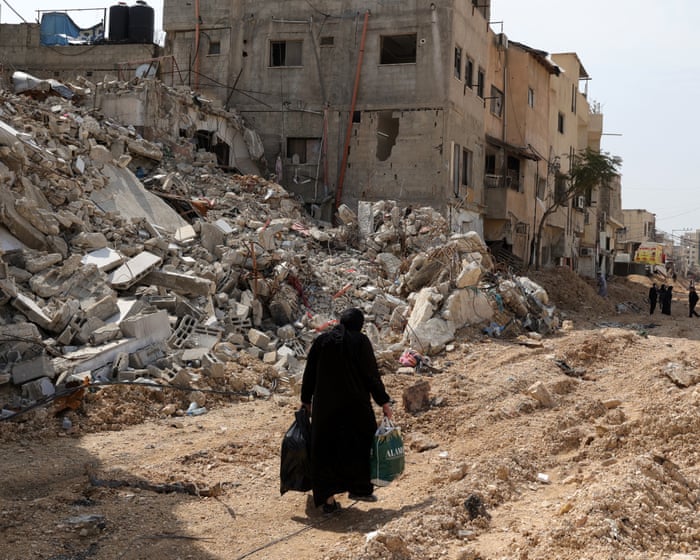
The Israeli military isn’t waiting for them to go. Earlier this year, the IDF demolished large sections of three camps in the northern West Bank—Tulkarm, Nur Shams, and Jenin—which have been at the forefront of resistance since the second intifada and again since 2023. Israel called them “hubs of terror,” while Palestinians reported that the military warned residents of Aida and other camps they would be destroyed unless they complied.
When Israeli forces entered the Jenin refugee camp in 2002, they faced fierce resistance. At the time, I spoke with Israeli sergeant Israel Kaspi, a combat veteran of the 1973 Yom Kippur War and the 1982 Lebanon War, who said the fighting in Jenin was the most intense he had ever experienced. He described how Palestinians had turned the camp into a fortress, with booby traps, hidden explosives, and well-prepared firing positions. Israel lost 23 soldiers in the street-by-street, house-by-house combat.
Earlier this year, when Israeli forces moved into the camps in Jenin, Tulkarm, and Nur Shams, they lost three soldiers but managed to evacuate around 30,000 residents combined, breaking up close-knit communities and forcing people into temporary shelters across the West Bank. Approximately 850 homes and other buildings were destroyed across the three camps.
During a visit to Tulkarm and Nur Shams last month, I saw tank or bulldozer tracks in the muddy roads, but little else—partly because it was dark, but also because going further is dangerous. The Israeli military had warned that anyone trying to enter the camps would be shot. This was not an idle threat: three days later, cameraman Fady Yasmeen was shot during a protest near the entrance.
I traveled to Tulkarm with Aseel Tork, who works for the Bisan Centre for Research and Development, a nonprofit that runs community projects in rural areas, especially for women and youth. Israel designated the group as a terrorist organization in 2021, a move condemned by the UN Office of the High Commissioner for Human Rights, among others. Tork told me she believes a third intifada is now impossible. “During the first and second intifadas,” she said, “the Palestinian community as a whole was…”We used to look out for one another. There were fewer divisions—ideologically, politically, geographically. Today, we have not stood up for the people of Gaza as we should have. If an intifada were going to happen, it would have happened after October 7th and 8th.
At a November event in Ramallah called “Poetry after Gaza,” a European and a Palestinian discussed a quote from Kafka. I heard it twice more that week from other Palestinians: “There is plenty of hope—an infinite amount of hope—but not for us.”
Where do Palestinians find hope? Few clear answers emerge. Could the Palestinian Authority be overhauled? Elections are long overdue, but they are complicated internationally due to widespread support for Hamas. Is a two-state solution even possible anymore, given how much land settlers now occupy in the West Bank? What about a one-state solution, with Israel as an enlarged apartheid state, where Palestinians could fight for equal rights with international backing, as in South Africa? One weary Palestinian writer, after declaring the two-state solution dead, said he would accept a one-state solution if it meant he could finally move freely.
Last month, a global campaign began for the release of Marwan Barghouti, widely seen as the figure most likely to unite Palestinians. Barghouti, accused by Israel of leading Fatah militants in the West Bank during the second intifada, has been in an Israeli prison since 2002, convicted on five counts of murder—charges he denies. Many hope he could emerge as a Palestinian Nelson Mandela. Though he is Fatah, he is popular among Hamas supporters and other factions. I interviewed him in Ramallah the year before his capture and wrote then that he could be a future leader. He was impressive but lacked Mandela’s warmth, and he struck me more as a street fighter than a political visionary. But perhaps prison has changed him, as it did Mandela. Barghouti has been held in solitary confinement since the October 7th attack and, according to his son Arab, has been beaten by guards four times, most recently in September, when he was left unconscious.
Barghouti was on Hamas’s list of prisoners to be released as part of the October ceasefire deal. Israel released others convicted of murder but refused to free him. This may reflect Israel’s preference for a weak, malleable leader like Abbas over a potentially stronger figure.
Basem Ezbidi, a leading political scientist and member of the Al-Shabaka thinktank who studied with Barghouti, warned against expecting a political savior. “In times of despair, people create myths of a superhero coming to the rescue,” he said. “People see Barghouti that way. But he is not a miracle-worker. He may be cleaner than others, but that’s not enough—you need political skill and the right vision.”
With few options from within, many Palestinians see the international community as their best hope, believing worldwide outrage over Gaza’s destruction has reached a turning point. At the Birzeit conference, Saleh Hijazi of the Palestinian BDS National Committee called for increased pressure on Israel: ending military ties, enforcing arrest warrants for war crimes, divesting from complicit companies, and expelling Israel from bodies like the UN, FIFA, and the Olympics. He noted that action is already being taken, such as Malaysia closing its ports to Israeli ships, and even some movement in Europe.We may be approaching a turning point like the one seen in South Africa, but greater support for the BDS movement is still needed.
Such campaigns could succeed over time, as they did in South Africa. Yet in the near future, they are unlikely to improve the daily reality for Palestinians in the West Bank, who are trapped between an ineffective Palestinian Authority and an Israeli military crackdown, along with unchecked settler violence. Although more lives were lost during the second intifada, Budour Hassan, a legal researcher at Amnesty International from Nazareth, observes that in every other way, conditions are now far worse. “Even back then there was some hope,” she said. “Now people seem utterly desperate. They feel completely abandoned.”
In Bethlehem, Manger Square had been left dark and quiet during Christmas for the past two years as a gesture of solidarity with Gaza. But on December 6, the mayor lit the Christmas tree again before a crowd of thousands of Palestinians—both Muslim and Christian—along with a handful of international visitors. Canawati, a local, hopes the return of celebrations will bring back tourism. For him, the relit tree stands for hope and resilience.
“Those who lost hope have already left,” Canawati told me. Since 2023, around 4,000 Palestinians are estimated to have emigrated from Bethlehem. “I will never leave, no matter what happens. I know there are many like me,” he said. While he remains hopeful that global outrage over Gaza will rally world leaders to the Palestinian cause—and that negotiations initiated by Trump could lead to peace and a sovereign state—he is also disheartened by the growing influence of extremists in Israel’s government and among settlers.
His words reflect the despair I encountered across the West Bank: “The extremists don’t want a two-state solution or a one-state solution. They don’t want to give us our own state or include us in theirs. They want the land without the people. They just want us gone.”
Frequently Asked Questions
FAQs Returning to the West Bank After 20 Years
General Beginner Questions
Q What was your overall impression after returning
A I was deeply shocked The situation has become significantly worse in terms of daily life freedom of movement and visible tension
Q What looked the most different
A The physical landscape many more Israeli settlements military checkpoints and the separation barrier have dramatically reshaped the territory
Q How have things gotten worse Can you give an example
A Yes For example the network of checkpoints and roadblocks has expanded making it much harder for Palestinians to travel short distances for work healthcare or to see family
Q What was the biggest shock for you personally
A The profound sense of confinement and fragmentation I witnessed in communities that were more connected twenty years ago
Specific Changes Daily Life
Q How has daily life changed for ordinary Palestinians
A It has become more difficult isolated and economically strained Movement is highly restricted opportunities are fewer and the presence of the military and settlements feels more pervasive
Q What are settlements and why do they matter
A Settlements are Israeli civilian communities built on land occupied since 1967 Their growth is considered illegal under international law by most of the world and makes the creation of a contiguous Palestinian state much harder
Q What is the separation barrier or wall
A Its a physical barrier built by Israel largely inside the West Bank Israel cites security reasons Palestinians see it as a land grab that cuts them off from their land and each other
Q Has the economic situation changed
A Yes While there are pockets of development the overall economy is heavily constrained by restrictions making unemployment high especially among youth and creating deep dependency
Deeper Analysis Context
Q Is there still hope for a twostate solution
A From what I observed the physical changes on the groundespecially the expansion of settlementshave made a viable independent Palestinian state seem like a much more distant prospect than it did two decades ago
Q How has the political situation changed
A Its more stagnant and fractured The peace process has broken down