It’s a strange season to talk about forgiveness. While streets glow with fairy lights and shop windows suggest compassion is just a gift box away, Germany is once again confronted with the unresolved wounds of its recent past. The trap of the season is believing that every gesture of regret must be met with mercy—as if forgiveness were a resource available to anyone reasonable enough to move on, no matter how atrociously they have been treated.
For the families of the victims of the National Socialist Underground (NSU), it is certainly not that simple. During the 2000s, the neo-Nazi terror group killed ten people: nine immigrants, mostly small business owners, and one police officer. Because investigators focused on probing the victims’ families and communities rather than on Nazis, the NSU was able to continue murdering undisturbed. German media reported on the atrocities as the “Dönermorde”—the kebab murders—as if it were some exotic true-crime phenomenon.
In 2011, when the NSU outed itself in a video claiming responsibility for the murders and several nail bomb attacks, it also exposed profound structural failures in the German state’s approach to right-wing terrorism. Subsequent inquiries revealed that security agencies had informants close to the perpetrators, overlooked relevant intelligence, and in some cases destroyed files after the group was uncovered. As a result, the NSU case has come to be understood not only as a series of racist murders but as an indictment of the state’s inability—or unwillingness—to adequately recognize and confront far-right violence.
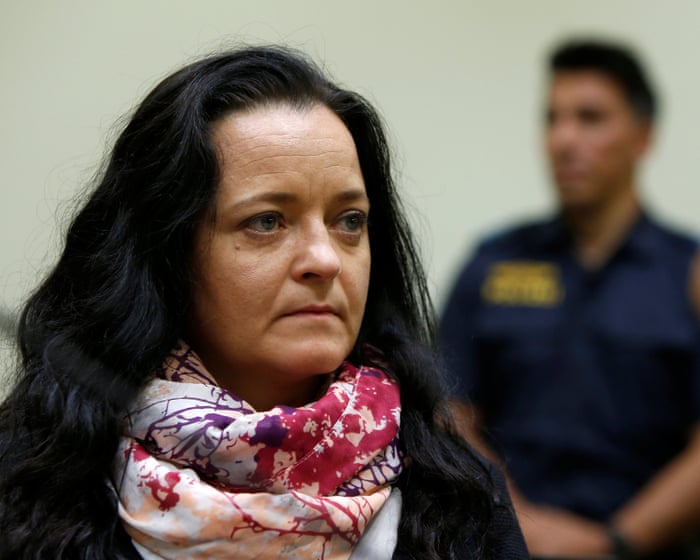
Now, in ongoing proceedings related to the NSU, Beate Zschäpe—sentenced to life in 2018 for her role in the NSU core cell responsible for ten murders—recently appeared in court as a witness in a related trial. This time, however, Zschäpe struck a markedly different tone than before: one of remorse, or at least something resembling it. She spoke of shame, of reconsideration, of recognizing her own guilt, which she claims only began during her own trial, which ended in 2018.
Back then, Zschäpe denied any involvement in the murders, and her cooperation with authorities was extremely limited. A full investigation would only have been possible with her truthful testimony, since her two accomplices, Uwe Mundlos and Uwe Bönhardt, had killed themselves in 2011 to evade arrest. Zschäpe had gone into hiding with the two men and lived with them under false identities in various German cities for over a decade. In court, she remained silent for years. Then, in a 53-page written testimony, she managed to avoid answering any of the 300 questions posed by the victims’ relatives, who appeared in court as co-plaintiffs. Instead, Zschäpe claimed she was never informed in advance about the murders and bomb attacks carried out by her two partners, saying she only found out about them afterward.
Now, the 50-year-old Zschäpe has appeared in court and spoken of how “ashamed” she is. Inevitably, one has to wonder whether this shift reflects a genuine moral transformation or a more pragmatic pivot made in the hope of improving her situation in prison. Last summer, she was admitted to a neo-Nazi exit program, alarming the victims’ relatives, as this could increase her chances of early release. In 2026, Zschäpe will have served 15 years in prison, the minimum for a life sentence. Due to the gravity of her crimes, she will not be released next year, but the court must set a so-called minimum term for her remaining imprisonment. Her participation in the exit program and her public display of contrition may influence the court’s decision.
“There is no excuse for the murders. I will never be able to make it right,” Zschäpe said in court earlier this month. Gamze Kubasik, whose father Mehmet Kubasik was shot in the head…On the day in court, a relative of a man murdered by the NSU in 2006 at his own kiosk shouted, “Then tell us the truth!” Zschäpe responded with only a silent look. This silence speaks louder than all the vague words of remorse she is now using in court. The performance of remorse has a tradition in Germany, a country that has confronted its historical crimes—or at least likes to believe it has. As a nation, it has learned that a mix of contrition and silence can pave the way back to social acceptance. The desire for atonement is not wrong in itself, but it becomes problematic when treated as a shortcut: when forgiveness is expected without any believable effort to earn it.
If Zschäpe sincerely wanted to distance herself from neo-Nazi ideology, she would help clarify the circumstances of the murders. She could still share information that many families are begging for, to understand what happened to their loved ones. But Zschäpe chooses silence. Her actions do not show she has become a different person; she only tries to sound like one. And perhaps that is the point about forgiveness: you do not have to forgive someone just because they ask—they have to earn it.
Frequently Asked Questions
FAQs Christmas Forgiveness and Saying Sorry
BeginnerLevel Questions
1 Why is Christmas often called a time for forgiveness
Christmas celebrates themes of peace goodwill and new beginnings inspired by the Christian story of grace and reconciliation Its a cultural and emotional reminder to mend relationships and let go of grudges as the year ends
2 Whats the difference between saying sorry and actually forgiving someone
Saying sorry is an apologyan acknowledgment of wrongdoing and an expression of regret Forgiveness is the responsea conscious decision by the hurt person to release resentment regardless of whether an apology was given One is an offer the other is a process
3 Is a simple sorry enough to fix things during the holidays
Often no A simple sorry can feel insincere or like a quick fix to avoid tension For minor issues it might suffice but for deeper hurts real forgiveness usually requires a more meaningful apology and changed behavior
4 What should a good apology include if sorry isnt enough
A sincere apology should be specific take full responsibility without excuses show empathy for how you hurt the other person and include a plan to make amends or change behavior in the future
5 Do I have to forgive someone just because its Christmas
No Forgiveness cannot be forced by a date on the calendar Christmas can be an inspiration to consider forgiveness but the process is personal and takes time You can choose peace for yourself without fully reconciling if the relationship is unsafe or unrepentant
Advanced Practical Questions
6 What if I say sorry but the other person isnt ready to forgive
You must respect their timeline A true apology is given without demanding forgiveness in return Your job is to sincerely apologize and demonstrate change through your actions their job is to heal at their own pace
7 How can I forgive someone who hasnt even apologized
This is often the hardest work You can forgive for your own peacereleasing the hold the anger has on youwithout the other persons involvement This is about internal freedom not necessarily reconciling the relationship