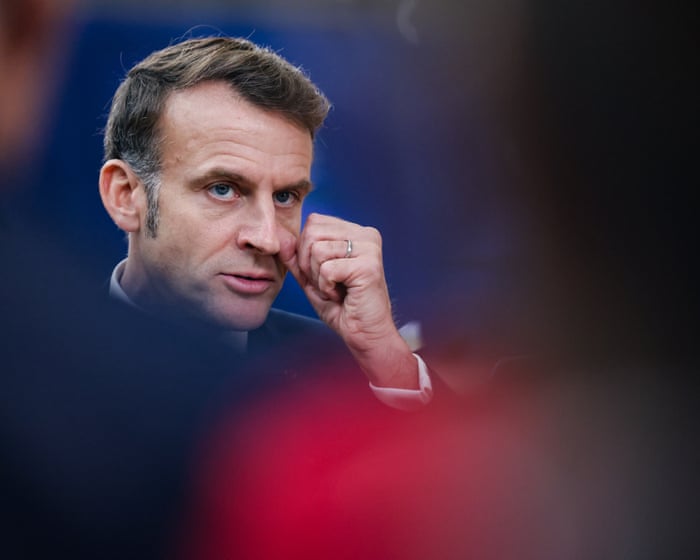
French President Emmanuel Macron and the European Union have accused the United States of “coercion and intimidation” after Washington imposed visa bans on five prominent European figures central to efforts to regulate American tech giants.
The bans, issued on Tuesday, target Thierry Breton, a former EU commissioner and key architect of the EU’s Digital Services Act (DSA), along with four anti-disinformation campaigners: Imran Ahmed, CEO of the U.S.-based Center for Countering Digital Hate; Anna-Lena von Hodenberg and Josephine Ballon of the German nonprofit HateAid; and Clare Melford, co-founder of the Global Disinformation Index.
U.S. Secretary of State Marco Rubio defended the move on social media, stating: “For far too long, ideologues in Europe have led organized efforts to coerce American platforms to punish American viewpoints they oppose. The Trump administration will no longer tolerate these egregious acts of extraterritorial censorship.”
While Washington views the DSA as a form of censorship, European leaders argue the regulations are necessary to control hate speech. The dispute risks escalating into a broader cultural and political clash between the Trump administration and Europe, with artificial intelligence and digital technologies emerging as a key battleground.
Macron strongly condemned the visa bans, writing: “These measures amount to intimidation and coercion aimed at undermining European digital sovereignty. The European Union’s digital regulations were adopted through a democratic and sovereign process. They apply within Europe to ensure fair competition and to make sure that what is illegal offline is also illegal online. The rules governing the EU’s digital space should not be determined outside Europe.”
French Foreign Minister Jean-Noël Barrot added: “The peoples of Europe are free and sovereign and cannot let the rules governing their digital space be imposed by others.”
Breton, who served as European commissioner for the internal market from 2019 to 2024, responded: “Is McCarthy’s witch-hunt back? As a reminder: 90% of the European Parliament—our democratically elected body—and all 27 member states unanimously voted for the DSA. To our American friends: censorship isn’t where you think it is.”
A European Commission spokesperson warned: “If needed, we will respond swiftly and decisively to defend our regulatory autonomy against unjustified measures.”
The EU maintains that its regulations aim to create a safer online environment by requiring tech giants to do more to tackle illegal content, such as hate speech and child sexual abuse material. Washington, however, claims the EU is imposing undue restrictions on freedom of expression and unfairly targeting U.S. tech companies and citizens.
Notably, Elon Musk’s X platform was recently fined €120 million by the EU for violating online content rules.
Breton has been succeeded in his EU role by another French politician, Stéphane Séjourné, who expressed solidarity with his predecessor: “No sanction will silence the sovereignty of the European peoples. Total solidarity with him and all the people of Europe affected by this.”
When announcing the bans, U.S. Under Secretary for Public Diplomacy Sarah Rogers described Breton as a “mastermind” of the DSA.
Germany’s justice minister also criticized the U.S. action, calling it an unacceptable attempt to influence European policymaking.The ministry stated that the two German activists had the government’s “support and solidarity” and that the visa bans were unacceptable, adding that HateAid assists individuals affected by illegal online hate speech.
“It is a misrepresentation of our constitutional system to label this as censorship,” the ministry said in a statement. “The rules we wish to govern digital spaces in Germany and Europe are not determined in Washington.”
Dennis Radtke, a German MEP from the ruling CDU party, commented: “Trump supporters in Europe defend this as a fight for free speech. But where exactly has an opinion been suppressed? Where is their advocacy for free speech concerning China and Russia? This is purely about business interests and undermining the rule of law.”
French socialist MEP Raphaël Glucksmann addressed Rubio in a message: “For too long, Europe has been hesitant to enforce its own laws and protect its interests. You have chosen to align with tyrants and challenge democracies. It is time for us to take a stand. You may kneel before Putin as much as you like—we now represent the free world.”
“We are not a colony of the United States. As Europeans, we must defend our laws, principles, and interests. This outrageous sanction against Thierry Breton honors his commitment to our sovereignty. We will carry on this fight together, to the very end.”
The dispute highlights ongoing tensions between the U.S. and Europe. In August, Washington sanctioned French judge Nicolas Yann Guillou, a member of the International Criminal Court, due to the court’s focus on Israeli leaders and a prior investigation into U.S. officials.
Michel Duclos, a former senior French diplomat and fellow at the Institut Montaigne think tank, criticized the move, referencing Russian envoy Kirill Dmitriev’s recent visit to Miami for discussions on the Ukraine war. He remarked: “Dmitriev celebrated in Miami, while Breton was denied a U.S. visa. Europe is becoming the new Russia in Washington’s eyes. This recalls the 1920s—when America favored its former enemy, Germany, over its allies—but now it’s even worse.”
Mika Beuster, chair of the German Journalists’ Association, voiced solidarity with Berlin-based HateAid. “This is censorship in its purest form, something we have previously only witnessed in autocratic regimes,” said Beuster.
Frequently Asked Questions
FAQs Macron EU Criticize US Visa Restrictions in Censorship Dispute
1 What is this dispute about in simple terms
Its about a disagreement between the US and some European countries mainly France over a US law that can deny visas to foreigners accused of supporting online censorship The EU and France argue the law is being used unfairly to target their tech experts and officials involved in content moderation
2 Who is Macron and why is he involved
Emmanuel Macron is the President of France He is involved because he along with other EU leaders is publicly criticizing the US policy arguing it harms transatlantic cooperation and unfairly punishes European citizens and officials
3 What US visa restrictions are they talking about
They are referring to a US law of the Immigration and Nationality Act that allows the US to deny visas to foreign individuals believed to have been involved in wrongful detention of US citizens or in serious violations of religious freedom The dispute centers on its application to those involved in content moderation policies that the US views as censorship
4 Why does the EU care about a US visa law
The EU cares because its citizensincluding lawmakers tech regulators and researcherscould be barred from entering the US for doing their jobs in Europe They see it as US overreach punishing allies for enforcing their own digital laws
5 What does this have to do with censorship
The US government particularly some lawmakers alleges that certain European laws and actions by tech platforms constitute improper censorship especially of American political speech The visa law is being used as a tool to pressure those the US deems responsible
6 Is this a new problem
The underlying tension over online content regulation and censorship accusations has been growing for years However the specific use of this visa law to target European officials in this context is a recent escalation bringing the dispute to a diplomatic level
7 What does the EU want the US to do
The EU wants the US to stop applying this visa law against European officials and experts involved in content moderation They