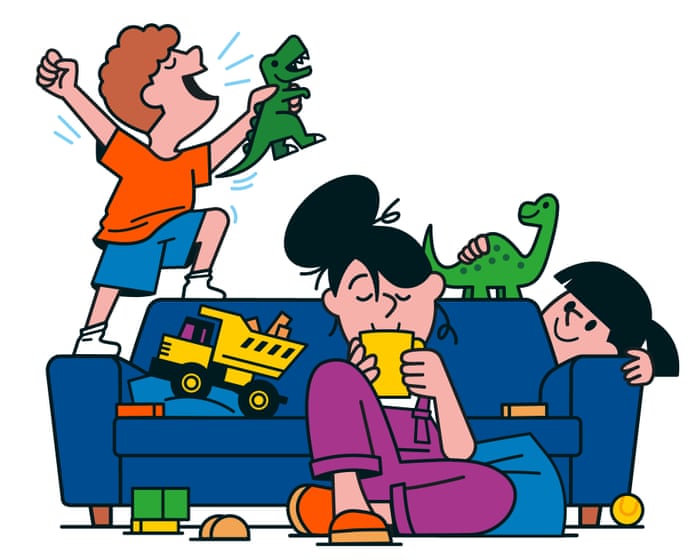
My four-year-old is in the living room playing with a dinosaur, a pig, and Jessie the cowgirl from Toy Story. I’m trying to cook dinner. “Mama, mama, pleeease can you play with me?” I hear a pot lid rattle. The broccoli is starting to smell burned; I dash back to the kitchen. “Help! Quickly come! I’m falling!” I rush through. She’s dangling from the sofa, pretending to fall off the side of a volcano. “HEEELP!” The broccoli is definitely burning. And then the door goes. “Muuuum, I need a poo!”
This wild five-minute ride is one most parents will recognize. Getting through the day can feel like you’re being pulled in a million directions—by turns defeated, happier than you’ve ever felt, completely drained, in control, or like you’re careening off a cliff. It forces you to get good at planning and prioritizing: knowing what to say yes to, when to say no, when to sit and play, and when to admit, “Sorry, I need to sit down or go for a run.”
Take the morning rush, for example—often a major friction point. Clothes need to go on, teeth need brushing, porridge needs eating, all while you’re trying to get ready for work. Tensions can fray quickly, especially on little sleep. Sarah Ockwell-Smith, a parenting expert known for her emphasis on attachment parenting, suggests preparing children mentally ahead of time. “Try in advance to think: ‘What can I do to make this easier for myself or my child?’”
Otherwise, she says, “We panic and everything gets rushed, and they dig their heels in and refuse to move. Then everybody’s in fight-or-flight mode.”
I think back to my own morning: cortisol spikes, check; stubborn child, check. Ockwell-Smith suggests a simple fix: “Put another hour into your day.” Easier said than done when you’ve had five hours of sleep, half of them with a foot in your face. “I know it’s insanely early, probably,” she says, “but you can have a really calm breakfast together. You play with each other for half an hour first… and then everything is slower and easier. Even though getting up earlier is horrendous, you’ll feel so much better.”
In some cases, having a routine can make tricky days easier. Dr. Martha Deiros Collado, a clinical psychologist whose books and social media advice emphasize connection over control in parenting, believes “a bit of routine that becomes predictable makes things smoother for everyone. We know kids do well with a routine.” But she stresses it doesn’t have to be elaborate. “It can be things like a rough wake-up time, rough timing for dinner and bedtime… these are non-negotiables.”
Sometimes, though, overplanning can actually make days more stressful, and Collado is clear about the “need to have a degree of flexibility embedded within a good routine.” A curveball—work, illness, a particularly bad night’s sleep—might mean you need to adapt. In those moments, she says, “You’ve got to accept that ‘good enough’ doesn’t mean doing it all. It means doing what you can when you can. On days when you’re in survival mode, appreciate that you met the basic requirements.”
Sometimes, though, it feels impossible to sort the must-dos from the nice-to-dos, or to tell good from good enough. This week, for instance, making spinach and ricotta cannelloni felt inexplicably urgent. The increasingly slimy kilogram of spinach in the fridge has been glaring at me accusingly every day, making my week—without exaggeration—25% more stressful than it needed to be. Honestly, it would have been a lovely win, but not doing it shouldn’t feel like failure.Collado encourages focusing on “actual needs” – such as feeding both your children and yourself, or getting the kids to school and yourself to work. In contrast, wants are “extras.” She uses the example of a planned outing: if it doesn’t feel right on the day, it’s okay to simply let it go. This may sound simple, but granting ourselves that permission could spare many parents from forcing situations that just don’t fit.
Child-friendly public spaces are a great help. One way to create a little breathing room is to take your kids to environments where they can interact with children of different ages and play independently, without requiring you to be a constant playmate. Elena Bridgers, a science writer specializing in motherhood and parenting in hunter-gatherer societies, believes we can learn a lot from these communities, as they represent the conditions in which our species evolved for much of its history. In such societies, child-rearing is a collective effort—the well-known “it takes a village” idea. To recreate some of that support, Bridgers recommends using child-friendly public spaces like parks. In winter, she used the indoor play area at a local McDonald’s, where her kids would play for hours with other children, allowing her to get work done.
Parenting often feels less pressured when we let go of rigid ideals about what we should be doing or the kind of parent we wish we were. Anyone who has felt guilty after seeing Instagram posts of mothers setting up elaborate play scenarios or craft tables knows this feeling. Bridgers offers reassurance: “Less is more,” she says. Research shows that children need sensitive, attentive caregiving and social stimulation like singing, reading, and playful interaction. But they don’t necessarily need you to play with them. Instead, she suggests involving them in daily tasks: if you have chores, give them a small job. This kind of engagement is beneficial for children’s learning and development, and there’s no evidence it’s any less valuable than playing Lego with them.
Setting boundaries is another important topic and can be key to avoiding exhaustion by mid-morning. While easier said than done, it helps to distinguish between fixed and flexible boundaries. Ockwell-Smith suggests asking yourself: “Why am I doing this? Does it really matter if they jump on the sofa?” Safety boundaries are non-negotiable, but others might be more flexible. For example, if a child wants to wear a Spider-Man suit to nursery, it might be easier to allow it. However, wearing it to a funeral is probably not appropriate. Collado uses routines like bedtimes, breakfast, and bath times as examples: “My kids don’t go to sleep at eight on the dot every night… sometimes it’s earlier if that’s what they need, and sometimes it’s later because they were watching Strictly.”
Parenting coach and mother-of-three Olivia Edwards recommends using language that gives children a sense of autonomy to help move things along. For instance: “I wonder how we can make sure we wrap this up and get to school on time?” or “What’s your plan for putting this away so we can come back to it later and go downstairs to get our shoes on?” This approach avoids the dynamic of simply ordering them to do something because you said so.
After moments of chaos, rupture, and repair…Language is essential in all aspects of parenting. Collado recommends using language that focuses on joining in. Instead of telling children you need to hurry to get to work, she suggests tapping into their motivation for emotion and playfulness. Try turning leaving the house into a shared project by asking, “How quickly can you grab your shoes? Can you get to the front door before me?” With older kids, she emphasizes making sure they feel heard through conversation and negotiation. For example, you might say, “Okay, you’re really tired. I get it. But I can’t leave you home alone, so you need to come with me to the shops—and you get to choose dinner tonight.”
Sometimes, however, situations feel impossible. Ockwell-Smith notes, “It would be really nice if we could tell people, ‘You can’t do it all.’ Our society isn’t set up for this. It feels hard because it is really bloody hard.” When quick tips aren’t enough, she recommends a “do the least harm” approach. In moments when both work demands and your child need you, ask yourself, “What causes the least harm?”
When things go wrong and days fall apart, the idea of rupture and repair can be healing. It helps rebuild connections with children and eases the guilt of using a tone you regret. For young children, Ockwell-Smith suggests apologizing, sharing a big hug, and playing together, as that’s how kids often reconnect. With older kids, it might mean scheduling a day to do something fun together, listen, and reconnect.
Beyond the emotional benefits of connection, Edwards points out that a connected child is more internally motivated to cooperate and less likely to resist or fight back.
To manage all this, it’s key to equip yourself with coping tools. Edwards highlights the importance of the nervous system, noting that it’s easy to become overwhelmed from a sensory perspective. She advises that if you find your patience running low or feel triggered by your child’s behavior, it’s a sign you need to prioritize time and space for yourself.
A little self-awareness goes a long way, Edwards adds. “Get good at recognizing your own warning signs, because we often don’t notice our own stress until it leads to complete dysregulation.” Staying hydrated helps, too. “Drinking cold water can work well for both adults and children. It helps calm the nervous system, slowing everything down when your heart starts racing.”
Collado is clear about the need for self-care: “Being a mother doesn’t mean you have to be a martyr. The idea of self-sacrifice is a societal myth that places unachievable pressure on mothers.” Research shows that children thrive when they see their parents as full human beings in their own right. And to be a full human, she says, “you need to do things that fill your cup.” She sometimes tells her daughters, “You know how you love playdates or little parties and have so much fun with your friends? Well, I need that too.””Friends? I need that too.” She says that modeling this behavior is really important.
But as Ockwell-Smith points out, self-care can easily turn into “just another thing we feel we’re failing at… like thinking, ‘I’m not a good mom because I don’t do enough self-care.'” Instead, she practices what she calls “self-kindness,” which “doesn’t require time, money, getting away from the kids, or doing something perfectly. It’s simply telling yourself, ‘This is hard because it really is hard—not because I’m a bad mom.'”
It’s about “treating yourself the way you would treat your children. So if you’ve had a bad day, you just say, ‘You know what? It’s just a bad day. This is really tough.'” It might sound simple, but being kind to yourself when you feel like you’re failing isn’t easy. “It’s about allowing yourself to make mistakes and accepting that you’re good enough.”
Frequently Asked Questions
FAQs The Perfect Day for Parents
Q What does a perfect day for parents even mean Isnt that impossible
A It doesnt mean a flawless stressfree day It means a day where you find a good balanceyour kids are engaged and content and you also carve out a little time for your own wellbeing even if its just 10 minutes
Q Whats the most important thing to focus on first
A Your own basic needs Think of the airplane oxygen mask rule you cant help your kids effectively if youre running on empty Prioritizing a bit of sleep hydration and a quick healthy snack for yourself sets a better tone for the whole day
Q How can I get my kids to cooperate in the morning without a fight
A Create a simple visual routine Give clear timed warnings Stay calm and consistentyour calmness is contagious Avoid power struggles by offering limited positive choices
Q I feel guilty taking time for myself Isnt that selfish
A No its essential Selfcare is not selfish its what refuels you to be a patient present parent Even small acts like reading a chapter of a book or taking a short walk count as vital recharging
Q What are some easy healthy meals that please both kids and adults
A Try buildyourown meals like taco bars baked potato bars or wholewheat pita pizzas You can also deconstruct mealsserve the components of a stirfry or salad separately so everyone can choose what they like
Q How do I handle screen time without constant arguments
A Set clear consistent limits before screens go on Use timers Create screenfree zonestimes Offer engaging alternatives like going outside a craft or a board game
Q My kids seem bored all the time How can I keep them happily occupied so I can get things done