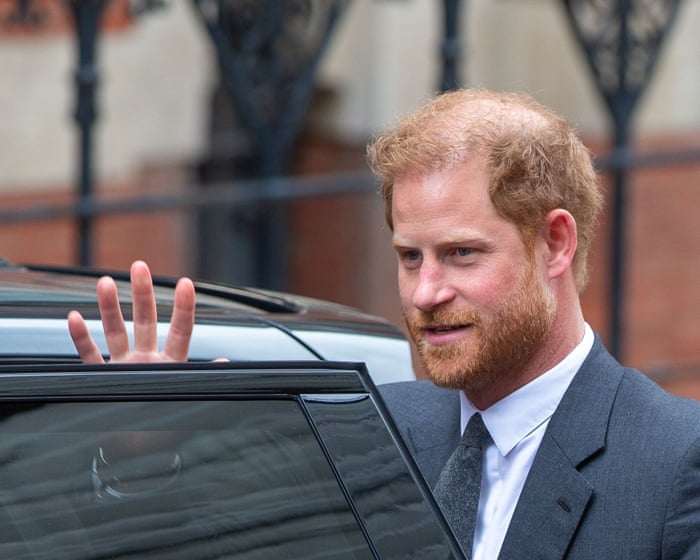
On Monday morning, Prince Harry’s long-running legal battle against the Daily Mail, one of the most powerful forces in British media, will finally go to trial at London’s High Court.
He is joined in the lawsuit by several prominent British figures: singer-songwriter Elton John and his husband David Furnish; actors Liz Hurley and Sadie Frost; Labour peer Doreen Lawrence, whose son Stephen was murdered in a racist attack; and former Liberal Democrat leadership candidate Simon Hughes.
Their opponent is the publisher of Britain’s bestselling newspaper, with its long-serving editor-in-chief, Paul Dacre, expected to testify.
The allegations against the Daily Mail and its sister paper, the Mail on Sunday, are serious. Harry and his fellow claimants accuse the newspapers not only of intercepting voicemails, but also of tapping landlines, bribing police officers, obtaining medical records through deception, and even bugging celebrities’ homes.
The publisher, Associated Newspapers, has called the claims “preposterous” and an “affront to the hard-working journalists whose reputations and integrity are wrongly traduced.”
The Prince vs. the Press
Harry’s anger toward the press runs deep. His mother, Diana, Princess of Wales, was killed in a 1997 car crash while being pursued by paparazzi in Paris. More recently, he has criticized the media’s treatment of his wife, Meghan, the Duchess of Sussex. In 2021, a judge ruled that the Mail on Sunday breached Meghan’s privacy by publishing part of a letter she wrote to her estranged father.
Taking on the tabloids has come at a personal and financial cost for Harry. For him, it is a matter of principle—one that may have contributed to the strain in his relationship with the royal family. In his memoir, Spare, he recalled that his ties with his father, King Charles, and brother, Prince William, grew tense over what he saw as their failure to confront alleged wrongdoing by journalists.
In 2019, during a holiday at Elton John’s villa in France, a conversation with barrister David Sherborne convinced Harry that newspapers should be held accountable in court for their past actions.
So far, his decision to challenge the press has been vindicated. In 2023, Harry became the first royal in over 130 years to testify in court, in a privacy case against the publisher of the Mirror. The judge ruled that the newspaper had hacked his phone “to a modest extent” between 2003 and 2009, awarding him £140,600 in damages.
Last year, his privacy claim against the publisher of the Sun and the now-defunct News of the World was settled out of court for an undisclosed sum, reportedly around £10 million. The publisher apologized for phone hacking at the News of the World and for “serious intrusion” into his private life by the Sun, including unlawful activities by private investigators.
However, Harry’s showdown with the Daily Mail—estimated to cost £38 million in legal fees for both sides—is expected to be fiercely contested. The trial, scheduled to last nine weeks, will likely bring a cast of characters with complicated pasts into the spotlight.
One key figure for Harry and his co-claimants is Graham Johnson, a former journalist who has been investigating alleged wrongdoing at the Mail titles since 2015 as part of a project once called “Operation Bluebird.” But Johnson is a controversial figure. In 2014, he pleaded guilty to phone hacking while working at another newspaper.In 2001, he received a suspended sentence for his actions at the Sunday Mirror. In his 2012 memoir, Hack, he reflected on his time working for tabloids, describing himself as a “professional liar” who regularly made up stories. However, he noted that in 2007, after reading a book on philosophy, he realized “how important it was to tell the truth” and decided to change his ways.
Last year, a private investigator considered central to the claimants’ legal action stated that his signature on an earlier witness statement was a “forgery.” Gavin Burrows, who has been linked to serious allegations of unlawful information gathering in the case, retracted his alleged confession, calling it “completely false.”
The Case of Lady Lawrence
In 1997, the Daily Mail ran one of the most memorable front pages in British newspaper history, featuring the five men suspected of killing Stephen Lawrence, an 18-year-old student murdered in a racist attack four years earlier in Eltham, south London. The headline read: “Murderers: The Mail accuses these men of killing. If we are wrong, let them sue us.” Two of the men, Gary Dobson and David Norris, were later convicted.
Stephen’s mother, Lady Lawrence, later wrote a piece for the newspaper expressing that she was “indebted” to it for using its considerable influence to support her quest for justice. However, in a BBC interview last year, she said she was “floored” when Prince Harry contacted her in 2022 with suspicions that she had been a victim of phone hacking and other unlawful information gathering by Daily Mail journalists.
“Why would anybody want to be listening to my calls, hacking into my phone?” she said. “All I’m trying to do over the years is to try to get justice for my son.”
Lady Lawrence’s legal claim includes perhaps the most explosive allegation: that the Daily Mail instructed private investigator Jonathan Rees to bug her and conduct covert surveillance. Rees often worked for the News of the World before its closure, though his credibility has long been debated—he was convicted in 1999 for perverting the course of justice after planting drugs in the car of a client’s estranged wife.
The Daily Mail has stated in its legal defense that it never used Rees’s services.
In a December episode of Channel 4’s Dispatches, Rees claimed he was aware of the alleged surveillance but was not involved. “They’re going to have to rethink that, and their legal team is going to have to rethink that,” he said.
When asked by reporter Cathy Newman if his comments “blow a hole” in the case against Associated Newspapers, Rees replied: “Not really, because it was done. All I can say to support that woman is: yes, I did hear about it; yes, I was invited to be part of the team; yes, I saw factual transcripts; I know it was going on; I know that surveillance teams were being used against her and her family. But I can’t provide any documentary evidence for that.”
Rees added that he believed the Daily Mail would have been “foolish” to ask private investigators to bug Lady Lawrence and likely made an “open request for information” about her family’s background. When asked if he thought the Daily Mail did anything illegal, Rees said: “No.” He is not expected to testify in the trial.
Lady Lawrence told ITV last week that she is “more determined than ever” to hold the Daily Mail accountable for its alleged wrongdoing. It is understood she will now rely on documents that appear to show payments made by the Daily Mail to other private investigators.Several articles about her were published in the newspaper at the time. In cases against other newspapers, some private investigators have been found to have unlawfully obtained information about public figures. Lawyers for the Daily Mail have denied the allegations, including that any payments relate to Lawrence.
As proceedings begin this week, some of those involved are surprised it has reached this stage. Lawrence said she had hoped the Daily Mail would settle her case to spare her the “stress of litigation.”
The claimants must now convince the judge, Mr Justice Nicklin, that the evidence they are relying on is reliable for their case. If they lose, they could be forced to pay the Mail’s substantial legal costs and have been warned by the judge that their insurance may not cover the full amount.
Meanwhile, the Mail faces the uncomfortable prospect of having 30 years of its journalistic practices scrutinized in court. Although it says it banned the use of private investigators in 2007, it will have to explain its past relationship with them under oath. In 2012, former editor Paul Dacre acknowledged there was a prima facie case that one investigator, Steve Whittamore, may have broken the law in his work for the newspaper.
Timing is another factor in the case. The claim was filed in October 2022; claimants have six years from discovering they may have been victims of unlawful activity to bring a privacy case. The Mail is expected to argue that the claim is too late. However, this could be seen as a hollow victory and is unlikely to be viewed favorably by the public.
For now, all sides are holding their ground. For Prince Harry, taking on the press over what he sees as a campaign against him and his family is worth the risks. The trial will place him, his co-claimants, and senior editors in the spotlight.
But with the investigative practices of both Prince Harry’s team and the Daily Mail about to be exposed in open court, regardless of the outcome, the question remains whether there can truly be any winners.
Frequently Asked Questions
Of course Here is a list of FAQs about Prince Harrys legal battle against the Daily Mail designed to be clear and accessible
Beginner Core Questions
1 What is this court case actually about
Prince Harry along with several other highprofile figures like Elton John and Elizabeth Hurley is suing the publisher of the Daily Mail and Mail on Sunday They allege the newspapers engaged in illegal informationgathering including phone hacking hiring private investigators to place listening devices and obtaining medical records
2 Who is Prince Harry suing exactly
He is suing Associated Newspapers Limited the parent company that publishes the Daily Mail Mail on Sunday and MailOnline
3 Why is this case such a big deal
Its a direct confrontation between a senior royal and a major media empire The outcome could expose decades of alleged wrongdoing force major changes in press practices and set a powerful legal precedent for privacy in the UK
4 Hasnt the phone hacking scandal already been dealt with
The earlier Leveson Inquiry and prosecutions focused mainly on the News of the World This case alleges similar illegal activities were widespread at the Daily Mail titles which the publisher has always strongly denied
5 What does Prince Harry want to achieve
He seeks financial damages but more importantly a court judgment that proves unlawful activity took place He has stated his goal is to hold the owners of the Daily Mail and the Mail on Sunday accountable for their vile and entirely illegal acts
Advanced Contextual Questions
6 What specific allegations are in this case
The claimants allege a range of illegal activities from the 1990s to 2011 including intercepting voicemails bugging homes and cars obtaining phone records through deception and accessing confidential medical and financial documents
7 How is this different from his other lawsuits
Harry is involved in multiple cases This one is distinct from his separate libel cases against the Mail on Sunday or his ongoing claim against the publisher of the Sun for phone hacking This illegal informationgathering case is broader covering a wider range of alleged offences