Sad news from Tottenham this week: Ryan Norys’s talk at the South by Southwest festival on Friday has been canceled. The club’s chief revenue officer, who has driven a 40% increase in commercial revenue over the past three years, was scheduled to speak on “how Tottenham is evolving beyond football to become a global cultural brand.” Given the wealth of cultural content Spurs have provided the world in recent weeks, you’d have to call the initiative a stunning success.
Unfortunately, when Norys promoted the event on his LinkedIn page this week, Spurs fans erupted in anger, forcing the talk to be called off. Thankfully, anyone still curious about how Tottenham is evolving beyond football can simply watch their recent performances on the pitch. Igor Tudor’s Tottenham Hotspur: proudly evolving beyond defending. Beyond possession. Beyond goalkeeping. Beyond tactics, beyond teamwork, beyond competence, beyond the basic human ability to stand upright. And—who knows?—perhaps even beyond the Premier League.
Already, journeyman forwards in the Championship are licking their lips in anticipation. Carlton Morris has the fixture circled in his diary. Scott Twine can’t wait for preseason. Jay Stansfield has put down a deposit on a new kitchen. Lincoln fans—now top of League One—are singing: “Tottenham away, olé, olé.” Prediction models estimate about a 20% chance of relegation, the bookmakers roughly double that, and the Spurs fans who actually watch them put it at double again. The club that once fired Harry Redknapp for finishing fourth has taken just 12 points from its last 20 games, and the sucking sound you hear is water circling the drain.
After four defeats in his first four games, Tudor has paid the ultimate price: being forced to keep his job. Frankly, the cantankerous and thoroughly inadequate Tudor is the manager Spurs truly deserve right now—the logical outcome of a grand self-immolation strategy perhaps eight years in the making. A strategy in which Tottenham built one of the most impressive commercial operations in professional sport while forgetting every single thing that makes professional sport worth watching.
Go to a game at the Tottenham Hotspur Stadium—and you probably can, since plenty of tickets are available—and what strikes you is how much you’re encouraged to watch something else. The electronic hoardings flash ads for the stadium’s many other attractions: the Skywalk, rugby, American football, a Bad Bunny concert in June. For longtime fans who went to the old White Hart Lane, who trekked to Wembley and Milton Keynes, it sends a subtle message: you may think this is your home. But it’s not, not really.
And of course, this is also the wildly successful financial model that underpins modern Tottenham—the model that paid for Tanguy Ndombele and Xavi Simons, that propelled them into the Deloitte Money League top 10, that secured two decades of comfort and earned them a seat at the ill-fated Super League table. In that context, a Tottenham relegation could rank as the single most spectacular failure in English football history: the 90-yard own goal, the Theresa May snap election, the Devon Loch of high performance.
Igor Tudor is the latest Spurs manager unable to halt the club’s decline since Mauricio Pochettino was sacked.
Which is why—with sincere apologies to Spurs fans still in a state of glazed shock—it really needs to happen. Simply put, there must be accountability for failure if sport is to mean anything. Perhaps in years to come, “doing a Tottenham” will take on a mythical horror in boardrooms—the cautionary tale, the macabre bedtime story CEOs tell their assistants at night. Except this is no fairy tale. It is, conve…In a way, this is what happens when you stop believing in magic.
Of course, poor management behind the scenes plays a part. Look at the disastrous recruitment from around 2016 to 2022. During those years, Tottenham kept the wage bill relatively low while still performing well on the pitch, which fed the dangerous illusion that the team would simply take care of itself. Can you name a single, undeniably successful signing Spurs have made in the last ten years? Perhaps Lucas Bergvall? Maybe Micky van de Ven or Pedro Porro? All the while, the great team Mauricio Pochettino built was slowly dismantled. Players like Harry Kane, Son Heung-min, and Eric Dier were never truly replaced, either in quality or in their connection to the club. They were not just great players; they loved the club and formed a vital link between the team and the fans.
Despite the efforts of Johan Lange, this is still a squad full of talent: World Cup winners, sought-after stars, and experienced internationals in every position. What’s fascinating about the current team is how even very good players depend on a supportive environment, a strong culture, confidence, and a clear playing style. And that’s where the managers come in. Since Pochettino, there have been about five permanent managers, each of whom, in their own way, drained a little more life from the club.
Maybe Pochettino’s team was always destined for an overhaul. But replacing him with José Mourinho in 2019 was like performing surgery with pliers and a blowtorch—it scorched an entire philosophy in favor of reactive, defensive football. Then came the limited Nuno Espírito Santo, the condescending Antonio Conte, a brief spell of Cristian Stellini’s quackery, and finally the Ange Postecoglou travelling circus.
While they all had different tactics, they shared a common refrain, a rehearsed litany of excuses that went something like this: “I am a winner. You, however, are losers. Losing is in your DNA, ingrained in the fanbase and baked into the very walls. I’ve tried everything, but you are hopeless losers. If you lose under me, it’s not my fault.”
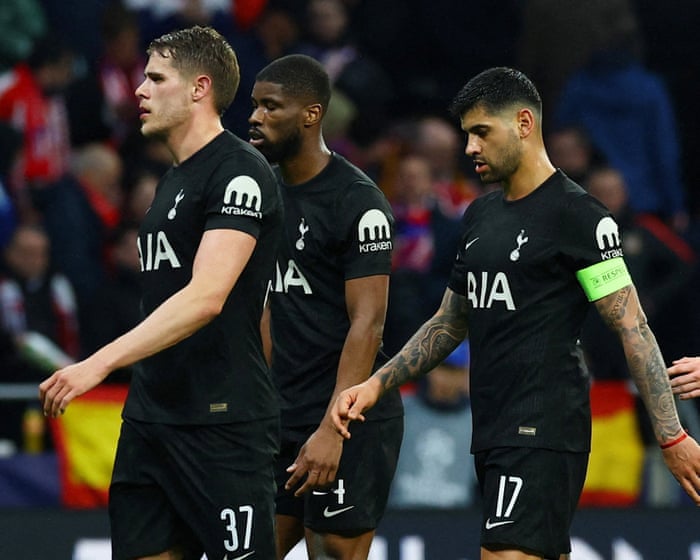
Nearly every Spurs manager since Pochettino has walked this path eventually. And maybe it’s true! But perhaps it’s no surprise that a squad constantly told it’s steeped in a culture of failure eventually starts to play like it. That was the paralysis on display against Atlético Madrid—elite footballers seemingly hypnotized by suggestion, stripped of basic competence, barely able to kick a ball without stumbling.
Conte and Postecoglou briefly overcame this with their brilliant communication and clear football ideas. Thomas Frank, by contrast, had no discernible style or identity; he projected an illusion of extreme competence largely based on having good hair. There’s a certain irony in Frank failing so utterly in a league that has, in many ways, tried to copy Brentford. But it also highlights how football teams, no matter how chaotic, can still function on the basis of an idea, a founding myth.
Manchester United keep bouncing back because, on some level, they still believe in their own magic. Chelsea are the most foolish world champions in history. The tragically clumsy Barcelona are on track for back-to-back titles. For years, some of the world’s biggest clubs have been locked in a battle between wealth and foolishness, and somehow, wealth keeps winning. Maybe it’s time for foolishness to triumph for once.
And in the long run, perhaps relegation is what Spurs need, too. Surely that’s better than a Sean Dyche-flavored quick fix—a shrill, short-term scream that would condemn them to being Everton for the next decade.What they need is a reset, a dose of humility, a trip to Lincoln to remember why football truly matters. Not a digital marketing plan or a commercial safety net, but a ritual and a rite—football for the sheer joy of it, players playing for the love of the game. Sometimes the darkest night comes just before the dawn.
Do you have thoughts on the issues raised here? If you would like to send a response of up to 300 words by email for possible publication in our letters section, please click here.
Frequently Asked Questions
Of course Here is a list of FAQs about the provocative idea that Tottenham Hotspur might need to face relegation for a longterm reset
FAQs The Grim Tale of Tottenham Relegation
Beginner Definition Questions
1 What does this even mean Why would a big club like Tottenham need relegation
This is a hypothetical drastic argument It suggests that the clubs cycle of underachievement and repeated disappointments is so ingrained that only a major shock to the systemlike dropping to a lower divisioncould force a complete rebuild from the ground up clearing out deeprooted issues
2 Has a big Premier League club ever been relegated and come back stronger
Yes The most famous recent example is Leicester City They were relegated in 2004 rebuilt with a clear strategy won promotion and later famously won the Premier League in 2016 While not a perfect parallel it shows a reset can work
3 Isnt this just a massive overreaction from frustrated fans
For many yes Its an emotional response to cycles of hope and disappointment However the argument is presented as a serious if extreme critique of the clubs sporting culture and decisionmaking over many years
Advanced Practical Questions
4 What specific grim problems would relegation supposedly solve
Proponents argue it could
Break a soft culture Force out players not fully committed and reset wage expectations
Clear financial deadwood End costly contracts for underperforming players
Reset fan expectations Build a new unified identity from a position of humility
Force a true football philosophy Allow a manager to build a team and style over time in a less pressurized environment
5 What are the huge obvious risks of this happening
The risks are enormous
Financial Catastrophe Loss of over 100 million in Premier League TV revenue
Player Exodus All top talent would leave making the rebuild even harder
No Guarantee of Return The Championship is a brutal physical league promotion is never assured
LongTerm Damage Global brand appeal sponsorship and stadium revenue would suffer massively