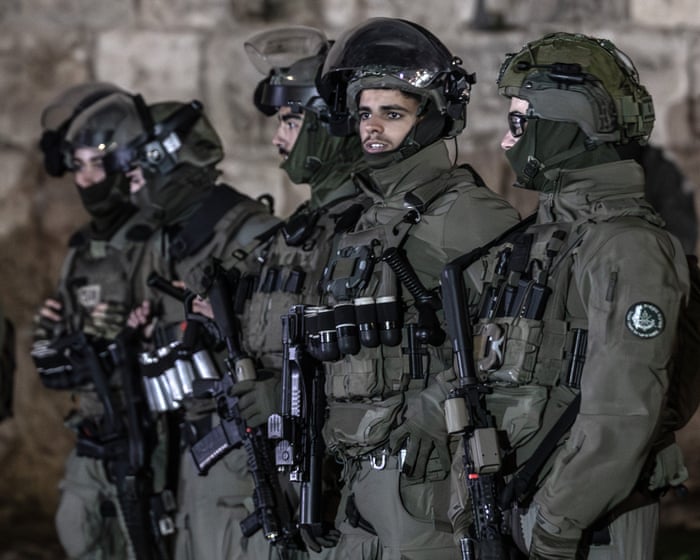
For the first time since 1967, Jerusalem’s most sensitive holy site, the al-Aqsa mosque, was closed at the end of Ramadan on Friday. Tensions rose among Palestinians as Israeli authorities kept the complex shut, forcing worshippers to hold Eid prayers as close as possible to the sealed site.
Hundreds of worshippers were forced to pray outside the Old City on Friday morning, with Israeli police barricading the entrances. Israeli authorities had effectively sealed off the mosque complex to most Muslim worshippers during Ramadan since February 28, citing security concerns related to the confrontation between the US, Israel, and Iran. Officials framed this as a security measure, leaving thousands of Palestinians to gather and pray outside the gates instead.
However, Palestinians say the move is part of a broader Israeli strategy to use security tensions to tighten restrictions and entrench control over the al-Aqsa mosque complex, known to Muslims as al-Haram al-Sharif, which also includes the seventh-century Dome of the Rock shrine. To Jews, it is the Temple Mount, the site of the First and Second Temples from the 10th century BC, destroyed by the Romans in AD 70.
“Tomorrow will be the saddest day for Muslim worshippers in Jerusalem,” said Hazen Bulbul, a 48-year-old resident who has marked the end of Ramadan at al-Aqsa since childhood. “What I fear is that this sets a dangerous precedent. It may be the first time, but probably not the last. Israeli interference in the holy city has been escalating since October 7,” he added, referring to the Hamas attack on Israel and the subsequent war in Gaza.
In recent months, there has been a sharp increase in arrests of Palestinian worshippers and religious staff in the Old City, alongside repeated incursions into the complex by Israeli settlers. Police have detained individuals inside the mosque precinct, including during prayer times, and restricted access for many Palestinians seeking to enter.
The Old City, usually crowded with Palestinians in the days leading up to Eid, was largely deserted on Friday, with streets unusually quiet. Palestinian shopkeepers were barred from opening most businesses, with only pharmacies and essential food shops allowed to operate. Traders said the measures had pushed them into acute economic hardship. Around 6 a.m., Israeli forces blocked worshippers from entering the Old City through Herod’s Gate, deploying what appeared to be stun grenades to disperse the crowd.
Sheikh Ekrima Sabri, the preacher of al-Aqsa and former grand mufti of Jerusalem, issued a religious ruling urging Muslims to perform Eid prayers at the closest possible point to the mosque. With a heavy security presence in the alleys of the Old City, and Israeli forces carrying out searches and confronting residents, many fear that tensions over the mosque’s closure on the final day of Ramadan could escalate into clashes with police.
The closure has drawn condemnation from the Arab League, which described it as a “blatant violation of international law” and said it risked undermining freedom of worship and inflaming tensions across the region. The Organisation of Islamic Cooperation, the League of Arab States, and the African Union Commission have also expressed strong condemnation for the closure of al-Aqsa mosque to Muslim worshippers, “especially during the blessed month of Ramadan.”
In a joint statement, they said the closure “constitutes a grave violation of the existing historical and legal status quo in the Islamic and Christian holy sites in the occupied city of Jerusalem, an assault on the established religious rights and freedoms of the Palestinian people, and a provocation to the feelings of Muslims worldwide.”The statement condemns these actions as “a blatant assault on the Islamic heritage of the nation, a provocation to the feelings of Muslims worldwide, and a violation of the freedom of worship and the sanctity of holy places.”
It holds Israel, as the occupying power, “fully responsible for the consequences of these illegal and provocative measures,” warning that their continuation “risks an escalation of violence and tension and threatens to undermine regional and international peace and security.”
Palestinians gathered outside the Old City walls to pray in protest of the closure of the Al-Aqsa Mosque.
Khalil Assali, from the media unit in the president’s office at Al-Quds University, described the mosque’s closure as “a catastrophe for Palestinians.” He added, “When Israelis see young Palestinians trying to pray at the closest point to Al-Aqsa Mosque, they run after them and kick them out while they are praying.”
Sorrow and Joy in the Ruins of Gaza
Meanwhile, in Gaza, a deepening humanitarian crisis continues, overshadowed by the wider war. Israeli bombardments, though more sporadic, have not ceased, as hundreds of thousands of Muslims prepare to mark the end of Ramadan amid the ruins of wrecked cities.
Gaza experiences Eid as a place of stark contrasts—sorrow and fleeting joy, hunger and celebration, grief and the fragile resilience of daily life—where the sound of bombardment now mingles with celebrations marking Ramadan’s end.
“The joy of Eid is incomplete,” said Sadeeqa Omar, 32, a mother of two displaced from northern Gaza to Deir al-Balah. “Each of us carries our own burdens. Some have lost their homes, others have lost family members. My husband is far away and cannot return due to the closure of the crossings. Still, we try to follow our religious teachings, which encourage us to show joy during Eid.”
“In the first year of the war, during Ramadan, we were displaced from al-Qarara,” said Alaa Al-Farra, 49, from Khan Younis. “This Eid will not be very different from previous ones, as our movement remains limited due to sudden daily airstrikes.”
After months of war, traces of tradition have cautiously returned. In crowded camps, the scent of pastries drifted from makeshift ovens fueled by scraps, as families tried to recreate rituals many children have never known. Markets glowed with sweets and colors, but for many, these remained out of reach—hands hovered then retreated, as parents settled for the smallest offerings to grant a momentary sense of festivity.
On Thursday, for the first time since strikes on Iran, the Rafah border crossing in southern Gaza reopened, allowing some UN convoys in. Yet Eid’s joy is unevenly felt.
“Of course, there is a relative sense of safety after the ceasefire, but it is not enough,” said Kholoud Baba, 42, from Gaza City. “Just last week, an area near our home in western Gaza was evacuated in preparation for an airstrike. This happened close to Iftar time, forcing displaced people to leave without taking anything with them.”
Behind the subdued celebrations lies a landscape of loss: mothers mourning children killed in recent strikes, and others marking the holiday in silence, stripped of its rituals, navigating Eid with little more than memory.
Frequently Asked Questions
Of course Here is a list of FAQs about the closure of the AlAqsa Mosque on Eid designed to be clear and helpful for a range of readers
General Understanding
Q1 What is the AlAqsa Mosque and why is it so important
A AlAqsa Mosque is one of the holiest sites in Islam located in Jerusalems Old City Its the entire compound containing the Dome of the Rock and the silverdomed mosque itself Muslims believe the Prophet Muhammad traveled here during the Night Journey making it the third holiest site after Mecca and Medina
Q2 What is Eid and why is it significant to pray at AlAqsa on this day
A Eid is a major Islamic holiday marking a celebration and a time for communal prayer Praying at AlAqsa on Eid is considered a highly virtuous act amplifying the joy and spiritual significance of the day for Muslims especially those in Palestine and around the world
About the Specific Closure
Q3 Why was AlAqsa Mosque closed on Eid
A Typically closures are ordered by Israeli authorities citing security concerns or tensions often around Palestinian protests or clashes The specific reason can vary per incident but usually relates to maintaining public order which worshippers often view as a restriction on their religious freedom
Q4 Who has the authority to close AlAqsa
A While the Islamic Waqf administers the sites religious affairs Israel as the occupying power in East Jerusalem controls security and access Israeli police can impose age restrictions close gates or shut down the entire compound
Q5 How often does this happen
A While not every Eid closures or severe access restrictions have occurred several times in recent years particularly during periods of heightened political tension or conflict
Impact and Reactions
Q6 How does this closure affect Muslim worshippers
A It causes profound sadness anger and a sense of injustice For many it feels like a direct infringement on their fundamental right to practice their religion at one of its most sacred times and locations It turns a day of celebration into one of mourning and protest