In 1988, at age 20, Wolfgang Tillmans tore an A0 poster from a construction site hoarding and nailed it to his apartment wall in Hamburg. It advertised the Pet Shop Boys’ new album, Introspective, and featured thick vertical bars in different colors. “It was just so cool in the context of the time,” the artist recalls, admiring how the pop group had gone “one level more abstract.”
Around the same time in Doncaster, teenager Alasdair McLellan—now an A-list fashion photographer—was captivated by the style of Pet Shop Boys keyboardist Chris Lowe. He took note of details like the cap, striped T-shirt, and Issey Miyake glasses on the cover of their single Suburbia. “I always thought he was the best-dressed man of the ’80s,” McLellan says. “Obviously, he just stood there playing the keyboard, and I always noticed what he was wearing, especially all that sportswear. He just seemed to do it better than everyone else.” Unable to access style magazines in his village, McLellan’s visual education came from pop music and the music press. “I got into photography through album covers, Smash Hits, and NME.”
Both men eventually photographed and made videos for the Pet Shop Boys: Tillmans created a video for Home and Dry in 2002, and McLellan directed one for Loneliness 22 years later. Their work, along with the early visuals that inspired them, is collected in a new 600-page book titled Pet Shop Boys: Volume. Billed as a “complete visual record” spanning over 40 years, it brings together the record sleeves, music videos, and concert imagery that have been as integral to the band’s appeal as their music.
Lowe and singer Neil Tennant are discussing their bright orange doorstopper of a book at a table in the corner of the London restaurant Toklas. Coincidentally, we’re seated beneath a Tillmans photograph of fruit and vegetables arranged by a swimming pool. “We’ve always taken joy in packaging and considered it part of the creative statement,” Tennant says, ordering a carafe of white wine. “I won’t say Gesamtkunstwerk, but…”
“Go on, Neil, say it,” Lowe teases. “I know you like saying it.”
Gesamtkunstwerk is the term Wagner popularized, meaning “total work of art,” where sound and visuals merge into an overwhelming whole—and the Pet Shop Boys were ideally positioned to elevate pop in this way. When they began making records in the mid-80s, the music industry was flush with cash thanks to the introduction of the CD, which inspired many fans to repurchase their favorite albums in the new hi-fidelity format. “Record companies were making money hand over fist and had budgets to throw around,” recalls Mark Farrow, whose company has designed the vast majority of the Pet Shop Boys’ visual output. “It was great!”
Back then, the group’s singles were released in multiple physical formats: a CD single, cassette single, 7-inch vinyl, and often two 12-inch singles. “Mark used to love it because you could do variations on a theme,” Tennant says. Take the sleeve for the 12-inch remix of It’s a Sin, which features a close-up of the keys and chains worn by Lowe—who plays the jailer leading Tennant to be burned at the stake in the track’s Derek Jarman-directed video. Meanwhile, the 12-inch remix of 1989’s It’s Alright is fluorescent pink on one side and green on the other. “Minimalism in color,” Farrow notes.
“I like fluoro,” Lowe says. “i-D magazine in the ’80s was always fluoro. And that was an era I really liked—all that street fashion.”
“I’ve still got issue two, when it was like a fanzine,” adds Tennant, a former assistant edBefore becoming a pop star, he was the editor of Smash Hits. He shares a theory that the magazines thriving in print’s decline are those stapled, not bound with spines: “The New Yorker, The Spectator, The Atlantic. A stapled magazine opens invitingly, while a perfect-bound one instinctively wants to close.”
“Nothing to do with the content, then?” asks Lowe.
Pet Shop Boys first met designer Mark Farrow early in their career, when they were managed by Tom Watkins. “He arrived in the office from Manchester,” says Tennant (from Newcastle), while Lowe is from Blackpool. “We were northerners. The rest of the office was basically full of southern gays. We immediately got on with him.” Farrow’s first sleeve for them was a remix of “West End Girls,” their first No. 1. His second, for “Love Comes Quickly,” had no text on the front—just a close-up of Lowe in a cap with the word “Boy.” It sounds uncommercial, but Pet Shop Boys always had a trump card. “We had in our contract: total artistic control,” Lowe says. “So we could do whatever we wanted.”
The original concept for their debut album, Please, had been designed by Watkins. Tennant recalls it as “a piece of paper engineering with 64 separate flaps. It was ridiculous—it took me half an hour to get the record out.” Farrow designed a cover that took the opposite approach: largely white space, with miniature typography and a tiny picture of Tennant and Lowe’s faces in the middle. “It looked outrageous in 1986,” Tennant says, noting that many sleeves then were either brash or poorly designed. “Even Tom had to admit it was really good.”
This minimalism matched their performance style. Despite their energetic hits, Pet Shop Boys would barely move on shows like Top of the Pops. “I think Tom said something like, ‘Oh God, they don’t do anything,'” says Lowe, who has been reading his late manager’s autobiography, Let’s Make Lots of Money (named after the subtitle of their song “Opportunities”).
“There was general panic,” Tennant agrees. “But we had no performance experience, and we were trying not to look showbiz. We didn’t bend to other people’s way of doing things. For our first TV performance of ‘West End Girls’ in Germany, they put about 300 teddy bears around us and two dancers pretending to be prostitutes. Since it was too late to change it, we simply ignored them.”
They maintained this ethos. In 1987, performing “Rent” at the Royal Variety Performance—with Lowe in a dramatic inflatable Issey Miyake jacket—they caused a stir by refusing to wave at the Queen and Prince Philip at the end. “It had a revolving stage,” Tennant says. “You stand there at the end, it goes round and you wave. We don’t wave. It looks lame. So we just didn’t turn up for the finale. Live television is easy. They can’t do anything. Our mothers were both furious. It was the first time our parents met, actually, backstage, and they were united in fury.”
Carry On star Barbara Windsor, who appeared in their musical film It Couldn’t Happen Here, wasn’t happy either. “She slapped our bottoms,” Tennant says. “She said, ‘You’re very naughty, boys. You should have done the finale.'”
“It’s one of those things I just can’t do,” Lowe says. “You know at the beginning of Who Wants to Be a Millionaire? They’re all doing that”—he waves—”If I were on, the director would be like, ‘Cut! Cut!'”
“Well, you see,” says Tennant.”The director would prefer it if you didn’t wave, because he’d say, ‘Oh, that’s so Pet Shop Boys.'”
Along with their refusal to be overly friendly, Pet Shop Boys also didn’t sell sex—or at least, not obviously. “You don’t think we were very sexual?” asks Lowe, pretending to be offended. One exception was in 1994, when Tennant decided to come out in a cover feature for the British gay lifestyle magazine Attitude. Before that, Pet Shop Boys had avoided labeling their sexualities. “I had this pleated Issey Miyake shirt,” Tennant says. “I decided to undo it in an inviting way, because I’ve got a slightly hairy chest. And actually, the picture’s great.”
“Did you get a lot of offers?” Lowe asks.
“I don’t know if I did, actually,” Tennant replies. “Well, I was in a relationship. It was quite fun doing that. But we haven’t done sexy that often.”
The video for their 1990 single “Being Boring” was another example: directed by photographer Bruce Weber, it horrified the record company by opening with a naked man bouncing on a trampoline. “We were basically told off,” Tennant says. “I remember saying, ‘The Chart Show [a pop video program] only shows the middle bit, so they won’t show the guy jumping naked at the beginning, and you won’t see the couple at the end. So what’s the problem? This is the era of Bruce Weber’s Calvin Klein underwear ads. It’s mass culture. It’s not some weird, sleazy thing we’re doing.'”
They were recently shocked to discover, about 35 years later, that the video had been censored. “We had a sample DVD of Smash, our singles compilation, and I loyally flicked through the whole thing,” Tennant says. “‘Being Boring’ starts with Bruce Weber’s lettering over a plain background. EMI America had edited out the naked guy.”
Were they expressing what would now be called a queer sensibility? “Someone recently said we were queer trailblazers,” Tennant says. “We want to do a T-shirt: queer trailblazer. We went through the late ’80s totally undefined. That word sounds quite liberating, doesn’t it? Now everything is completely defined. In fact, it’s frowned upon not to be defined.” Ambiguity and complexity, he says, are key to Pet Shop Boys. “They are at the very core of the culture. Always.”
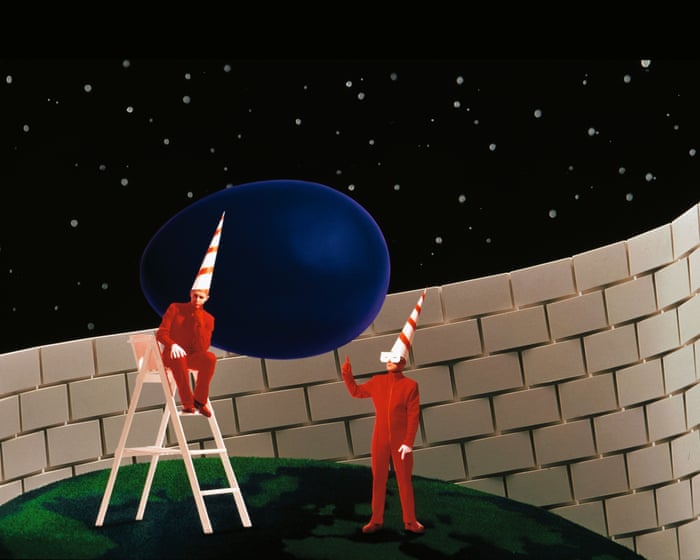
One reason their work has earned lasting respect is that, while always proudly pop, it hasn’t been afraid to be awkward. In the ’90s, they had periods of wearing odd costumes, like the orange suits and dunces’ hats they wore to promote their single “Can You Forgive Her?” “Our manager was worried that we would be ridiculed,” Tennant says. “But I always remember Adam Ant’s great line, ‘Ridicule is nothing to be scared of.’ We wanted to sidestep the pop-star thing. Also, that was a reaction to aging and maybe feeling insecure. In 1993, I was about to be 40.”
“That young!” Lowe says. He is 66, Tennant now 71.
“Well, of course, being middle-aged is much worse than being old,” Tennant says.
Perhaps Pet Shop Boys’ most unconventional moment is Tillmans’ video for “Home and Dry,” which consists almost entirely of grainy footage of mice filmed at Tottenham Court Road tube station in London. “As much as I love their detached aesthetic, I wanted to bring a matter-of-factness to the mix,” Tillmans says. “It is so good to work with them because they mean what they say. When I delivered it and the record company said, ‘This is not a video,’ they stood by it.””Was he expecting us to change it?” Lowe asks. “Like, ‘What is this? Go away and make a proper video!'”
“I thought it was cute,” Tennant says. “The typical move would have been to accept it and then just make a conventional video, but I think we like that we never take the easy way. You always have to work at liking Pet Shop Boys because we do a lot of things to put you off.”
One thing that reliably pleases crowds is their greatest hits tour, Dreamworld. It began in May 2022, has played everywhere from global festivals to London’s Royal Opera House, and shows no sign of stopping; there are another ten dates this summer. “It’s going on forever,” says Lowe, laughing. “Get used to it.”
“It’s a bit like having a successful musical,” Tennant says. “Some people come to see Dreamworld who wouldn’t normally go to a Pet Shop Boys show, and as it continues, we often play bigger venues. It’s great to have something with broader appeal where we haven’t compromised at all in how it’s presented. We come out wearing masks, stand completely still, and the audience just has to deal with it.”
Its ultimate draw, of course, is Pet Shop Boys’ arsenal of massive hits, but those will be missing from a series of five gigs they’re putting on this week at London’s Electric Ballroom. Since they’ll only be playing B-sides and album tracks, they’re calling the shows Obscure. Aimed at hardcore fans, they say it’s partly to promote their book, Volume. “One motivation was that we wouldn’t have to do book signings,” Tennant says. “I find them too weird. A bit unnerving.”
“Although we have signed a lot of books,” adds Lowe.
They’ve rehearsed 35 songs in total and will play 24 each night, with the setlist and intro music changing. Lowe selected the songs from a playlist he made of tracks he wanted to perform live.
“It lasted five and a half hours,” Tennant says.
“Only four hours and 42 minutes,” Lowe corrects, checking the playlist on his Spotify. “And Neil said, ‘You can’t do a concert that long.’ So then we went through the list. Neil added a couple.”
“As a special treat, I was allowed to add a couple,” Tennant smiles. “If we played this show to a mass audience at the Uber Arena in Berlin, I think a lot of people would just spend the whole time at the bar. But I’m hoping at the Electric Ballroom they won’t.”
Tennant wants to make a final point before they leave. “There’s a tendency to assume everything we do is carefully thought out and planned,” he says. “But actually, it’s much more improvised and instinctive.”
He gets the bill, and they head out of the restaurant, coincidentally bumping into—and getting kissed by—another legend behind iconic record sleeves: Peter Saville, designer for New Order. “Don’t tell Mark Farrow,” chuckles Lowe.
Pet Shop Boys: Volume is published by Thames & Hudson on April 7. Obscure is at the Electric Ballroom, London, April 6–10. Dreamworld continues at the Medimex festival in Taranto, Italy, on June 20.
Frequently Asked Questions
FAQs Pet Shop Boys Barbara Windsor smacked our bottoms
BeginnerLevel Questions
What is the Barbara Windsor smacked our bottoms story about
Its a famous funny anecdote from the Pet Shop Boys They were recording a TV show in the 1980s when the actress Barbara Windsor playfully smacked their bottoms as a joke which shocked the more conservative TV bosses
Who are the Pet Shop Boys
They are an iconic English synthpop duo formed by Neil Tennant and Chris Lowe known for their intelligent lyrics catchy electronic music and groundbreaking visual style
Why are their visuals considered stunning
From the start they worked with top designers and directors using bold costumes theatrical staging and innovative music videos to create a unique artistic image that was as important as their music
Did they really turn down the Queen
Yes They were asked to perform at the Royal Variety Performance in the late 80s but declined Neil Tennant has said they felt it wasnt the right setting for their act and they wanted to avoid being presented as a novelty pop act
Advanced Detailed Questions
How did the Barbara Windsor incident reflect the Pet Shop Boys relationship with mainstream showbiz
It highlights the clash between their witty slightly subversive personalities and the oftenstuffy traditional entertainment industry They embraced the humour of it which cemented their image as clever insiders poking fun at establishment norms
What are some key examples of their groundbreaking visual style
Key moments include the geometric suits and minimalist dance of West End Girls the theatrical camp of Its a Sin video the iconic helmet worn by Chris Lowe and their ambitious stagefilling concert tours designed by artists like Derek Jarman and Zaha Hadid
What was the benefit of them turning down the Royal Variety Performance
It was a strategic move for artistic credibility It reinforced their identity as serious selfdetermining artists rather than traditional entertainers strengthening their connection with a fanbase that valued intelligence and independence
What common problem or misconception did they face early in their career
Many initially dismissed them as just a lightweight pop duo because of their catchy tunes Their stunning visuals and sharp lyrics were a direct response to this proving