If any year called for a soundtrack of loud, unapologetic female chaos, it’s 2026. With the horrors of war, AI, and the climate crisis all around us, women are still expected to be symbols of order and calm: thin, beautiful, and forever 25—a kind of perfection now easier to buy thanks to weight-loss drugs and deep plane facelifts.
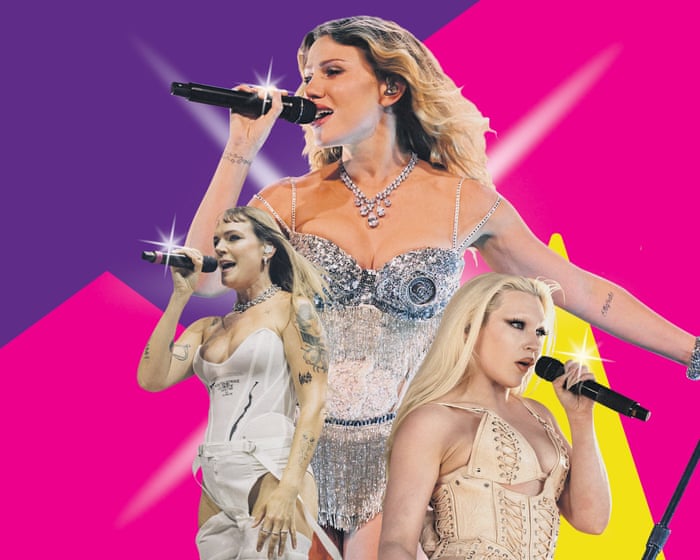
But a group of young female pop stars is pushing back against this tired expectation. They’re unironically wearing leopard print and rhinestones, making brash electronic pop with shamelessly hedonistic lyrics, wild sexuality, and a fascination with what used to be called “white trash.” This look and sound is embraced by artists like Slayyyter, Kim Petras, Cobrah, Demi Lovato, Snow Strippers’ Tatiana Schwaninger, Tove Lo, and returning scene icon Kesha.
On “I’m Your Girl Right,” the lead single from her new album Estrus, Lo sings, “We fuck all night on Ritalin-lin-lin-lin.” Slayyyter calls herself a “too drunk, trashy St Louis girl … extensions showing … looking kinda crazy.” And “Thong,” a recent single by rising London artist Amara ctk100, celebrates barely-there underwear (the cover art shows a thong peeking above a skirt waistband) and a fake-it-till-you-make-it attitude: “Benz outside / Oh no, I lied.”
“Part of this feels like an extension of post-lockdown nihilism,” says Ione Gamble, editor of the upcoming essay collection The Polyester Book of (Bad) Taste. “Things are so bad politically that we might as well have fun.”
What makes this different from earlier eras of hard-partying recession pop is its reckless main character energy and its bold rejection of feminine respectability. “The older I get, the more pressure there is to be a ‘good woman,’ and that role feels so boring,” says Lo, who is 38. “There’s confidence in not doing everything perfectly.”
Five years ago, sad-girl bedroom singer-songwriters like Olivia Rodrigo and Holly Humberstone connected with a generation that spent their formative years in lockdown. Once the pandemic lifted, Gen Z reclaimed the reckless post-9/11 underground culture as “indie sleaze” and partied through the wreckage of their own uncertain futures. Smudged eyeliner, ripped tights, and electroclash came back, thanks to artists like the Dare and Fcukers.
That 2000s sound is “definitely influencing music right now,” says Lo. She loves its “rawness and roughness,” which she thinks came from “people not giving a fuck because they weren’t being filmed” in a pre-smartphone age. “That need to rebel against the norm is building inside us like a pressure cooker. The aggressive, ‘getting punched in the face while I scream’ sound of Slayyyter’s song ‘Crank’ makes that possible.”
In 2026, those influences have turned into sleazy electro-pop—from pounding drum’n’bass to hyperactive EDM—delivered with rock-star energy and rap-style vocals. The production is aggressively maximalist: grimy guitars, blown-out synths, and addictive hooks. The energy comes from the impulsive, raunchy mid-2000s US culture: MTV’s Spring Break, Britney Spears at her wildest, and the rise of online porn and reality TV (often combined, as in shows like Girls of the Playboy Mansion).
Demi Lovato in Los Angeles in 2025. Photograph: Richard Shotwell/Invision/AP
Spilling out of Hollywood’s gay club scene, old pop songs by reality TV stars once dismissed as tacky—by the likes of Paris Hilton, Heidi Montag, and The Real Housewives of Beverly Hills’ Erika Jayne—have been reclaimed as trash-pop classics. Whether it’s Slayyyter screaming “I’m actually kinda famous” or Kim Petras flashing a Louis Vuitton bag and cash in her “Freak It” video, these stars evoke a time when the rules of fame were shifting, and for some, celebrity offered a rhinestone-studded ladder out of poverty.
You can hear early hints of this trash sound in the gritty raunch of eIn the early 2000s, electroclash icon Peaches and the clever, rap-influenced provocations of Princess Superstar stood out. Princess Superstar’s 2005 single “Perfect” even had a Gen Z-fueled revival after being used in the film Saltburn. Trash-pop really took shape in the mid-2000s Hollywood party scene, where figures like EDM godfather Skrillex would party alongside Hilton. This mix inspired Porcelain Black, who moved from Detroit to LA as a teenager. She created a loud blend of electro-pop and industrial club music, with lyrics about being “king of the world” and “fucking like a star.” That got her signed to Virgin Records, but she says the label panicked over her edgy attitude and tried to push her to become “something like Avril Lavigne.” Black refused to comply and defied the label by uploading her songs to Myspace, where they earned millions of plays. “People dream of doing numbers like that online now,” she says.
But it wasn’t long before the music industry realized how profitable this archetype was. In 2009, Kesha’s wild debut single “Tik Tok” captured the post-financial crisis mood of nihilism, and she became the queen of pop excess. Last year, Slayyyter and Kesha teamed up with British producer Rose Gray on the club banger “Attention!” Slayyyter has said, “My music would not exist without Kesha.”
Two years ago, Charli XCX’s album Brat brought new energy to pop with its hedonistic club vibe, opening the door for trash-pop to flow into the mainstream. “Charli is an instigator, not a reactor,” says Lo. “Her sound is so infectious that it’s impossible for it not to seep into everything new.” Slayyyter’s producer Kyle Shearer adds, “It touched a nerve in the culture. It hits, and it feels good.”
Since Brat was Charli’s sixth album, it also offered a career blueprint for Slayyyter. Her third album, Wor$t Girl in America, swapped Hollywood glam for denim hotpants and trucker hats, finally giving her the pop breakthrough she’d been chasing since 2018. By the time Slayyyter played to a huge crowd at Coachella this year, she had become one of the most talked-about artists in US pop. Charlie Harding, co-host of the podcast Switched on Pop, says the album felt like “Slayyyter going all in, her last-ditch effort. Pop music often rewards what feels most authentic to the artist.”
Even if mainstream audiences are just catching on, the high camp, unapologetic brashness, and full-frontal sexuality of trash-pop have always attracted a huge LGBTQ+ following. Artists from the community—including Slayyyter, Kim Petras, Swedish star Cobrah, and US hyperpop rapper and producer Ayesha Erotica (an early Slayyyter collaborator)—have been making this kind of music for years.
Riding this wave, Cobrah is now gaining wider recognition for her aggressive, sexually charged club music. Demi Lovato even asked her to feature on the new song “Fantasy.” Many of Cobrah’s tracks—like the industrial, icy “Brand New Bitch” and the hedonistic “Good Puss”—are about chasing extreme highs. “Everything else just feels very lame and tame,” she says. By leaning harder into her sexuality in her lyrics, she explains, “I’ve become more like myself. The opposite of diluted: concentrated.”
Harding suggests that by reveling in hedonism, these artists are “straddling stereotypes of women being unhinged and hysterical while being the masterminds behind the whole thing.” You could see it as a reclamation of the mid-2000s era, when disheveled white-girl stars were assumed to be out of control. We now know that Hilton was just playing the part of an airhead, though Britney Spears wasn’t so lucky—she lost control of her own life when she was placed under a conservatorship that lasted 14 years.
“It’s an ‘early internet’ type of glamour that, until very recently, was still considered very low taste,” says Gamble. Slayyyter even named a song “Brittany Murphy” after the late star of Clueless and Girl, Interrupted.She died in 2009 at age 32 from pneumonia, anemia, and overuse of prescription medication. “Women from that era who were once looked down on are now being re-evaluated,” Gamble suggests.
‘I didn’t think anyone would be into it’: Slayyyter turns midwest trash into pop gold
Read more
This week, Slayyyter made her debut on America’s Tonight Show wearing a bra made of beer cans, a nod to a famous scene from the Murphy-starring trailer-trash pageant film Drop Dead Gorgeous. This deliberate “white trash” look could be seen as both reflecting and romanticizing the economic struggles many face in the US. In 2010, a reporter wrote of Kesha: “She’s this celebration of white trash. She makes lowbrow feel like highbrow.”
Professor Robin James theorizes that “if ‘white trash’ refers to whiteness that is uncomfortably close to Blackness, then white queer women performing ‘trashy’ femininity is their way of doing something like a white girl version of ‘ratchet’—a feminine sexuality that steps outside the bounds of racial and class-based respectability.” She points out its roots in rap: “Of course, Black artists like Megan Thee Stallion and Cardi B were doing this five years ago.”
Major labels are noticing how profitable this archetype can be. After starting out on SoundCloud, Slayyyter signed with Columbia for her latest album. Korean singer Heyoon, formerly of the clean-cut pop group Now United, recently released the hyperactive EP Seriously Unserious, showing how trash-pop is breaking into the highly lucrative South Korean market. “I grew up as a ‘performer,’ which meant I had to look perfect and do everything perfectly,” she says. Shifting to something “raw and messy” helped her let go of the stress of chasing flawlessness. “It was a healing experience for me,” she adds.
The sound is now so popular that it’s already being parodied. Comedian Meg Stalter—from Hacks and Lena Dunham’s Netflix series Too Much—has just launched a music career with the knowingly titled Prettiest Girl in America, a textbook trash-pop song about how hard it is to be rich, famous, and beautiful, complete with a “tramp stamp” tattoo on the cover art.
View image in fullscreen
Charli xcx on stage in Brisbane, Queensland in 2025. Photograph: Henry Redcliffe
While this aesthetic sharply contrasts with a wave of sleek, retro-styled pop stars like Olivia Dean, Raye, and Sienna Spiro, it risks becoming just as artificial. The trash-pop look might suggest maxed-out credit cards, but underneath are financially savvy pop stars. Still, culture critic Philippa Snow argues that Gen Z probably won’t care whether these artists are truly living what they sing about. “All trends are performative by nature, right?” she says. As for Gen Z fans who adopt the look without the matching tequila habit, “maybe they’re onto something in the long run: we all wrecked our bodies in the 2000s.”
But there’s more driving this trend than just the desire to have fun. “People’s rights are being taken away,” says Harding. “Queer people, women—everyone deserves to be angry. This music turns frustration into celebration, and hopefully, on the other side, into some kind of action.” And Lo adds: “Letting that inner turmoil out and letting it run wild is incredibly cathartic. I’m glad many of us are realizing that.” Tove Lo’s album Estrus is out via Pretty Swede/Virgin on September 18. Cobrah’s album Torn is out now on Atlantic. Amara ctk100’s self-released single Thong is out now.
Frequently Asked Questions
Here is a list of FAQs based on the article title Trash is a hit Heres why a wave of wild pleasureseeking female pop stars are ditching the need to be seen as respectable
BeginnerLevel Questions
1 What does trash mean in this context
Its a playful ironic term It means rejecting polished good girl behavior in favor of being messy loud sexual and unapologetic Think of it as embracing chaos and fun over respectability
2 Who are some examples of these pop stars
Artists like Miley Cyrus Doja Cat Cardi B Megan Thee Stallion and Lizzo They often rap or sing about partying sex and having fun without caring about being polite
3 Why are they ditching respectability
For decades female stars had to be classy modest and familyfriendly to be successful These artists are saying thats boring and fake They want to be free to be wild sexual and flawed without being shamed
4 Is this just about being shocking
No While its eyecatching its really about authenticity They are prioritizing their own pleasure and fun over pleasing critics or older generations who want them to be proper
5 How is this different from male pop stars
Male stars have always been allowed to be bad boys This wave is about women demanding the same freedom to be messy and sexually expressive without being called sluts
Intermediate Advanced Questions
6 What are the benefits of this trash trend for female artists
Massive commercial success Fans love the raw energy and relatability
Creative freedom They can make weirder more fun music and videos
Reclaiming power By owning the trash label they take away its sting It becomes a badge of rebellion
Emotional release It allows them to express frustration anger and desire openly
7 What are the common criticisms or problems with this trend