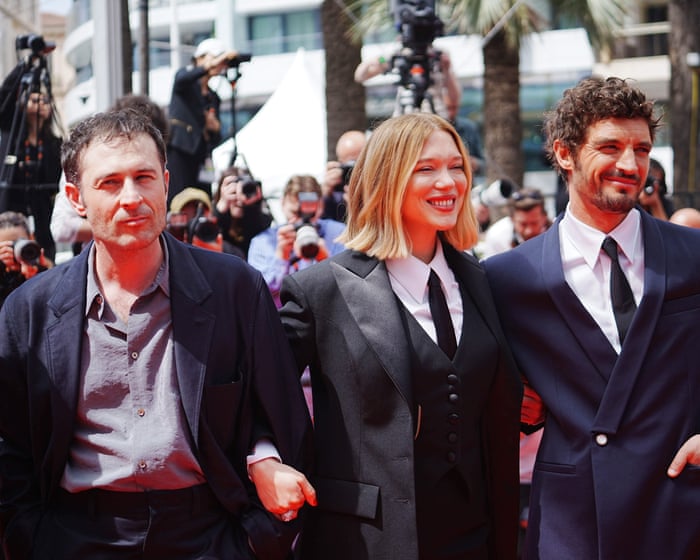
The shadow of Joseph McCarthy’s “red scare” hung over this year’s Cannes Film Festival. In a move reminiscent of the mid-20th-century blacklist that shut out around 300 suspected communists from Hollywood, the French media group Canal+ effectively banned twice that many French film professionals—including actors like Juliette Binoche and directors like Jean-Pascal Zadi and Arthur Harari. Their offense? Signing an open letter that criticized the growing influence of conservative billionaire Vincent Bolloré, Canal+’s main shareholder, over French media and cinema.
Canal+ CEO Maxime Saada defended the punishment, saying the signatories’ claims were an “injustice” against Canal+ staff, who he insisted are committed to the organization’s independence.
Over the past decade, Bolloré has tightened his grip on a large chunk of France’s news and entertainment media—from the Fox News-like CNews to the Journal du Dimanche, Europe 1 radio, and the publisher Fayard. He’s often accused of shifting the editorial direction of his acquisitions toward a right-wing agenda, much like Rupert Murdoch. Recently, his decision to fire the CEO of literary publisher Grasset led to a walkout by over 100 authors, spanning a wide political spectrum that includes high-society philosopher Bernard-Henri Lévy and feminist novelist Virginie Despentes.
In their petition—which has since gained support from international stars like Javier Bardem and Mark Ruffalo—the film professionals wrote: “By leaving French cinema in the hands of a far-right owner, we risk not just the homogenization of films, but a fascist takeover of the collective imagination.”
The fallout from Canal+ cutting ties with actors, writers, directors, and technicians could also hit the industry hard. Canal+ accounts for more than 40% of all private funding for French broadcasting, streaming, and cinema. And since French productions often rely on a mix of public and private funds, that number likely understates Canal+’s critical role. From Mulholland Drive to Paddington in Peru, few other European producers and distributors have the group’s global reach.
Should one person—or a handful of people—be able to significantly shape a nation’s cultural output based on their desire to control artists’ political speech? And should the government step in?
In Canal+’s case, intervention might be tempting. After all, public regulation played a bigger role in its creation than the label “private enterprise” suggests. Launched in 1984 as France’s first subscription channel, Canal+ has been legally required to spend a certain percentage of its budget on French and European cinema.
But trying to legislate against this apparent blacklist is also risky. The French far right is closer to power than ever. In countries led by illiberal, far-right parties, the government can be just as dangerous a source of media censorship as a billionaire owner.
Public funding for journalism and the arts is certainly part of the solution. Democracy tends to be healthier where public media funding is strong. In 2025, Reporters Without Borders (RSF)—which stresses the importance of “predictability and sustainability” in public media financing—found high levels of trust in public service media across Europe. In France, 69% of people think public media works well, even though 61% feel public services overall don’t. But how public funding is handled also matters. RSF notes that trust drops in places where the far right is or has recently been in power, and where it has often used media funding as a tool.Public media’s reliance on discretionary funding allows outside influence to shape its editorial direction.
[Image description: The 12 May edition of Libération, featuring a letter signed by over 600 people stating that Vincent Bolloré’s dominant position threatens the industry’s independence. Photo: Liberation]
Bolloré has long denied interfering for political or ideological reasons, insisting his interests are purely financial and focused on promoting French soft power. Still, his influence is a reminder that no part of Europe is immune to the same forces of media consolidation driven by ideology that we’ve seen in the US, or the outright transformation of public service media into far-right state media in Hungary. The warning signs are flashing urgently, calling for stronger financial support and independence for existing public media organizations.
It’s speculated that Emmanuel Macron is trying to “future-proof” various French institutions against a government led by the National Rally. Similarly, the EU—with its long history of funding public service media and the arts—could make that funding an independent counterbalance to both agenda-driven billionaires and repressive governments. This could be done by moving from annual, discretionary budgets or earmarked taxes (like a TV licence) to public media endowment funds that answer only to their governing boards, with appointments spanning multiple electoral cycles.
Creating such a “meta-endowment” at the EU level, tasked with providing supplementary funding for national, regional, and local public service media, journalism, publishing, and cinema across Europe—from cross-border Arte to independent magazines, France Médias Monde, and a rebuilt Hungarian public broadcaster—would add an extra layer of independence and resilience for journalists, artists, and writers facing political and private pressures.
Of course, I can already hear critics pointing out the hefty price tag of such an initiative—some will surely call it eye-popping. But this endowment fund wouldn’t necessarily mean extra spending; it would simply front-load part of the billions EU member states already spend annually on public service media—€35 billion across all member states in 2023. By following the 4% spending rule used by pension funds and university endowments, such a fund could provide inflation-adjusted grants to European media indefinitely, regardless of shifting political will or priorities.
In any case, even “eye-popping” numbers fade when compared to defence budgets, which rose by €495 billion in Europe and Canada from 2024 to 2025, and by tens of billions more in 2026, especially in Germany. Democracy depends on information; what’s the point of spending money to defend a democracy’s territorial integrity if we don’t also protect its cultural and intellectual integrity?
Alexander Hurst writes for Guardian Europe from Paris. His memoir Generation Desperation is out now.
Do you have an opinion on the issues raised in this article? If you would like to submit a response of up to 300 words by email for possible publication in our letters section, please click here.
Frequently Asked Questions
Here is a list of FAQs about French celebrities concerns regarding Vincent Bolloré written in a natural tone with clear concise answers
BeginnerLevel Questions
1 Who is Vincent Bolloré and why do French celebrities care about him
Hes a billionaire businessman who controls a huge media empire in France Celebrities care because his outlets have a strong conservative political slant and they worry he uses his power to shape public opinion and silence critics
2 What exactly are French celebrities afraid of
Theyre afraid of being blacklisted or losing their jobs if they criticize him or his political allies They also fear that his media outlets spread misinformation or push a narrow agenda which can harm their reputations or careers
3 Is Vincent Bolloré illegal or doing something wrong
Not necessarily illegal but many people believe his concentration of media power is unhealthy for democracy Hes been investigated for corruption in the past but in France his media control is legaljust controversial
4 Can a celebrity really get in trouble for speaking out against him
Yes its happened Several journalists and TV hosts have been fired or had their shows cancelled after clashing with his editorial line For example popular host Yann Barths has publicly criticized him and others have lost their slots on his channels
5 How does Bollorés power affect regular people not just celebrities
Regular people get news and entertainment from his channels which often push a farright probusiness antiimmigration viewpoint Critics say this skews public debate and normalizes extreme ideas
AdvancedLevel Questions
6 What specific strategies have French celebrities used to fight back against Bolloré
Theyve used public boycotts leaked internal memos and social media campaigns to expose censorship Some have formed unions or legal groups to challenge unfair firings A few have moved to rival networks like France Télévisions or Netflix
7 Are there any laws in France that limit how much one person can own in media
Yes but theyre weak France has rules against owning too many TV or radio licenses but Bolloré works around them by using holding companies and family trusts Recent reform efforts like