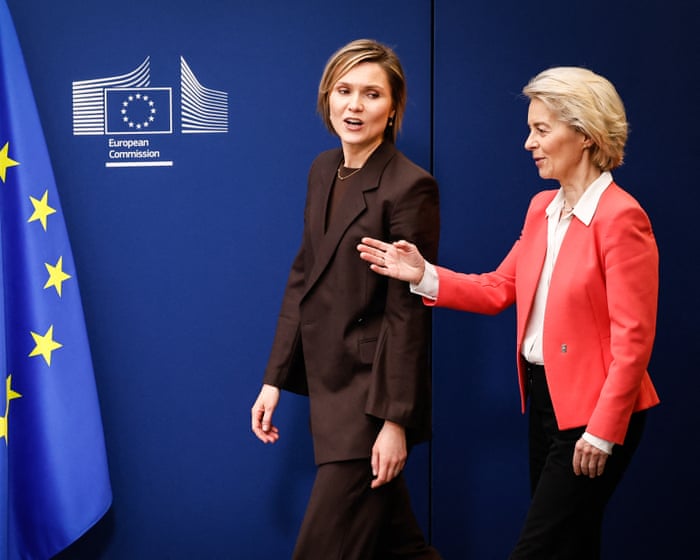
Giant butter mountains, wine lakes, and the apocryphal EU ban on bendy bananas formed the mythical backdrop to Britain’s 2016 Brexit referendum disaster. But while many Vote Leave claims were exaggerated, inaccurate, or outright false, the EU’s ability to make itself look ridiculous hasn’t faded a decade later. Take the odd case of the complaining EU commissioners, annoyed that their official electric cars can’t handle the time-consuming 280-mile trip between Brussels and Strasbourg without needing a recharge.
This important issue, first reported by Politico, raises key questions. Do these highly paid bureaucrats really need chauffeur-driven “company cars”? Surely they could take a train, fly, or cycle. Using EVs is mandatory for road trips. The cars are provided as part of the EU’s Green Deal emissions-cutting policy, which commissioners should support, not complain about. So why is the commission president, Ursula von der Leyen, allowed a petrol engine? The biggest question of all is why make these tedious Brussels-Strasbourg trips in the first place?
The answer is that the European parliament doesn’t operate like any ordinary parliament. It holds sessions in both cities, as required by treaty. Twelve times a year, commissioners, officials, and hundreds of MEPs make the trip, costing taxpayers tens of millions of euros. In 2023, a train meant to take MEPs to Strasbourg was accidentally diverted to Disneyland, which some unkind people thought was only fitting. Yet despite all the trouble and expense, France would never allow Strasbourg to be bypassed. National pride is at stake.
Such EU “gravy train” stories shocked UK Brexit supporters but don’t seem to bother today’s voters in Europe’s northernmost regions, where renewed interest and even enthusiasm for the EU is unexpectedly growing. Iceland will hold a national referendum in August on restarting accession talks. It signed a security and defense partnership with Brussels in March. In Norway, a long-time EU holdout, the main conservative opposition party now wants the country to join the bloc. Faroe Islanders, too, are reportedly reconsidering their push for independence from EU member Denmark.
Two common factors are warming cold northern hearts. One is Donald Trump’s pressure campaign on Greenland – sovereign Danish territory that he has threatened to annex “whether they like it or not.” The US president, who also has designs on Canada, Cuba, and Panama and recently kidnapped Venezuela’s president, says control of resource-rich Greenland is necessary for US security. This smash-and-grab policy reflects Trump’s belief in US imperial dominance over the western hemisphere – what Russians, in their sphere, used to call the “near abroad.”
Trump’s aggressive iceboat diplomacy has set off alarm bells across the far north. After unusually harsh criticism from EU and NATO leaders, Trump, distracted by his Iran fiasco, has quieted down for now – but he hasn’t given up. After inviting himself to the capital, Nuuk, this month, Jeff Landry, Trump’s “special envoy” (who, bizarrely, is also the Republican governor of Louisiana), was bluntly told by Prime Minister Jens-Frederik Nielsen that Greenland “is not for sale.” Unsurprisingly, US threats have put Greenlanders’ dreams of independence on hold, pushing them closer to Denmark and the EU.
Pointing to a second common factor influencing regional opinion, Iceland’s Foreign Minister Þorgerður Katrín Gunnarsdóttir told the Guardian’s Miranda Bryant this week she was worried that covert and harmful Russian interference in Reykjavík’s upcoming EU referendum might help the “no” campaign and create Iceland’s own “Brexit moment.” She warned that misinformation and rhetoric taken straight “from the playbook of Nigel Farage and Reform” could potentially distort the outcome.Looking at the bigger picture, the growing and destabilizing competition between Russia, the US, and China in the Arctic—a strategically important region that’s becoming easier to access—is making local people focus more on the benefits of being part of large multinational groups like the EU. Iceland, like Greenland, doesn’t have its own military and depends on NATO—mainly the US—for defense. But in the Trump era, that security guarantee has big gaps, as larger European countries, including Britain, are finding out the hard way.
EU membership, or more specifically, renewing membership, has also become a tricky central issue in the key UK by-election in Makerfield on June 18, which happens to be the anniversary of the Battle of Waterloo. Keir Starmer wants to reset UK-EU relations. His likely rivals for leadership, Andy Burnham—Labour’s candidate in Makerfield—and Wes Streeting, both support returning to the EU fold, sooner or later. Reform wants the vote to be all about Europe and the government’s “betrayal.” Evelyn Waugh might have called it Brexit revisited, but this time without the jokes.
All this interest in joining, rejoining, getting closer to (or pushing away from) the EU raises a bigger question: is Brussels up to the geopolitical challenge? The twin threats from east and west offer unique reasons to revive and reform its old, rule-bound, and slow-moving institutions. This week, GCHQ’s surveillance chief, Anne Keast-Butler, highlighted Russia’s escalating efforts—failing in Ukraine—to intimidate and destabilize European states through cyber-attacks, sabotage, assassination, disinformation, and quasi-military provocations, like the recent electronic jamming attack on UK defense secretary John Healey’s RAF plane. “Russia is ramping up its daily hybrid activity against the UK and Europe,” she said.
EU responses to Trump have been uncoordinated and too conciliatory, though national leaders like Germany’s Friedrich Merz have taken a tougher line on Iran. Last year’s US-EU trade deal was a humiliation. On supporting Ukraine, Europe has mostly managed to stay united against Vladimir Putin’s aggression and Trump’s serious backsliding, though in practice, it often does too little, too late. As for Ukraine’s membership bid and enlargement policy in general, the EU’s recent track record is poor. Candidate countries are lining up across the Balkans and eastern Europe. Turkey has been waiting since 1987.
Despite efforts by France’s president, Emmanuel Macron, the EU is still years away from creating a credible, independent “European army” separate from US-led NATO, and it continues to underperform in shared weapons manufacturing and procurement. While von der Leyen is good at keeping many plates spinning, she inevitably goes in circles. Opportunities to strengthen the EU by finally mending ties with Hungary after Viktor Orbán, and with a returning UK, are at risk of being missed—blocked by member states’ endless budget disputes, national rivalries, lack of political imagination, and chronic inertia in Brussels.
The faith that people in Iceland, Greenland, and other northern friends have in the EU’s ability to help them survive and thrive in a more dangerous world is hopefully not misplaced. Predators like Putin and Trump, and allied reactionary forces like Reform UK, won’t wait for Europe if Europe fails to seize the moment. Those whining Brussels commissioners should get moving.
Simon Tisdall is a Guardian foreign affairs commentator.
Frequently Asked Questions
Here is a list of FAQs based on the question When will the EU start acting like a major player in a dangerous world
BeginnerLevel Questions
1 What does it mean for the EU to be a major player in a dangerous world
It means having the military strength political unity and quick decisionmaking to protect its borders deter threats and influence global eventsrather than just relying on the US or NATO for security
2 Why does the EU currently not act like a major player
Because its a union of 27 countries each with its own army foreign policy and veto power Its hard to agree on a single fast response when every member has different priorities
3 Is the EU trying to become a major player
Yes Its investing in joint defense projects creating a rapid reaction force and trying to reduce energy dependence on Russia But progress is slow
4 Whats the biggest obstacle to the EU being a global power
Lack of unity Countries like Hungary or Germany often block strong military or foreign policy actions because they fear escalation costs or losing sovereignty
Intermediate Questions
5 If the EU cant defend itself why would countries want to join
Joining the EU still offers economic stability trade access and the protection of Article 42 But candidate countries like Ukraine or Moldova are now asking Will the EU actually fight for us or is it just a trade club
6 What would change if the EU acted like a major player
It could deploy troops quickly impose real economic sanctions that hurt adversaries and negotiate peace deals from a position of strengthnot just from a position of lets talk more
7 Has the EU ever acted like a major player in a crisis
Rarely During the 2022 Ukraine invasion the EU acted fast on sanctions and funding but it still relied on NATO for military defense In the 2015 migration crisis it failed to act decisively
8 What needs to happen for the EU to become a major player
Three things 1 End the veto on foreign policy 2