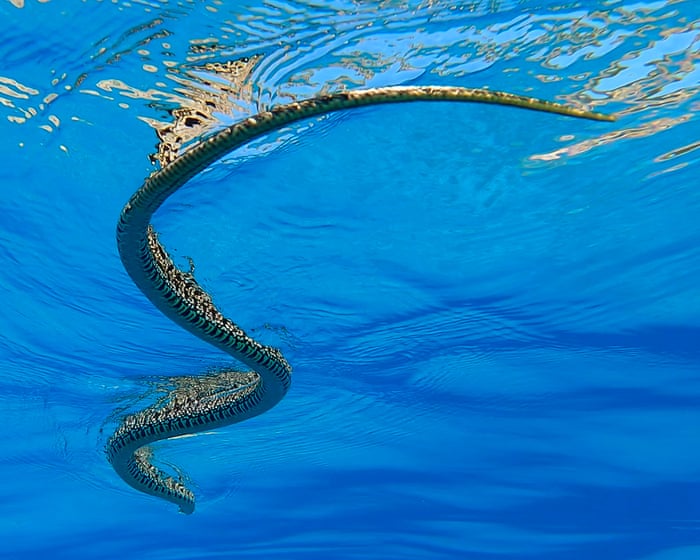
In April 2024, a grainy video shot on a tiny island in the Balearics finally confirmed what Spanish researchers and wildlife experts had long suspected and feared. It showed a pale, solitary horseshoe whip snake gliding through the turquoise waters between Ibiza’s east coast and the islet of Santa Eulària, 450 meters away, searching for new territory and food.
The snake’s arrival on Santa Eulària, captured by a local wildlife ranger, proved that this relentless invader from mainland Spain—which has nearly wiped out Ibiza’s unique population of brightly colored wall lizards—had opened a new front.
“There had been growing anecdotal evidence from fishermen and tourists who saw snakes swimming, so we thought it was happening often,” said Oriol Lapiedra, a biologist at the Centre for Ecological Research and Forestry Applications (Creaf) in Catalonia. “But this was the first solid evidence of a snake swimming from Ibiza to the islet.”
The horseshoe whip snake, a non-venomous reptile found across southern and eastern Spain, has become a serious threat to the lizards since it first appeared on the island about 20 years ago. Its rapid spread is linked to the trend among wealthy Ibiza property owners of importing ancient olive trees from mainland Spain to decorate their homes. Unknowingly, these trees—with their nooks and hollows—provided perfect hiding spots for hibernating snakes and their eggs.
Twenty years after arriving, Hemorrhois hippocrepis now occupies at least 90% of Ibiza and has developed a taste for the unsuspecting lizards, whose familiar colors and shapes appear on much of the island’s tourist merchandise, from T-shirts and fridge magnets to towels and mugs.
But these days, the kitsch lizard items may outnumber the real lizards. In October 2022, the International Union for Conservation of Nature moved the Ibiza wall lizard (Podarcis pityusensis) from “near threatened” to “endangered” on its extinction red list.
The lizards are not only loved for their beauty and gentle nature; they are also a keystone species that helps maintain the region’s ecosystems.
“They control insect populations, including agricultural pests, so everything changes when they disappear,” said Lapiedra. “But they also pollinate flowers and spread seeds.”
What’s more, the lizards are an evolutionary marvel: each of the dozens of islands and islets in the Pityusic Islands has a different population with distinct colors, including green, blue, black, brown, grey, and orange.
No one knows exactly how many invasive snakes are on Ibiza. According to the Balearic regional government, which is working with Creaf and other groups to protect the lizards, more than 3,500 horseshoe whip snakes were captured on the island last year alone, and over 16,000 have been killed since 2016. Still, forecasts suggest they will cover 100% of the island by the end of 2027.
On the mainland, these snakes are usually thin and rarely grow longer than 1.8 meters. But on Ibiza, they are thriving so much that some specimens have been found over 2 meters long and weighing 2.5 times more than their mainland counterparts. As Lapiedra put it: “We’ve found animals as thick as my wrist.”
The biologist and his colleagues, whose research was recently published in the journal Ecology, believe that increased competition for food among the snakes on Ibiza may have driven them toward the islets. While there is hope that dwindling food sources might eventually reduce the snake population, the damage has already been done.This has already happened. In 2016, researchers counted 72 lizards on Santa Eulària, but by 2023, there were only three. Today, the unique lizard populations of ten small islands—including Santa Eulària—have gone extinct, wiping out thousands of years of unique evolution. Meanwhile, horseshoe whip snakes have been found on Formentera, the island next to Ibiza.
[Image: A member of the Centre for Ecological Research and Forestry Applications holding a horseshoe whip snake. Photograph: Guillem Casbas]
To protect the species, a “Noah’s ark” captive breeding program was set up at Barcelona Zoo last year, involving lizards from eight different populations. It’s going well so far. But the small size of the islands, combined with the snakes’ huge appetite, leaves little reason for optimism—and even less for complacency.
Lapiedra compares the situation to Guam, a Pacific island where brown tree snakes arrived on US military ships 80 years ago. That led to the loss of 10 out of 12 native forest bird species.
“The only difference is that the snakes in Guam aren’t known to swim,” he added. “So there are islands around Guam that still have the species Guam used to have.”
Still, Lapiedra points out that all is not lost on Ibiza. In a strange twist, the safest lizard populations on the island are now in urban areas—ironic, given that humans’ constant reshaping of the landscape helped push them toward extinction.
“The lizards are still present in Ibiza’s largest cities, and the populations are doing fine,” he said. “Basically, in urban areas, the snakes get run over by cars, and people also kill them because they don’t like snakes. So for now, some of these urban areas have healthy lizard populations.”
But for Lapiedra, his colleagues, and people across Ibiza, the rapid loss of the lizards is both an ecological and cultural disaster.
“Each—or most—of these small islands have unique lineages that are being completely lost to science and to humanity right now,” he said. “So this is a tragedy—it’s like a fire in an old church.”
Frequently Asked Questions
Here is a list of FAQs about the topic swimming snakes are opening a new front in the fight against Balearic lizards written in a natural tone with clear concise answers
BeginnerLevel Questions
1 What is the tragedy mentioned in the headline
The tragedy is that invasive swimming snakes are killing off the unique native Balearic lizards on islands in the Mediterranean These lizards have no natural defense against the snakes
2 Which snakes are we talking about
The main culprit is the Horseshoe Whip Snake Its not native to the Balearic Islands it was accidentally introduced
3 How do snakes swim to the islands
They dont swim the whole way from the mainland They hitch rides on boats and cargo But once on an island they are excellent swimmers and can easily move between small nearby islets
4 What is a Balearic lizard
It refers to the Balearic Wall Lizard a small colorful lizard found only on the Balearic Islands and their surrounding islets Its an endemic species meaning it lives nowhere else on Earth
5 Why is this a big problem
Because the snakes eat the lizards faster than the lizards can reproduce On some small islets the snakes have already wiped out the entire lizard population This is a major blow to biodiversity
AdvancedLevel Questions
6 How did the snakes get introduced in the first place
The primary pathway is human transport The snakes are thought to have arrived as stowaways in potted olive trees imported from the Spanish mainland for landscaping They then spread from the main islands to smaller satellite islets
7 Is this a new front in the fight What does that mean
Yes Conservationists were already fighting the snakes on the main islands The new front refers to the snakes now swimming to and colonizing offshore isletstiny previously safe refuges for the lizards This makes the problem much harder to control
8 What are the practical methods being used to stop the snakes
Conservationists use a combination of