It was definitely a literary festival, but if your idea of one comes from places like Hay-on-Wye, Edinburgh, Melbourne, Sydney, New York, or Washington DC, then Kyiv Book Arsenal might make you feel like you’ve slipped through a crack in the universe into an alternate reality.
For one thing, the audience was so young. Dressed in their finest clothes, they clutched bags of books bought straight from publishers’ stalls and stopped to hug friends. The festival was the perfect excuse for a leisurely stroll through the venue—the city’s vast 18th-century military arsenal—while people-watching.
[Image: Visitors at Book Arsenal in Kyiv. Photograph: Julia Kochetova/The Guardian]
As an outsider, you wouldn’t have guessed from the crowded halls and long bathroom lines that, according to everyone, this was actually a bit quieter than previous years. Partly, that was due to the terrible weather (Kyiv seemed to have swapped its usual spring warmth for Hay-on-Wye’s typical rain). But there was also the small matter of repeated warnings about an imminent Russian attack, like the one the week before, when the invaders launched 60 missiles and 600 drones, most aimed at Ukraine’s capital.
That attack—a barrage of ballistic missiles and Shahed drones on the city—didn’t come until after the festival ended, on Monday night. Still, on Friday, the venue was evacuated several times, and Deputy Minister of Culture Bohdana Laiuk had to compete with air-raid sirens to award a prize for the best foreign translation of a Ukrainian book (won by Nina Murray for her English version of Lesia Ukrainka’s early-20th-century feminist verse drama, Cassandra).
[Image: Visitors at the Book Arsenal in Kyiv. Photograph: Julia Kochetova/The Guardian]
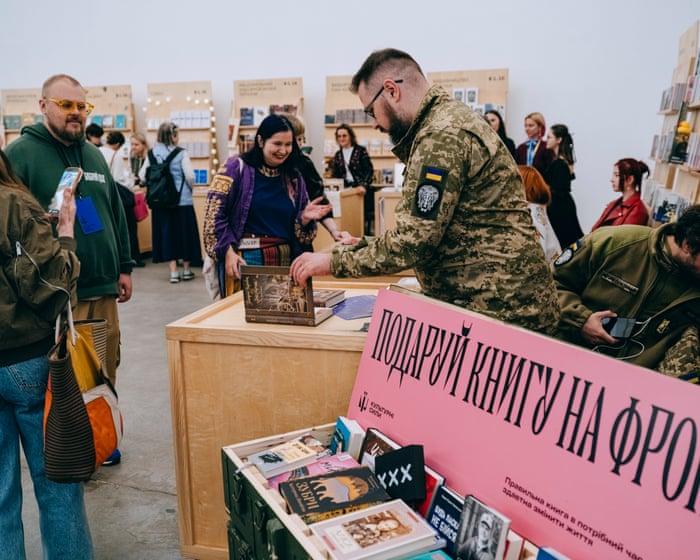
Then there were the military uniforms, everywhere. The 8th Air Assault Force ran what might have been the best coffee stand (a high bar in a coffee-obsessed country), handing out bookmarks printed with the slogan “If you love reading, we like you” and a link to donate. The army’s cultural forces had set up an ammo box for donated books to be sent to the front line: offerings included Ukrainian translations of Alice’s Adventures in Wonderland and The Hitchhiker’s Guide to the Galaxy, along with a volume by contemporary poet Halyna Kruk and a recent book about life on the front line, Please Don’t Be Afraid, by Pavlo “Pashtet” Belyanskiy.
A sign of how completely war has engulfed the nation was the number of soldiers on stage—writers who had become soldiers, soldiers who had become writers. The Russia-Ukraine war has dragged on so painfully and for so long that entire publishing cycles have turned since 2022. Early in the full-scale invasion, poetry collections emerged, since verse could most quickly capture the explosion of time and meaning that war brings.
[Image: Maksym Butkevych, a human rights activist and war veteran, is one of the festival’s programmers. Photograph: Julia Kochetova/The Guardian]
But now, after four years, soldiers have had time to put together finely crafted volumes of frontline memoirs. “I’m seeing more and more books describing the experience of those who have joined the army, reflecting a shift from civilian to military life and how it has affected their sense of self,” said Maksym Butkevych, one of the festival’s programmers. A human rights defender, he volunteered for the army in 2022 and was captured, tortured, and held prisoner for two years.
It was he who suggested this year’s festival tagline, which in English translates to “bear your freedom.” It hinted at the burden of responsibility that comes with the privilege of liberty. “Reading is a symbol of freedom—something I was forbidden from doing for most of my time in captivity. It’s a place where you have an inner world that your captor cannot invade.”“,” he said.
A discussion among soldier-writers, including Artur Dron’, a young author and poet whose new essay collection Hemingway Knows Nothing has become a bestseller, touched on balancing freedom, honesty, and responsibility. Since their writing isn’t censored by the government, and telling the truth about harsh frontline conditions seems essential to bridge the gap between soldiers and civilians, the writers debated whether they should voluntarily hold back for the greater good. “It’s not about forbidding yourself something,” Dron’ said during the session, “but about feeling responsible for what you do.”
[View image in fullscreen: Visitors queue to enter the Book Arsenal in Kyiv after an air-raid alert. Photograph: Julia Kochetova/The Guardian]
In another session called Fragility of the Hero, Dron’ and others focused on moving away from an old Soviet image of the soldier as an inhuman, flawless, untouchable being. Dron’ warned that such exaggerated rhetoric could let citizens shift their own responsibility onto these supposedly perfect “heroes.” “If we put the military on a pedestal,” added Butkevych, “we take away their right to be ordinary, imperfect people.”
Time has also brought new approaches to writing. From the short, deliberately unexperimental documentary style of the early years, new forms are emerging, like Katya Iakovlenko’s poetic book-length essay Donbas as a Metaphor, recently published in Ukrainian by ist publishing. Sasha Dovzhyk, director of the Institute for Documentation and Exchange (Index), which supports writers and researchers documenting the invasion, pointed to work by Anna Gruver. In her mix of “diary, essay, and poetic writing,” she was “breaking free of expectations of what ‘war writing’ should be. Writers are ready to experiment.”
[View image in fullscreen: Kateryna Zarembo, a combat medic, translator, and poet, reads her poetry at the festival. Photograph: Julia Kochetova/The Guardian]
Not everything was directly about the war. There were long queues for Ilarion Pavliuk’s thick mystery novels (one air-defense volunteer was carrying two to be signed, along with a few kids’ books for his grandchildren in the US). National treasure and public intellectual Oksana Zabuzhko talked about the 30th anniversary of her novel Fieldwork in Ukrainian Sex, which was a bestselling feminist scandal when it came out in 1996 and a pioneer for Ukrainian-language publishing in the newly independent country. Osnovy publishing house was promoting titles like the first Ukrainian translation of E.M. Forster’s A Room with a View. On the outdoor stage, performers competed in the national slam poetry championships. There were collage workshops for teenagers, soft play for kids, a Ukrainian calligraphy studio, and a quiet room in case the sensory overload got too much.
But of course, the war touched everything. The publishers themselves had a tough time, like everyone else during the past winter of blackouts and freezing temperatures. One talked about rising material costs made worse by the exchange rate against the euro; the necessary but expensive use of generators in printing factories and warehouses; floods damaging stock when heating systems burst after the winter freeze; and delayed print runs. All of this made books more expensive for buyers. “Two years ago, people were buying two or three books without hesitation,” the publisher said. “Now it’s a question of, this one or this one?”
[View image in fullscreen: The writer and poet Artur Dron’ signs a book. Photograph: Julia Kochetova/The Guardian]
It was hard to imagine a book festival with higher stakes. The boom in Ukrainian publishing that started three years ago was a direct result of a shift in consciousness for many Ukrainians.This shift included moving away from the Russian language and literature that many had grown up with. As Bohdana Laiuk (then Neborak) said in 2023: “People began to understand that the Russians came here to kill people simply because they were Ukrainian. So people are asking: what does it actually mean to be Ukrainian? Literary culture gives us a way to understand who we are.”
“Kyiv Book Arsenal is more than just a book festival—it’s a space for exchanging ideas,” said Butkevych. “It’s about discussing our values and what we share as a community. Everything is connected: the Ukrainian language, buying books, and talking about ideas—these are the threads that hold our community together.”
Frequently Asked Questions
Here is a list of FAQs about the Book Arsenal Festival in Kyiv during wartime covering the realities of airraid sirens and frontline stories
BeginnerLevel FAQs
1 Is it safe to hold a literary festival in a city that is being bombed
No its not perfectly safe The festival takes place in a metro station and bunkers with strict safety protocols Everyone must go to shelters when sirens sound
2 Why would anyone hold a festival during a war
To show that Ukrainian culture and life cannot be destroyed Its a way to support local authors boost morale and remind the world that Kyiv is still alive
3 What happens when the airraid siren goes off at the festival
The event pauses immediately Organizers guide everyone to designated bomb shelters The reading or discussion often continues inside the shelter
4 Who attends this festival
Mostly Kyiv residents internally displaced people soldiers on leave and international journalists Some authors join via video call from the front lines
5 What kind of books are featured
A mix of everything war diaries poetry about resilience childrens books and classic Ukrainian literature Many authors write about their frontline stories life under occupation or in combat
Advanced Practical FAQs
6 How do authors write about war while actively being in a war zone
Many write in short bursts between airraid alerts using notes taken in trenches or shelters Some say the urgency of war makes their writing more raw and honest
7 What are frontline stories in this context
They are firsthand accounts from soldiers medics and civilians in combat zones These stories often include details about survival loss and the psychological toll of war read aloud by the author or a performer
8 How do you sell books when the power grid is unstable
Vendors use cash mobile payment apps and portable battery packs Many books are sold with a note inside written by the author during the last blackout
9 Is there a special protocol for authors reading about traumatic events
Yes Organizers often have psychologists on standby They warn the audience before a particularly graphic reading and provide a quiet separate space for anyone who needs a break