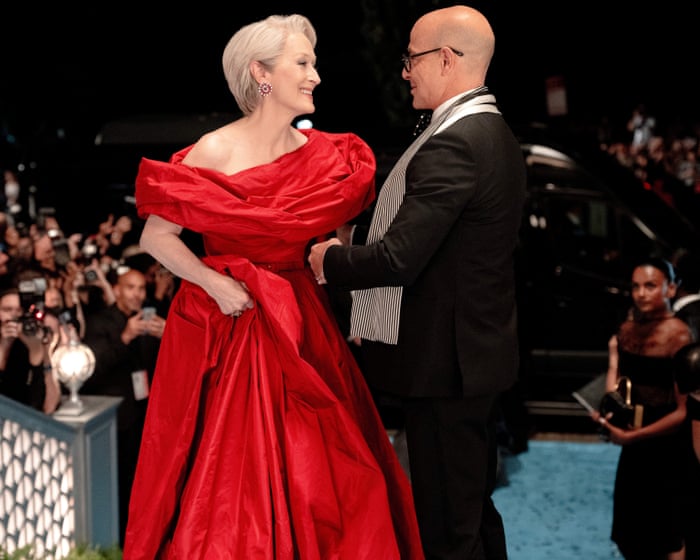
I didn’t expect The Devil Wears Prada 2 to make me cry, but it did. All the high-fashion camp and sharp one-liners from the first movie—like “By all means, move at a glacial pace, you know how that thrills me”—melt into sadness for a struggling media industry in the sequel. We meet an older Andy Sachs (Anne Hathaway), the put-upon assistant to Runway editor Miranda Priestly (Meryl Streep) in the original film, just as she and her newspaper colleagues are receiving an award for investigative reporting. But at that exact moment, they’re laid off by text message. It feels painfully real: large parts of the Washington Post, including Pulitzer finalists and war-zone correspondents, faced a similar fate—fired via email subject line—this past February.
I also didn’t think it would make me feel so nostalgic. The original Devil Wears Prada came out in 2006. Watching that thinly disguised portrait of American Vogue back then was fun. I had done my apprenticeship at Condé Nast, at British Vogue and The World of Interiors, and I felt a vague connection to Andy and her terrible blue jumper. She arrives as a skeptic, goes native, then leaves for her true calling at a progressive newspaper. But now, 20 years later, other feelings take over. As my former Vogue colleague Louise Chunn wrote recently in the New Statesman, in the 1990s we had no idea we were working “at the high watermark of the circulation and power of the glossy magazine industry.” When those huge, thick-papered magazines thumped onto our desks at Vogue House—hand-delivered, literally—they felt so solid, so reassuring, so full of the promise of glamour and beauty, that we thought it would last forever.
Of course, it was a ridiculous world. At Vogue, I worked in the copyeditors’ room, a self-contained island of grammatical precision. We were the guardians of the style guide, a safe place where dangling modifiers and misspellings of Dolce & Gabbana (two Bs, one N!) were strictly banned. I got the job after an interview with a grand lady from HR who asked what my father did. She made me take a pay cut from my previous job—down to about £11,000, if I recall—on the grounds that, yes, a million girls would kill for that role. From the copyeditors’ perch, most of the writing had to be wrestled into shape, to put it mildly. My first attempt at writing was a small piece commissioned by the deputy editor, Anna Harvey, who Princess Diana used to consult about her dresses. It was about why it’s unfashionable to travel in a black cab covered in ads. A major mineral water company got offended and pulled its advertising from the magazine as a result. Oops.
Alexander McQueen’s champion, Isabella Blow, would sometimes float by in her amazing hats. I subbed Nigella Lawson’s first cookery column. There was a woman nearby named Hicky, who seemed to often chat on the phone or gossip about Twiggy. My boss, the queen of the copy room and a member of an incredibly famous aristocratic family, wore Gap jeans and rode an old bicycle to work every day. She was magnificent, though she nearly fired me—after leaving a job writing mail-order catalog copy on a light industrial estate in Oxfordshire, I lost focus when I hit the gold-paved streets of London. But she gave me a second chance, and everything worked out. She acted completely indifferent to clothes, but then shocked everyone by buying a Chanel leather coat featured in the magazine. She unpicked the buttons with their interlocking Cs and sewed on ones she liked.
I would like to reI used to think my time there was a personal transformation into Chanel myself, like Andy in the first film, but let’s be real—H&M was what we juniors could afford back then. When I left, they gave me the most 1990s leaving card possible (Begbie from Trainspotting flipping a V) and a gorgeous pashmina, which I sadly lost in Odesa in 2024 while reporting on the war in Ukraine.
I still have a small archive from that time: a memo dated 10 January 1996 from the editor’s assistant, postponing a meeting so it wouldn’t clash with “the Manolo sale”; and an announcement from the managing director, Nicholas Coleridge, that the roof garden was now open, but “please don’t go too close to the edge and topple over.” Sometimes things felt beyond parody, but that wasn’t really true, because there was a spoof-memo writer running around. One perfect example, titled “Arriving on Time – Reminder,” had Coleridge supposedly scolding staff for “tending to drift in rather late, particularly when there is a major industrial dispute causing a complete shutdown of the London tube network.” It told employees to predict strikes, IRA bomb scares, and floods, and included a list of “useful telephone numbers” like the Acas offices, Michael Fish at the London Weather Centre, Coleridge’s personal chauffeur, and—before the Northern Ireland peace process—Sinn Féin HQ.
Happy days, sort of. The 1990s were the era of size-zero models and heroin chic. I remember a group of higher-ups debating whether it was okay to airbrush out the protruding ribs in a nude photo of two models, so the women (or “girls,” as they were called) didn’t look off-puttingly starved. I once got called into HR for doing something that looked a bit like union organizing. The World of Interiors—the Condé Nast magazine I moved to next, where I loved my coworkers—had an extraordinary, terrifying boss. Her methods wouldn’t have survived modern dignity-at-work rules or legal frameworks, since she chain-smoked Gauloises at her desk. Min Hogg once pointed a bony, nicotine-stained finger at my Ghost-clad stomach and asked if I was pregnant. She often wore a turban. One day when she was out, the whole staff, in a burst of crazy freedom, made turbans from scrap fabric and took photos of ourselves wearing them. In 2006, when I was already at the Guardian, I saw Hogg gleefully sliding down a helter-skelter in Tate Modern’s Turbine Hall—she was always up for it.
For me, these 1990s memories are mixed with the politics of the time. The Tories were in their final days. MP Jonathan Aitken had lied and lied and lied. In May 1997, I stayed up all night watching the election results, then went with a colleague from Interiors to Downing Street to see the new PM arrive. Diana died and was buried on my 25th birthday. A month later, I got a job at the Guardian. There, I found my people. And even if the Guardian sacked me by text tomorrow, I could never imagine going back to that glossy world.
Ukrainian Lessons: Art in a time of war with Charlotte Higgins and guests
On Wednesday 30 September, join Charlotte Higgins and our panel of acclaimed Ukrainian writers to reflect on the deep connections between war, art, and life. With Olia Hercules, Sasha Dovzhyk, Olesya Khromeychuk, and Shaun Walker. Book tickets here or at guardian.live.
Charlotte Higgins is the Guardian‘s chief culture writer.
Do you have an opinion on the issues raised in this article? If you’d like to submit a response of up to 300 words by email for possible publication in our letters section, please click here.
Frequently Asked Questions
Here is a list of FAQs based on the topic My time working at Vogue in the 90s wasnt exactly like The Devil Wears Prada The FAQs address both the reality vs fiction of the era and the broader experience
BeginnerLevel Questions
1 Wait didnt you work for Anna Wintour Was she really as scary as Miranda Priestly
Answer I worked at Vogue but I wasnt her direct assistant While she is famously demanding and serious the Miranda Priestly character is a fictional exaggeration She was more of a distant powerful force than a daily screaming villain
2 So was it all glamorous parties and free designer clothes
Answer Partly yes The perks were incredibleborrowing sample dresses attending fashion shows and meeting designers But the 90s were also very handson A lot of the job was grunt work steaming wrinkled samples tracking down missing shoes and making photocopies at 2 AM
3 Did you get to meet famous models like Kate Moss and Naomi Campbell
Answer Yes they were around the office for fittings and shoots But in the 90s models were treated like hangers for the clothes Youd say hello but you didnt really hang out with them unless you were a senior editor
4 Was the office as dramatic as the movie
Answer The movie condenses years of drama into two hours Real life had less witty oneliners and more boring stressful deadlines The drama was usually about a missing dress or a late shipment not personal sabotage
5 Do you need to be super skinny or rich to work at Vogue
Answer No In the 90s there was a look but you didnt need to be a model or wealthy Most assistants were broke The key was having good taste a strong work ethic and a thick skin
AdvancedLevel Questions
6 What was the biggest difference between the movie and your real experience