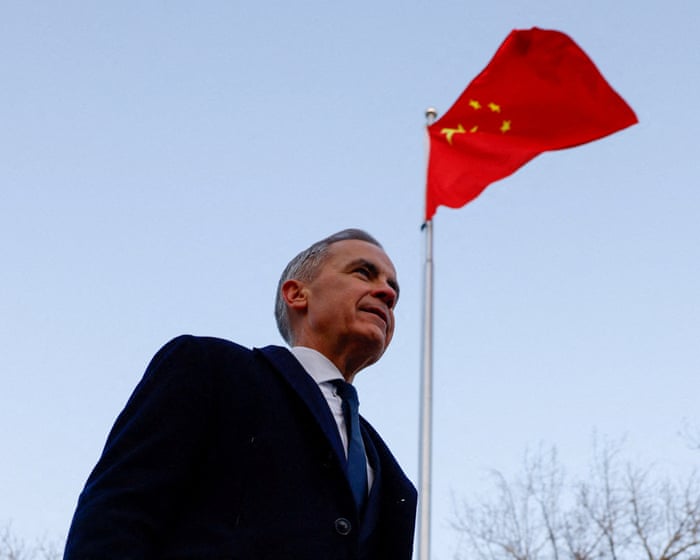
Mark Carney’s visit to Beijing this week resulted in what he called a “preliminary but landmark” trade deal and an acknowledgment—welcomed by China—that nations are navigating a “new world order.”
Carney’s trip marks the first time in nearly a decade that a Canadian prime minister has been received in Beijing. It follows years of strained relations between Ottawa and Beijing, which Carney aims to mend to lessen Canada’s risky dependence on the United States.
Guy Saint-Jacques, a former Canadian ambassador to China, noted, “The main goal of trying to reset or recalibrate the relationship with China has been achieved during this visit.”
This recalibration comes at a sensitive time for geopolitical ties between North American countries and China.
“Mr. Carney is driven by a sense of urgency, stemming from the challenges we face with our neighbor to the south,” Saint-Jacques added.
Just as Carney was traveling to Beijing, U.S. President Donald Trump told reporters that the U.S. does not need Canadian products. This remark underscores the pressure on Carney to diversify Canada’s exports away from the U.S., which currently receives about 70% of Canadian exports.
However, as trade observers worldwide have come to expect, Trump appeared to change his stance shortly after Chinese President Xi Jinping and Carney announced their agreement. “Well, it’s OK. That’s what he should be doing,” Trump told reporters at the White House on Friday. “If you can get a deal with China, you should do that.”
In Beijing on Thursday, Carney told reporters he believed the progress and partnerships between the two countries prepare them for the “new world order”—a perspective that aligns, at least rhetorically, with Beijing’s view that the era of a U.S.-led global order is fading.
While Carney and Canada are eager for closer ties with China, Beijing also faces increasing pressure to build new and stronger relationships, according to Lynette Ong, a political science professor and China expert at the University of Toronto.
“Despite the buzz around electric vehicles and technology markets, China still depends on exports to fuel economic growth,” she said. “Beijing’s leadership knows the economy is sluggish and cannot afford to let exports decline.”
Ong also noted that the Chinese foreign ministry did not mention any intention to undermine Canada’s relationship with the U.S., suggesting negotiators are approaching agreements in good faith.
Statements from both leaders may have been almost as significant as the trade deals reached this week.
On Friday, China and Canada announced a preliminary, provisional agreement allowing up to 49,000 Chinese electric vehicles into the Canadian market and a temporary reduction in Chinese tariffs on Canadian canola, lobsters, seafood, and peas from March through the end of the year. A mutual pledge to lower—though not eliminate—tariffs in key industries offers hope of ending a contentious trade dispute.
With attention focused on how the leaders would present the deal, Vina Nadjibulla, vice-president of the Asia Pacific Foundation of Canada, said the joint statement was the summit’s most surprising outcome.
“It is perhaps the most significant achievement, outlining this new strategic partnership between China and Canada,” she remarked. “It’s a bold move by Carney to position Canada in this new and evolving geopolitical landscape.”Prime Minister Carney appears to be navigating a new political landscape, aiming to steer Canada toward greater strategic independence. He also acknowledges that there are limits to what can be achieved with China.
Carney stated that the agreement between the two countries reflects the necessity for cooperation in an increasingly divided world. While some senior Canadian politicians have welcomed the deal, it has sparked frustration and anger among others.
Conservative leader Pierre Poilievre questioned, “Prime Minister Carney must explain how he went from calling China Canada’s biggest security threat before the election to announcing a strategic partnership with Beijing after the election.” Ontario Premier Doug Ford criticized the reduction of tariffs on electric vehicles, warning, “Make no mistake: China now has a foothold in the Canadian market and will use it to their full advantage at the expense of Canadian workers.”
However, Nadjibulla described the agreement as “creative,” noting it addresses the growing uncertainty in the multibillion-dollar auto sector. “Carney navigated this visit skillfully on a diplomatic tightrope, but many details remain unresolved. This new strategic partnership is ambitious, and its evolution and implications remain to be seen,” she said. She also expressed concern over Canada’s decision to deepen its reliance on canola exports to China, calling it “worrisome” and a repeat of an overreliance strategy that has previously backfired. “We’ve learned this lesson already. China has a track record of using coercion in sectors where we are heavily trade-dependent. This deal does not reduce that risk.”
President Xi hailed a “turnaround” in China-Canada relations since meeting Carney at the 2025 APEC summit in South Korea. Chinese commentators portrayed the visit as a pivotal moment in moving away from U.S.-led dominance. In a People’s Daily article, professors Wang Wen and Jin Zhen of Renmin University wrote, “Instead of blindly following Washington’s hardline stance, several Western nations are adjusting their China policies based on their own national interests. Canada, as a key U.S. ally and neighbor, has chosen to break the deadlock by re-establishing high-level ties with Beijing.”
On a personal level, Carney is respected in Beijing for his expertise. During his visit, he focused on extensive meetings with top officials rather than tourist activities. However, experts caution that his smooth trip should not be seen as a complete break from past difficulties. “Every new government—not just in Canada—thinks it can handle China better than its predecessor,” said Michael Kovrig, a former diplomat and senior Asia adviser at the International Crisis Group. “History suggests otherwise. China policy often follows a cycle: optimism, friction, damage control. This time, the goal should be stabilization, not transformation.”
Kovrig also warned against viewing China as a solution to over-reliance on any single partner. “China is not just another market; it is a one-party state that routinely uses trade and investment as political leverage.”
Carney outlined Ottawa’s “red lines,” including concerns over human rights and election interference. Yet he added, “We take the world as it is—not as we wish it to be.”
Additional research by Lillian Yang.
Frequently Asked Questions
Of course Here is a list of FAQs about Mark Carneys approach in China framed around the idea of aligning Canada with global reality rather than an idealized vision
BeginnerLevel Questions
1 What does aligning with global reality mean in this context
It means shaping Canadas economic and foreign policy based on how the world actually is todaywith China as a major complex global powerrather than on how we might wish it to be or on outdated Cold Warera thinking
2 Who is Mark Carney and why does his view on China matter
Mark Carney is a former Governor of the Bank of Canada and the Bank of England and now a UN Special Envoy on Climate Action His views matter because he is a highly respected global economist and financier whose advice is sought by governments and businesses worldwide on navigating complex international issues
3 What is the idealized vision that Carney is moving away from
The idealized vision is a simplistic binary view treating China either as a full strategic adversary to be contained or as a straightforward trading partner with no strings attached Carneys approach acknowledges the need to engage with China on critical issues like climate change and global finance while also being cleareyed about strategic competition and differing values
4 Whats a practical example of this realistic approach
A key example is climate cooperation Carney argues that Canada cannot solve climate change without engaging China the worlds largest emitter This means working with them on green finance and technology even while disagreeing on other issues like human rights or trade practices You cooperate where you must compete where you should and challenge where you need to
Intermediate Advanced Questions
5 How does this approach benefit Canadas economy
It provides a more stable predictable framework for Canadian businesses Instead of policy whiplash between engagement and confrontation a realistic approach allows companies to manage risks while still accessing crucial markets for commodities clean tech and agriculture
6 What are the biggest criticisms or problems with this realist approach
Critics argue it can lead to moral hedgingdownplaying serious concerns about human rights or security for economic or climate gains Others say it may be too accommodating to an authoritarian state potentially undermining Canadas values and longterm security interests