Penelope Farmer via the Cure
I first heard the Cure’s “Charlotte Sometimes” as a teenager, and it felt like waking from a dream. With its dissonant guitar chiming like church bells and opaque lyrics about getting ready for bed, it unearthed a childhood memory of reading Penelope Farmer’s ghostly 1969 book of the same name. As a child, I found it fantastical: on Charlotte’s first night at boarding school, she wakes to find herself forty years in the past, in another girl’s body, with an unfamiliar moon in the sky. But as a teenager, rereading the story on Robert Smith’s recommendation, it reflected my own increasingly uncertain sense of self. Hearing Charlotte’s disorientation play out through uneasy bass and Smith’s dizzying, layered vocals was strangely comforting—a confirmation that growing up has always felt like time travel. Learning that the band recorded the song exactly ten years to the day before I was born felt like further proof: my own cosmic link to a past life.
—Katie Hawthorne
Oscar Wilde via the Smiths
I bought Oscar Wilde’s The Picture of Dorian Gray in my youth because Morrissey name-checked him in the Smiths’ “Cemetry Gates” (“Keats and Yeats are on your side / While Wilde is on mine”). Also, I desperately wanted to impress a Morrissey obsessive in Hull I’d been writing to, who was coming to visit. I’d picked up Alan Sillitoe’s glorious Saturday Night and Sunday Morning—referenced in “Vicar in a Tutu”—for similar reasons, and hoped my vintage cardigan and 1930s typewriter from Leeds market would convince her I was a true Yorkshire Mozzer. Sadly, we were both so nervous that day our first interactions involved leaving typed messages for each other, but she eventually felt confident enough to dance around the living room to “Oscillate Wildly.” The mostly long-distance romance ended not long after the Smiths split up, but we’re still friends on Facebook, and I still have both books.
—Dave Simpson
Joe Orton via Adam Ant
I was in my final year of university, writing a dissertation on Joe Orton, wading through a pile of terrible plays from the 1940s and ’50s that at least showed how gay men were depicted on stage before Orton unleashed Entertaining Mr Sloane. It suddenly struck me that I was basically doing all this because of Adam Ant. At the height of his teen-idol fame, he seldom missed a chance to talk about Orton. As a devoted ten-year-old fan, I’d filed the name away; years after Adam’s star faded, I saw a paperback of Orton’s diaries and bought it, belatedly on his recommendation. They were hilarious and genuinely shocking, and led me to his plays and John Lahr’s biography, Prick Up Your Ears. Unlike many books I loved in my teens, I still adore Orton’s work—still find it funny, startling, and thought-provoking. I can lift even the grimmest mood by flicking through his diaries for the umpteenth time. A forty-year passion, for which I owe Adam Ant a debt of thanks.
—Alexis Petridis
John Berryman via Nick Cave
While Charles Bukowski was a refreshing, late-blooming working-class literary voice who captured the grime of everyday LA amid Hollywood’s glitz, he was also a difficult figure with undeniable issues around women. Even my young, naive brain, in a phase of romanticizing the starving-artist barfly cliché, couldn’t shake off watching footage of him drunkenly kicking his wife in a documentary. Then Nick Cave suggested another troubled alternative. “Bukowski was a jerk,” he declared on the rousing 2008 song “We Call Upon the Author.” “Berryman was best. He wrote like wet papier-mâché.” I’d never heard of John Berryman, so I sought him out. He and Bukowski had many similarities: deeply traumatic upbringings, alcoholism, and ravenous alter egos named Henry. But stylistically they parted ways, and Berryman’s 77 Dream Songs was a revelation—a beautiful, blurring whirlwind of woWords and voices that unfolded in a hazy yet clear way—dreamlike—and held all the simmering pain, anguish, and darkness a young man could crave. Daniel Dylan Wray
Samuel Taylor Coleridge via Iron Maiden
‘The ship drove fast, loud roared the blast’ … A Gustave Doré engraving of The Rime of the Ancient Mariner from the 1860s.
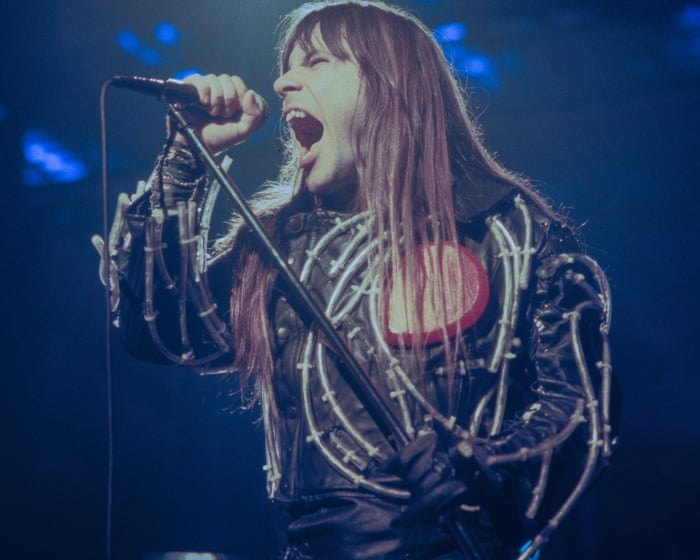
I owe my English A-level to Iron Maiden. I was 14 when I picked up a copy of their album The Number of the Beast, knowing it was essential listening for budding metalheads. I didn’t expect its demanding grandeur to calm my anxious mind, but it did. It started a lifelong obsession, especially with the most over-the-top parts of Maiden’s work—and they rarely got more flamboyant than the 13-minute The Rime of the Ancient Mariner from Powerslave, which closely retells Coleridge’s epic poem. I studied the song as if I’d be tested on it, from its marching verses to the creaking bridge and hallucinatory lyrics. It has no chorus, and I can still recite it word for word. By coincidence, the original Romantic masterpiece—about a sailor cursed with eternal life who learns to appreciate nature—was on my college syllabus soon after. I hardly went to class, but I aced the exam. Thanks, guys! Matt Mills
Grace Paley via the National
National treasure … Grace Paley.
With almost predictable inevitability, I discovered many books through the National, a band almost always described as “literary.” Singer Matt Berninger (whose wife is a former literary editor at the New Yorker) mentioned Play It As It Lays, which introduced me to Joan Didion. I think he also led me to Richard Yates. When Berninger did the Guardian’s reader interview three years ago, many people aware of his good taste asked what he was reading. That’s how I picked up Amy Bloom’s excellent White Houses. But my favorite discovery through Berninger was a bit different from those melancholic works. He has said the lyrics to Boxer were partly inspired by Grace Paley’s interconnected short story collection Enormous Changes at the Last Minute, about working-class New Yorkers who drift in and out of the same tenement buildings and beds. Her use of language is everyday, sharp, and hilarious, telling raw stories of domestic life. If I could start over, I could see myself dedicating a lifetime to studying her words. Laura Snapes
Saul Bellow via Fionn Regan
Conditioned, like most people, to think that calling a band or artist “literary” is the ultimate backhanded compliment—labeling them as sexless, pretentious enemies to pop’s raw joys—I usually cringe when a song name-drops a book title. So I should have run a mile when I heard Irish singer-songwriter Fionn Regan’s debut single, Put a Penny in the Slot, which does it not once, but twice. But the song is a gem: a wry ode to a lost love from the perspective of a lovesick, nostalgic, slightly pretentious ex, and a beautiful piece of fingerpicked folk. I was in the middle of a modern American fiction module at university at the time, so I even followed one of its recommendations and picked up Saul Bellow’s picaresque novel The Adventures of Augie March, about a young Jewish man’s misadventures in Depression-era Chicago. It was a great introduction to one of the 20th century’s greatest authors, a technician who performs a tiny magic trick with every sentence. Strangely, though, I’ve never followed the song’s other book recommendation: Paul Auster’s Timbuktu. I really should, since Regan hasn’t steered me wrong so far. Gwilym Mumford
Antonio Gramsci via Scritti Politti
It took me a while to fully warm up tScritti Politti singer Green Gartside once described the Peel Sessions EP’s sound as “scratchy-collapsey,” but within that splintering noise, a lot was happening—and the fiercely oblique lyrics pointed toward new worlds of ideas. The song “Messthetics,” in particular, stuck with me: “At your university, the pages are in French / It helps you find your way around in any English town.” That line genuinely gave me a primitive understanding of cultural capital. And “Hegemony,” which boldly opens with Italian anarchist Antonio Gramsci’s framing of dominant culture—”such here is the splendour of popular control”—basically introduced me to radical politics, even though its roots in English folk music went over my head. When “The Sweetest Girl” arrived not long after, it was a sonic shock, but Scritti’s dancing ideas—with clear references to Derrida, Foucault, and more—started me on the path to an MA in continental philosophy. Gartside has mentioned meeting a few men (always men!) after gigs who brought academic books, confessing they were inspired by his records. I haven’t written a book myself, but Scritti did help me find my way.
—Lindesay Irvine
This article was updated to correct an error introduced during editing: Powerslave is an Iron Maiden album, not a song.
Frequently Asked Questions
Of course Here is a list of FAQs about the idea of discovering great literature through pop music like Iron Maiden
Beginner General Questions
Q What does I owe my English Alevel to Iron Maiden even mean
A It means that listening to the heavy metal band Iron Maidenwhose songs are full of historical literary and mythological referencessparked an interest in those original stories This curiosity made studying classic texts for exams like English Alevel more engaging and personal
Q How can a heavy metal band help with literature
A Many bands use literature as direct inspiration For example Iron Maiden has songs based on The Rime of the Ancient Mariner Brave New World and Murders in the Rue Morgue The music acts as a thrilling gateway to the original book or poem
Q Isnt this just a lazy way to study
A Not at all Its about engagement not replacement Hearing a powerful song about a classic story creates an emotional hook and builds background knowledge You still have to read the original text and analyze it but you start with genuine interest and context
Q Can you give me a specific example
A Sure Iron Maidens epic song The Rime of the Ancient Mariner quotes directly from Coleridges poem and tells its story A student hearing it might think This is cool whats the original about and then seek out the 18thcentury poem already understanding its plot and themes
Deeper Dive Benefits
Q What are the main benefits of learning literature this way
A 1 Accessibility It makes old or complex texts feel immediate and exciting 2 Context You see how classic ideas remain relevant and are reinterpreted across generations 3 Motivation It transforms literature from a mandatory subject into a connected web of cool stories found in modern culture
Q Is Iron Maiden the only band that does this
A Far from it They are a famous example but many artists do this
Rush referenced Ayn Rand and Shakespeare