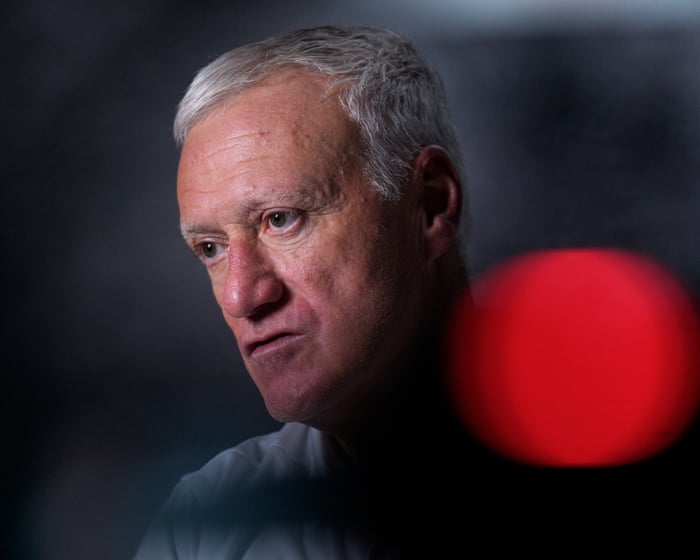
Follow the green path toward the Château de Clairefontaine, and you’ll come across a three-meter replica of the World Cup trophy, flanked by two stars that mark France’s World Cup victories. Didier Deschamps played a part in both—he captained the team to win in 1998 and then did it again as manager in 2018.
The 1998 World Cup final was France’s first ever, but now Les Bleus have been in four of the last seven finals, with Deschamps involved in three of them. In North America, he’ll have one last chance to reach another. These are the expectations, shaped by past success. Over his 14 years as manager, Deschamps has led France to three major finals. “We’re among the favorites,” he says as he sits down for the interview. “That word doesn’t bother me. If we have this status today—which seems logical and fair to me—it’s because of everything we’ve done and the results we’ve achieved.”
As we talk to Deschamps, his assistant, Guy Stéphan, pops his head in the door. “You’ve got the best,” he jokes. The France manager replies with a smile: “He’s always very objective.” Deschamps’ record as a player and then as a manager makes it hard to argue with Stéphan’s comment.
But there’s always a subjective side. “Abroad, there’s maybe more recognition,” says Deschamps. “I know very well, since I travel a lot abroad, that how people feel overseas is different from how they feel in France.” The concerns at home are about the playing style. Before addressing that, he lets out a small chuckle: “It depends on what you mean by ‘play style.’ Internationally, that’s one thing, but then there’s France, and goodness knows that if the French team has been labeled as defensive or restrictive, it didn’t stop us from getting results.”
But Deschamps isn’t someone who worries about his legacy. He insists that “it doesn’t matter” and that it doesn’t interest him. He adds: “The most important thing is today and tomorrow, and tomorrow is the World Cup. After that, everyone will have their own… interpretation, their own feeling.”
Public opinion is one thing, but how his colleagues see him is another. Gareth Southgate was a follower, and Deschamps reveals he’s also exchanged messages with Thomas Tuchel—”a very good manager that I like a lot too, and I get to talk with him often”—as well as Brazil’s Carlo Ancelotti and former Germany head coach Hansi Flick. Three major finals in 14 years and a Nations League title have made Deschamps the godfather of modern international football.
Yet he says there’s no secret formula to copy. “I have a magic word: adaptation… I tell myself, ‘Based on the person in front of me, I adapt.’ And that leads to changes… Just because we did something and it worked well doesn’t mean we shouldn’t change. But it’s not about changing just for the sake of it either,” he says.
Beyond tactics, there’s managing people, where adaptation is also key. “The generation from when I started in 2012 isn’t the same as today… the new generation needs more communication,” says Deschamps, who has overseen a shift in the France dressing room.
Since the 2022 World Cup final loss to Argentina, players like Hugo Lloris, Olivier Giroud, Raphaël Varane, and Antoine Griezmann have all retired from international football. “The baton has been passed,” says Deschamps, who named Kylian Mbappé as the successor to France’s most-capped player ever, Lloris.
“Kylian, today, who is our captain, before he was captain, he listened, he watched, he doesn’t…”He doesn’t do things like Hugo. It’s a completely different character and personality. He takes on that leadership role outside, on the pitch too, and he knows that when he speaks, he’s not speaking just for himself—he’s speaking for all the players as well.” Deschamps also defended his use of the Real Madrid forward: “I must be stupid, and there must have been a lot of stupid coaches who played him as a central striker in the teams he’s been with… for the last two years at Real and his final year at PSG… it’s been three years now that he’s played in a central role.”
Mbappé didn’t impress at Euro 2024. Breaking his nose in the opening game against Austria certainly didn’t help, and Deschamps also said his preparation for the tournament was “not ideal,” adding: “He came in after his last six months with PSG, which were very, very tough. He didn’t get much playing time.” Mbappé heads into this World Cup just one goal shy of Giroud’s all-time scoring record for France (57), and that alone justifies Deschamps’ decisions—choices that are always scrutinized, often criticized, but almost always the right ones.
[Image: Kylian Mbappé got closer to Olivier Giroud’s France goal record when he scored in a friendly against Brazil in March. Photograph: Franck Fife/AFP/Getty Images]
For Mbappé to break Giroud’s record, Deschamps needs to find the right “balance”—a word he repeats eight times during our conversation on a rainy afternoon. “At the 2022 World Cup, we already started with four attackers,” says Deschamps, pushing back against the idea that switching from a 4-3-3 to a 4-2-3-1 could leave France’s famously solid defense exposed.
He points to Griezmann’s role, who played in midfield at the 2022 World Cup as the fourth attacker in that setup. His replacement in the team came in the form of Michael Olise. “He’s more reserved, a bit shy, but when he’s on the pitch, it’s wonderful,” Deschamps says warmly. “Today, he’s someone who shines, and he’s one of the best players at the World Cup.”
Deschamps has tough decisions to make, especially in attack. Mbappé, Olise, Ousmane Dembélé, Rayan Cherki, Désiré Doué, Bradley Barcola, Marcus Thuram, Jean-Philippe Mateta, and Maghnes Akliouche can’t all play.
“It’s about managing the frustration of those who won’t start the game,” says Deschamps. “It’s always hard to accept, because every player thinks he’s better than the one playing in his spot… ask any top-level professional footballer, and they’ll say: ‘Competition? Of course, it’s part of our life,’ but only when it’s about a teammate. When it’s about them, it’s much harder.”
[Image: French fans pay tribute to Didier Deschamps during the friendly against Côte d’Ivoire. Photograph: Sebastien Salom-Gomis/Sipa/Shutterstock]
As a result, and in line with comments from Tuchel, who is newer to international management, Deschamps insists it’s not just about picking the best 26 players for the World Cup.
Deschamps, who will turn 58 in October, already knows all this. International management, he says, is a “completely different job” from club management, and none of his fellow World Cup coaches have as much experience as he does.
“If I’m still here today, it’s because the French team has won a lot of games. Otherwise, it could have ended earlier—whether I decided to leave or it was decided for me,” he says. In the end, it’s the former. As he confirmed in January 2025, Deschamps will step down after France’s campaign this summer.
Fashion goals: The World Cup’s style tournament has already kicked off
Read more
This isn’t retirement, but the former Juventus, Monaco, and Marseille manager isn’t thinking about what comes next.Here’s what comes next. “I won’t make any decision until after [the World Cup],” he says, but admits offers have come in.
When asked if he might take a break, Deschamps says he has “the freedom to choose.” That wasn’t the case the last time he stepped away from the game for a long period. “I stopped at Juventus in 2007. Between 2007 and 2009, I was on almost every shortlist. But my son told me: ‘The problem is, you always fall short.'” He doesn’t exactly need the World Cup to put himself in the spotlight.
Deschamps doesn’t care about his legacy, but as he left the Château de Clairefontaine for the last time on Sunday, he had already made sure he left one behind.
Frequently Asked Questions
Here is a list of FAQs based on Didier Deschamps statement about Kylian Mbappé
BeginnerLevel Questions
Q What did Didier Deschamps actually say
A He said Mbappé knows that when he speaks he speaks for all the players
Q Who is Didier Deschamps
A He is the manager of the French national football team
Q What did he mean by that statement
A He meant that because Mbappé is the team captain and a superstar his public comments carry huge weight He isnt just speaking for himself his words affect and represent the entire squad
Q Is this a compliment to Mbappé
A Yes and no Its a compliment acknowledging his leadership and influence but its also a warning It reminds him that he has a big responsibility to be careful with what he says
Q Why is this statement important
A It highlights the unique pressure and responsibility that comes with being a captain and the face of a national team especially in a highstakes environment like a World Cup or European Championship
Advanced Questions
Q What was the context for Deschamps making this comment
A The comment was made during a press conference at the 2024 European Championship likely addressing recent public statements or interviews Mbappé had given about the teams tactics his own form or offfield issues
Q Does this mean Mbappé is not allowed to have a personal opinion
A No He can have personal opinions but Deschamps is reminding him that as captain he must weigh his words carefully A personal opinion can quickly become the teams official stance in the media
Q How does this statement reflect on the teams internal dynamics
A It suggests Deschamps is trying to manage the narrative and maintain unity He wants to ensure that Mbappés influence doesnt create a star player vs the rest culture where one persons words create pressure or conflict for the other players
Q Is this a common issue for other team captains in sports