Andy Burnham is planning to create a “No 10 North” as the “nerve centre of a rewired Britain” to oversee the devolution of power and resources across the UK. He says this would deliver the change the country desperately needs.
The prime minister-in-waiting said the Westminster system is “broken” and that a “more of the same” approach would neither improve living standards nor restore people’s faith in how politics works for them.
In his first speech since Keir Starmer announced he was stepping down, Burnham kept coming back to the idea of a decade of “change.” But he also laid out concrete policies to transform how the country works, starting with overcoming Whitehall’s resistance to change.
No 10 North would have three “clear tasks” for devolution: increase public ownership of essential utilities like water, energy, and housing; reindustrialise large parts of the country; and regenerate towns, focusing on those that have been left behind.
This would include overseeing the biggest council housebuilding programme since the post-war period, he said, as well as ordering Whitehall to back British firms bidding for public contracts – even if it costs taxpayers more.
However, Burnham acknowledged that “people can’t wait forever for change,” hinting at an early cost of living support package once he reaches Downing Street. “I heard on doorsteps in Makerfield how people need a bit extra now to help with rising costs,” he said.
“I will do my very best to deliver it, and while not taking risks with public finances, I will seek to give Britain some breathing space as soon as I can. People need to be able to look forward to a night out or a holiday with the kids. People need hope.”
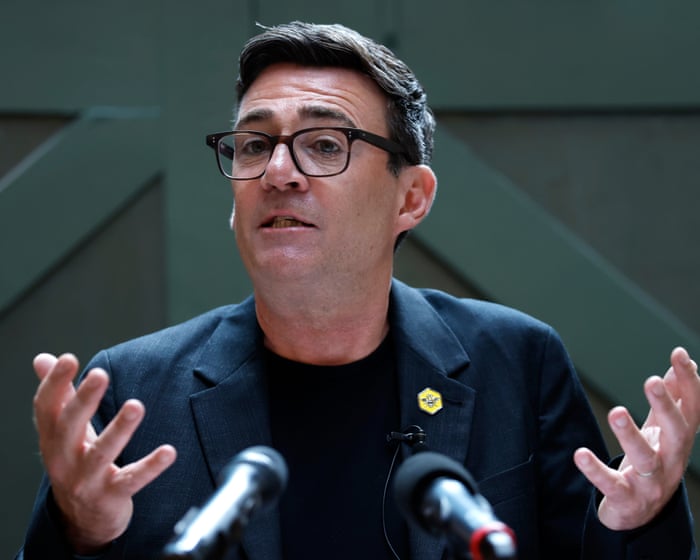
The new Makerfield MP, dressed in a dark T-shirt and jacket instead of the usual politician’s suit and tie, is expected to become prime minister on 20 July, unless he faces a challenge for the Labour leadership. His promise of a “new direction” is at the heart of his offer to the country.
He told his audience at the People’s History Museum in Manchester: “What hope can we have that it will be different this time? That is the question I would be asking if I was a voter right now.
“Westminster has not been working for people, and it hasn’t been working for a very long time. In fact, it is broken. And as a result, the country isn’t where it should be. It is stuck in a rut, and clearly we can’t go on like this.”
Burnham, who served in the last Labour government and sat on the opposition benches until he became mayor of Greater Manchester, said his generation of politicians had to take responsibility for not being good enough.
“Now that might matter less in a world where people’s lives are getting better, but when they are not, it is dangerous and destructive of what remains of cultural trust in politics,” he said. “We can’t go through another decade like the one we just had. We need a new determination to raise living standards… We need to change politics, and we need to do it now.”
Burnham used his speech to once again reassure the markets that he is committed to sticking to the fiscal rules, after he suggested last year that the UK was “in hock” to bond markets. He added that his programme is backed by “the discipline that comes from sound public finances.”
But despite speculation over his choice of chancellor, which would give the clearest indication yet of his economic direction, he said he would not announce key cabinet positions until he is closer to power.
Instead, he said he would…He wanted to create a “broad church” within the Labour Party, after concerns that the Starmer government had become too factional. He planned to reach out to other political parties to find “as much common ground as we can” to help deliver his 10-year plan for change.
Burnham said Whitehall had long been “too adversarial” and that different departments had wasted too much time fighting each other. “Let me say this very directly: the days of Whitehall fighting the devolution of power into the regions and nations are over for good.”
He said the UK needed “a complete rethink” on how to support the next generation to succeed. He promised to expand technical education, giving every young person a “clear path” into a reindustrialised Britain, and to rebalance the focus away from just the university route.
Echoing the words of John Lennon, Burnham asked people to imagine “hope in every heart” as he wrapped up his pitch to become Britain’s next prime minister. “Imagine what things could be like if we succeed. Imagine what it would feel like to live in a country wired to work for ordinary people rather than against them,” he said.
Frequently Asked Questions
Here is a list of FAQs about Andy Burnhams No 10 North proposal written in a natural conversational tone
BeginnerLevel Questions
Q What is No 10 North
A Its a plan by Andy Burnham to move the heart of the UK governments decisionmaking out of London The idea is to create a new hub in the North of England that would act as a central command centre for running the country
Q Who is Andy Burnham
A Hes the Mayor of Greater Manchester and a wellknown politician Hes a big advocate for giving more power to regions outside of London
Q Why does he want to do this
A He believes the UK is too Londoncentric He argues that too much money power and attention is focused on the capital which holds back other parts of the country like the North
Q Does this mean the actual Number 10 Downing Street would be moved
A No The Prime Ministers official residence wouldnt physically move No 10 North is a symbolic name for a new powerful government base in the North It would be a second equal nerve centre not a replacement
Q Who would work at No 10 North
A The idea is that senior government officials policy advisors and even the Prime Minister would spend significant time there It wouldnt just be a regional office it would be a primary location for running the country
Advanced Detailed Questions
Q How would No 10 North actually rewire Britain
A By physically relocating the centre of power it would force the government to see problems from a different perspective Decisions on transport housing and business would be made with a national not just a London view This would mean policies are designed to benefit the whole country not just the South East
Q What are the main benefits of this plan
A The key benefits include
Better decisionmaking Policies would be more relevant to the North and other regions
Economic boost It would create highskilled jobs and investment in the North helping to close the wealth gap with London
Improved public services Decisions on things like the NHS and transport would be made closer to the people they affect