This was it. The wreck we’d been searching for.
Richard: Bryn stood under a dripping hedge, waving like we were long-lost cousins meeting at a funeral. “Welcome to paradise!” he shouted as I stepped out of the camper, my raincoat flapping in the wind.
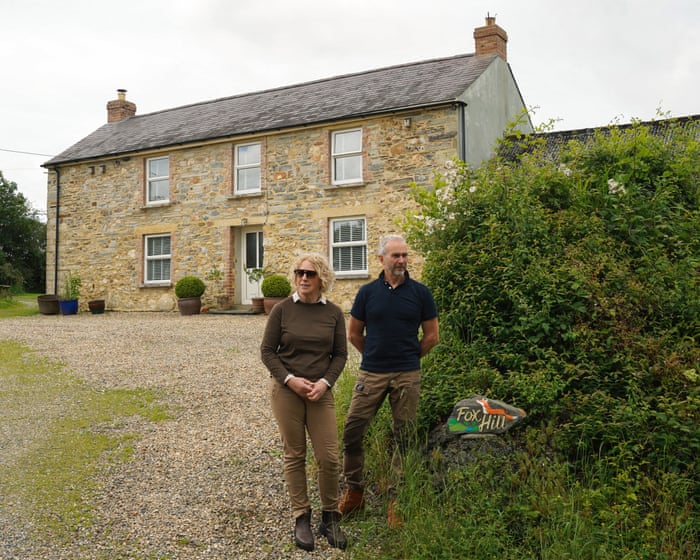
I’d come to see the old stone farmhouse Bryn was selling: Fox Hill in Pembrokeshire, west Wales. The place looked like someone had packed up in a hurry… around 1978. The front door got stuck halfway, and Bryn gave it a confident shoulder-barge, as if this was part of the tour. Inside, ceiling panels had fallen in, wallpaper was peeling in long curls, and the stairs looked like a booby trap. The kitchen smelled faintly of badgers and despair.
“You’ve got to see it with your heart, not your eyes,” Bryn said cheerfully, leading me through the wreckage. “It’s all in the bones.”
But then we stepped through the back door. The change was instant. The yard was uneven and overgrown with nettles, but beyond it, the land opened up like a secret you weren’t supposed to find. Water meadows rolled out in every direction, white with wood anemones. A narrow river, the Cleddau, wound its way through the fields. The woodland that bordered it stood tall and watchful.
I stopped dead, my breath caught. For the first time in months, maybe years, my mind went still.
“Bloody hell,” I said quietly.
Bryn stood beside me, hands on his hips, grinning like a man who’d just witnessed a conversion. “See?”
And I did. I saw it clear as day – my partner, Amanda, here, barefoot in the meadow, laughing. Archie, our bedlington/whippet-cross, running through the long grass. Mornings with birdsong instead of traffic.
This was it. The wreck we’d been searching for.
That evening, sitting in our camper with the rain still tapping on the roof, I phoned Amanda. My voice shook – a mix of excitement, disbelief, and exhaustion. “You need to see this place,” I told her. “The house is… indescribable. But the land? It’s like Wales has been saving it for us.”
We moved into Fox Hill in January 2018. Soon, the real work began. Drainage was first – or rather, the lack of it. The ground around the house was permanently soaked, more bog than garden. So out came the diggers, slicing trenches into the wet earth as we laid new pipes, gravel channels, and soaked through every pair of socks we owned.
Then came the roof. Or roofs. Slates were missing, chimneys were crumbling, and flues were gummed up with decades of soot and jackdaw debris. Outbuildings were rebuilt, one by one, until the place started to feel less like a haunted relic and more like a real, living home again. Despite everything the Welsh weather threw at us – and it threw plenty – we kept going.
We bought a tired but beautiful 1974 red Leyland Atlantean double-decker bus and set up camp in it until the house was ready to live in.
Some of the land from the old farm hadn’t been sold with the house, because Bryn had split it into three parcels. It didn’t take long before Amanda had set her heart on the surrounding paddocks. One afternoon, as she and Bryn stood by the gate, she told him how much the land meant to us, how we wanted to restore it and nurture the wildlife there. He gave her a solemn nod and said, “The land is yours, Amanda. As soon as you have the money, I’ll sell it to you.”
A sleek blue BMW rolled up the track. A tall man stepped out.
Amanda: It was one of those Welsh summer mornings that made weeks of rain and wind seem like distant rumors. The bus felt like home now, a strange, wheeled sanctuary on the hill. I’d made bread while Richard had gone off to buy a caravan for my grown-up daughter Grace to sleep in when she visited. It was the first time I’d been there on my own.
I was midway through choosing floral duvets and enamel crockery fOne evening, after watching a particularly disturbing video, I muttered, “He’s not right. There’s something going on in his head, and it’s not just stress.”
Another strange message came through on a Saturday. Cassie said she was bringing a friend to walk the footpath along our land. We replied warmly—no problem there. But that evening, Amanda noticed something odd. Cassie’s WhatsApp profile picture had changed. It was now a photo of our water meadow.
Amanda raised an eyebrow. “That’s our riverbank. She must have gone over the fence.”
She messaged Cassie: had the footpath gate been locked? Cassie replied that yes, it had been tied shut, so she took her friend to our water meadow instead. That was it. No apology. No thanks. Just a calm admission of trespass, as if our boundaries didn’t matter. That evening, we sat on the steps of the bus, a heavy silence between us.
“She wants us to react,” Amanda said. “They both do.”
Soon after, the message came: “We’re not selling you the land anymore. We’ll return your money.”
It quickly became clear they had no intention of doing that. Months later, my stomach dropped when I noticed Francis’s WhatsApp profile picture had changed. There it was: a gleaming Harley-Davidson, polished to perfection, chrome glinting in the light. Beneath it, a caption in his casual, mocking tone: “Just bought a new bike, cheers bus wankers.”
Within seconds, I Googled the model: £25,000. Our money. I had trusted Francis. We both had. We believed in their story—two misfits looking for peace and community. What we hadn’t seen was that their need went deeper than friendship. They needed control. They needed attention.
At night, I could still hear the ATV in the distance, circling their land, the engine whining like a warning. And then there were the dogs. Freya and Odin, their two sleek Dobermans, had once been just part of the background, racing across the fields, playful and carefree. But lately, their presence felt different—less like pets and more like part of the arsenal. In some of the videos Francis sent, the dogs were filmed barking aggressively toward the hedgerows, straining against his command.
At 9:51 PM, Amanda squeezed toothpaste onto her brush, turned the tap, and then… nothing—dry silence. “Babe, there’s no water!” she called, her voice tight with panic.
I felt a grim certainty settle in. “I thought he might. He’s cut the pipe.”
By then, we were well past hoping things would calm down. The police were already involved, and every new act of harassment was being added to an increasingly disturbing record. We followed protocol and dialed 101. Twenty minutes later, a figure appeared, uniformed and steady.
“PC Rory Pearce, at your service,” he said, his voice calm. “What seems to be the problem?”
“You can’t be without water,” he told us after a quick explanation. “I’ll escort you to find the fault.”
The last light of day hung in the sky as we traced the pipe across Francis’s land, scanning for puddles or bursts. “Maybe he hasn’t vandalized it,” I offered, clinging to hope.
“Here we go,” Rory called, pointing. A small fountain bubbled from the grass. We returned to the bus, and I scrambled for connectors and pipe.
The next night, I was jolted awake by the growl of an engine. Peering out, I saw Cassie and Francis driving across the field, straight toward the section where we had made our repairs the night before. Moments later, I heard Amanda’s voice.
“No water. They’ve done it again.”
Amanda dialed 101 with trembling fingers. Police officers arrived quickly, and I gathered my tools once more.
An email arrived from Francis: “I got approval for a campsite. It will overlook your special glade. Enjoy your privacy.”Privacy for the next month or so 🙂 I never stop, I never lose.
The water pipe had become Francis’s new target. Before he bought the fields, and before we bought the farmhouse and paddocks, the land was all one property. Bryn split it, thinking he’d get a better price, which left our main water supply buried under what was now Francis’s land.
Even on a Sunday, I found the parts. I patched the pipe again, dripping with sweat and anger in equal amounts. The effort wore all of us out, including the officers.
One afternoon, Amanda came home with a heavy step. Francis was putting up a fence. Not a hedge, not posts and wire, not the kind of weathered wood that fits into the landscape. This was palisade security fencing: two metres high, running the full length of the boundary where his land met ours. It was a continuous wall of galvanised steel, each section topped with jagged spikes that glinted in the sun like rows of bayonets. It was the kind of fencing you’d expect around an industrial estate or a scrapyard. To countryside eyes, it was an eyesore, a scar across open farmland. This wasn’t just a fence. It was a message: You are trapped.
Soon, Francis and Cassie fixed metal hoops around the steel posts and hung a long sheet of black silage plastic. It was designed to make noise. With the slightest breeze, the sheet thundered and rattled like a drum, a constant, grating backdrop meant to fray nerves.
As the noise and fear grew, the civil case we had started over the land we paid for moved at a snail’s pace. Francis lied at every chance, denying the land deal and then claiming he had already paid us back, even though we had proof he hadn’t. The solicitor’s bills were climbing far beyond his first estimate.
And still, Francis found ways to tighten the screws. One morning, an email arrived. Amanda opened it, trembling as she read aloud: “Did you see my visitor today? He was there to check out the fields. He passed you in the silver Audi. I got approval for a campsite. It will overlook your special glade. Enjoy your privacy for the next month or so 🙂 I never stop, I never lose.”
The words felt like a knife twisting.
“Stay inside,” the police handler said. “Officers are on their way.”
Amanda: One morning, Francis was at the huge fence, banging a piece of steel against the posts as if he were playing some awful percussion instrument. He tossed the bar aside, slid into his BMW, and roared off down the lane. The silence that followed wasn’t relief; it was heavier than the noise itself.
The Collinses came back a short time later in the ATV and climbed out as if they were arriving at a fair. Francis set a hessian sack against the ATV’s wheel. Cassie stood a step back, glancing up and down the fence line as if checking whether we were watching.
We were. I didn’t understand what I was looking at until he reached into the vehicle and lifted out a crossbow. Then another. For a few seconds, everything in me refused to accept the image – crossbows here, in this quiet field where the loudest sound should be a rook’s call or a gate latch knocking in the wind. Then the first thunk landed in the sack.
They reloaded from their pockets with practiced, twitchy movements, like they’d done it a hundred times in private and were now ready for the performance. A second thunk. Then a third. They weren’t firing bolts, but something smaller, maybe bullets or balls.
“It’s not normal,” I said when they finally drove away. “It’s not normal to play with weapons at your neighbours’ fence.”
Richard nodded slowly.”He wanted us to see.”
After dinner in the bus, all I wanted was to pretend, even for a little while, that we were living a normal life. Richard had set up the old TV in the front room, which we jokingly called the “lounge,” even though it was really just a half-stripped room with bare floorboards and drafts sneaking in under the door. When the credits rolled, I let out a small sigh and went back to the bus. I climbed the narrow stairs and felt a rush of air coming down the stairwell. I flicked the switch at the top — and froze.
The windows — two of them — were shattered. Spiderweb cracks spread across the glass like veins, and on the duvet on the floor, tiny shards glittered in the light. Scattered among them were small, round 10mm ball bearings — cold, heavy, deliberate.
Richard came running up behind me, but I barely noticed. My whole body was shaking, my knees felt weak. All I could think was, What if he’d been in bed? What if I had come up here sooner? We would have been hit.
“I thought they’d gone,” I whispered, my voice cracking. “I thought it was safe.” But it wasn’t safe. It was never safe. And in that moment, I realized our last illusion had shattered along with the glass.
Richard grabbed the phone, and his voice cracked as he gave the address — there was no need; they already knew exactly where we were. I could hear the calm efficiency of the handler on the other end, but her steady tone only made my panic feel sharper. “Stay inside. Officers are on their way.”
Suddenly, the driveway filled with blue flashing lights that turned the valley into a theater of flickering shadows. For what felt like forever, armed officers prowled the perimeter, their radios crackling in short bursts. And then, as quickly as they’d come, they were gone, leaving us alone, our nerves completely frayed.
The next morning, the police came back. They collected the two ball bearings from the bus floor upstairs and started searching the gravel outside. We realized then that several must have hit the bodywork too.
The ball bearings were sent for DNA testing. Weeks later, the answer came back: nothing. No prints, no DNA. It was another attack that he had gotten away with, untouched. Our hearts sank. Frustration burned hot in the pit of my stomach, and the police looked just as defeated.
‘You have no idea what they’re capable of’
Richard: Our days narrowed down to survival. We did what we could to keep things normal — feeding the dogs, fixing fences, cooking dinner — while the Collinses kept circling like vultures that had forgotten how to leave. Any quiet never lasted long.
When the smell hit, it was sharp, chemical, wrong. Fuel, thick in the air. For a second, I thought maybe the generator had leaked, or the bus’s old fuel tank had split in the cold. I stepped outside, the morning still pale and misty.
“Christ,” I muttered, crouching down to check under the bus. No leak. No wet patch. Just that acrid smell clinging to everything. I stood up, walked around the front, and stopped dead.
“Holy shit,” I whispered. “What’s he done?”
The gravel was blackened, and there was a scorched patch of ground near the bus door. And lying a few feet away were three petrol bombs: one had exploded, one had smashed but not ignited, and one was still intact.
For a moment, I just stood there, my heart pounding in my ears, trying to process what I was seeing. This wasn’t vandalism. It was an attack. The bus, our beautiful bus, was scarred. The red paint had blistered and bubbled where the heat had licked at its sides. The panels that used to shine were now pockmarked, dented, and blackened. The plywood windows, rough replacements for the glass Francis had shot out months earlier, were streaked with soot.
I looked at where the petrol bombs had landed, just feet from the fuel tank.The bottled gas pipe ran under the chassis. A few inches closer, and she would have gone up like a fireball. Francis didn’t know, but we had moved into the house just a few days earlier. He wasn’t trying to scare us. He was trying to kill us.
My brain was flipping through some kind of survival manual: preserve the scene, don’t touch evidence, do something—anything—to stop shaking. Then I forced myself to dial 999. The operator knew who I was before I even said my name.
It was strange how hope could show up dressed in the uniform of a police email. I read the message twice before I let myself believe it. Finally, the police had them. The email from DC Jason Thomas laid it all out, their bail conditions in bullet points that felt both cold and wonderful:
– Not to enter Pembrokeshire
– Not to contact you directly or indirectly
– Curfew between 21:00 and 06:00
I wanted to believe this was the turning point, that maybe, at last, the worst was behind us. But I also knew the Collinses. I had seen what they were capable of when cornered.
Then, on 3 June 2020, came the news we had been waiting for: Francis had been charged. Over the phone, DC Matt Briggs read out the list:
– Arson
– Possession of a firearm without a certificate
– Possession of ammunition without a certificate
– Sending electronic communications with intent to cause distress or anxiety
– Stalking involving fear of violence or serious alarm or distress
– Sending a threatening message
– Possession of a controlled drug – Class B (amphetamine)
The guns and drugs had been found when the Collinses’ property was raided. They had sent thousands of threatening messages—even horrific references to Amanda’s daughter Grace. I couldn’t speak. Amanda stood beside me, her hand over her mouth.
“Is he remanded?” I finally asked.
“Yes,” Briggs said. “He’s behind bars.”
I don’t think I’ve ever felt such a complex wave of emotion—relief, disbelief, grief, and exhaustion all mixed into one.
The night before the court hearing felt heavier than any we had known. Neither of us slept much. In the waiting room, the minutes dragged. Amanda sat with her hands folded tightly in her lap, staring at the clock. Finally, Mr. Scrivens, the CPS prosecutor, swept in, robes billowing, expression tight. He dropped into the chair opposite us.
“Well,” he said, “you won’t be giving evidence today.” He exhaled sharply. “The jury have been sent away,” he said. “A deal’s been struck between myself and the defence. Collins has entered a plea. The judge has agreed to his immediate release.”
For a moment, I didn’t understand. Then Amanda spoke, her voice cracking. “Wait—what? Released? How?”
Scrivens didn’t meet our eyes. “He’s pleaded guilty to the malicious communications and the petrol bomb incidents. The judge considers the seven months he’s already served on remand sufficient.”
I felt my throat close. Two years of evidence, thousands of messages, all the fear, the threats, the nights we slept with one eye open—gone in a blink. No jury. No testimony. No voice.
“He’s pleaded guilty,” Scrivens said. “The restraining order will remain in place.”
“That’s not justice,” I said. “That’s paperwork.” He didn’t argue. He just looked tired.
“The court believes they’re moving to Devon,” he added. “They no longer pose a threat.”
I laughed, a sharp, hollow sound. “You have no idea what they’re capable of.”
Amanda’s voice broke again. “Can we apply for compensation? For what he’s done to us—to our lives, our business…”
He cut her off. “Were you physically injured?”
She blinked. “No, but we’re mentally destroyed. He stole from us. He threatened to kill us. All these weeks of waiting for our time have been wasted…”
“Then I’m afraid,” he said, “there’s nothing we can do.””You’re entitled to nothing.”
View image in fullscreen
‘We tried to make sense of it all.’ Photograph: Leia Morrison/The Guardian
Saturday 11 September 2021. Autumn was quietly nudging summer aside—the air cooler, the light softer. The phone rattled against the counter, the sound oddly sharp in the calm.
“It’s Dyfed-Powys police. We’re just checking that you and Amanda are both all right.”
Something inside me went cold. The voice was polite, almost routine, but underneath it was a tone I recognised too well—the kind reserved for bad news.
“Yes, we’re fine,” I said slowly. “Why do you ask?”
“There’s been an incident at the Collinses’ house in Devon.”
For a moment, all I heard was the faint buzz of the radio, the dogs shifting in their sleep, and the kettle beginning to tick as it cooled.
“Local police have recovered the bodies of three animals and two humans.”
“Francis and Cassie?”
“Yes, sir.”
I sat down. The floor seemed to tilt slightly.
“What… what happened?”
“I’m afraid I can’t say more at this time,” the voice continued gently. “We just needed to check that you’re both safe.”
We never did learn what truly drove them into such darkness, what pressure was being placed on them and from whom.
I should have felt relief. Instead, what came was confusion, disbelief, and then, underneath it all, grief. Not for what they’d done, but for what we had lost of ourselves.
We never did learn what truly drove them into such darkness, what pressure was being placed on them and from whom. At the time of their deaths, we knew that the serious and organised crime department had been investigating Francis, but any answers that investigation might have held died with him. What remained were questions that, to this day, have never been fully resolved.
They were poorly—not just in mind, but in spirit—caught in something none of us could see or understand. Whatever it was, it consumed them, and in the end, it claimed them. Their deaths were ruled a double suicide. In the quiet that followed, we tried to make sense of it all. Sometimes we’d talk about it softly over breakfast, sometimes we’d sit outside in silence, letting the wind and birdsong fill the gaps that words couldn’t reach.
We were changed, both of us. Scarred, yes, but also sharpened—more awake to the fragility of things: the land, the sky, the small mercies we’d once taken for granted. As the autumn light faded over the hills, Amanda stood beside me on the field we’d once fought so hard for, her hand in mine. The grass shimmered gold, and a red kite wheeled lazily overhead.
“Maybe now,” she said, her voice soft but sure, “the land can heal.”
I looked out over the valley, at the place that had nearly broken us and yet somehow saved us, and nodded.
“Maybe we all can,” I said. And for the first time in years, I believed it.
Stalked by Amanda Hutton and Richard Burton is published by HarperElement. To support the Guardian, order your copy from guardianbookshop.com. Delivery charges may apply.
Frequently Asked Questions
Here is a list of FAQs based on the story He wasnt trying to scare us He was trying to kill us
BeginnerLevel Questions
Q What is this story about
A Its about a family who moves into their dream home only to discover that their neighbors are not just being weirdthey are deliberately stalking and threatening them The title reveals the neighbors ultimate goal was murder not just harassment
Q Who is telling the story
A The story is told from the perspective of the family who lived through the nightmare Its their firsthand account of being stalked by their neighbors
Q What does the title mean
A The title means the family initially thought the neighbors were just trying to frighten them But they later realized the neighbors were actively planning to kill them
Q Why would neighbors want to kill someone
A In this story the neighbors appear to be motivated by extreme jealousy a sense of entitlement or a deepseated grudge They felt the new family didnt belong in the neighborhood or had taken something they wanted
Q Is this a true story
A Its presented as a reallife account While specific details may be dramatized its based on actual events of neighbor stalking and threats
AdvancedLevel Questions
Q How did the neighbors stalk the family without getting caught
A The neighbors used subtle nonviolent tactics early on like leaving notes watching from windows and making strange noises They avoided direct confrontation making it hard for police to prove a crime was occurring until the threats escalated
Q What specific nightmare events happened in the story
A The family experienced things like constant surveillance property damage threatening messages the neighbors mimicking their daily routines and eventually physical threats or attempts on their lives
Q Why didnt the family just move out
A They initially tried to ignore the behavior hoping it would stop By the time they realized the danger they were trappedfinancially and psychologically The neighbors goal was to break them down before killing them