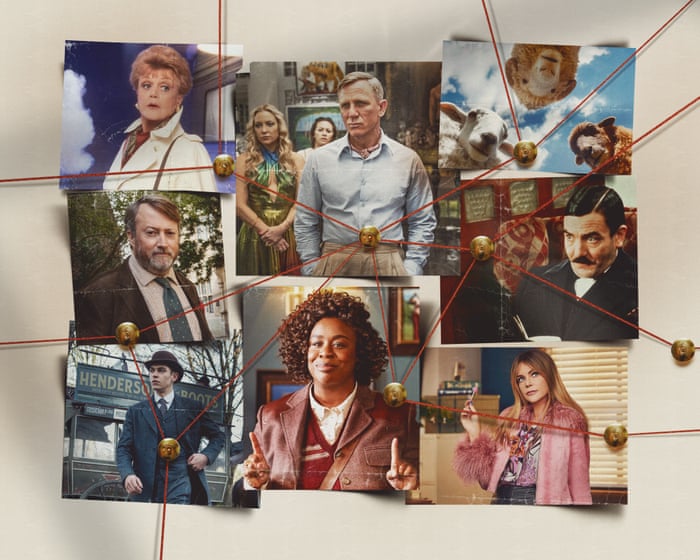
On TV, you don’t need to be a cop to solve crimes—the police can just hire you as a consultant. All you need is a knack for cracking every mystery before the next episode airs. You could be a retired detective (like in Monk, Ridley, or the many Poirot spin-offs), a bestselling mystery writer (Murder, She Wrote, Castle), a vicar (Grantchester), or even a convicted fraudster looking for redemption (White Collar, Wild Cards). You might be a fake psychic (Psych, The Mentalist), a human lie detector (Lie to Me), or a private investigator (like in all the Sherlock Holmes adaptations and spin-offs, or Shonda Rhimes’s The Residence). Or, in the case of Death Valley, you could be a retired actor famous for playing a detective on TV.
The “consultant” trope—a super-talented investigator who isn’t a cop but teams up with the police to solve crimes—is so common that the pop-culture site TV Tropes has its own page for it: “No badge? No problem!” But lately, this evergreen character has seen a resurgence.
For example, in the series High Potential, Morgan Gillory is a frazzled mother of three with a very high IQ who works as a cleaner for the LAPD. After solving a case left on an evidence board overnight, she’s asked to join the major crimes division. Elsbeth, a spin-off of The Good Wife, follows a sweet but sharp lawyer sent by the Department of Justice to monitor the NYPD and look into alleged misconduct. She ends up staying to catch a murderer each week. In Ludwig, the reclusive puzzle-maker John “Ludwig” Taylor infiltrates the Cambridge police by pretending to be his missing twin brother, who’s a real detective. When his identity is revealed, he’s not arrested—he’s offered a job.
We’ve also seen a wave of Holmes-inspired stories, from Guy Ritchie’s prequel Young Sherlock to the Enola Holmes franchise, which returns with its third installment this week (though the young detectives don’t work with the police yet). And the BBC has just announced another version of Agatha Christie’s Hercule Poirot, this time as a handsome thirtysomething private detective, which has caused some backlash: “We don’t need a young and sexy Hercule Poirot,” declared Metro. Meanwhile, on the big screen, the surprise hit of this spring was a family movie called The Sheep Detectives, where a flock of sheep (yes, you read that right) helps a bumbling policeman bring their shepherd’s killer to justice.
I’m as hooked on these stories as everyone else seems to be. But I can’t stop wondering why there are so many DIY detectives on our screens. Where did the “consultant” role come from, and how has it changed? Does this fictional role have any link to real-life policing? What makes it so lasting and appealing—especially now? In the spirit of amateur investigation, I’ve decided to look into it.
This figure can be traced back to the very start of detective fiction. Elspeth Latimer, an associate tutor in crime writing at the University of East Anglia, explains: “Between 1841 and 1844, Edgar Allan Poe published three mystery stories set in Paris featuring C. Auguste Dupin, who uses his powers of observation and deduction to help the police solve seemingly impossible crimes.” In his first story, The Murders in the Rue Morgue, Dupin boasts that “most men, in respect to himself, [wear] windows in their bosoms”—he can tell exactly what they’re thinking. He then identifies the elusive killer of a gruesome double murder (spoiler: it’s an orangutan).
“These tales of ratiocination”—that is, logical reasoning—“owe most of their popularity to being something in a new key,” Poe wrote at the time. No one was writing stories like his before. But soon, Dupin had a copycat who would far surpass him in fame and influence.When we first meet Arthur Conan Doyle’s Sherlock Holmes in the 1887 story A Study in Scarlet, he introduces himself as a “consulting detective” and explains: “Here in London we have lots of government detectives and lots of private ones. When these fellows are at fault they come to me, and I manage to put them on the right scent.” Like his predecessor, Holmes is an extreme rationalist and a walking encyclopedia who never misses a clue. He is also, crucially, an outsider who works outside the official police system. In true superhero style, he swoops onto the crime scene and saves the day.
The many consultants who have since appeared on our screens all follow this basic blueprint. (Every so often, there’s a wink to their roots – the pilot of Murder, She Wrote features the death of a man dressed as Holmes, complete with deerstalker hat, for a costume party.) As Latimer points out: “They may work with a team or have a sidekick, but often the lead character is shown to have a different interpretation of events that sets them apart from everyone else.”
They spot clues that no one else caught – or maybe they just have a hunch about a suspect. Then comes the eureka moment. Their face lights up and they announce it’s time to make an arrest. The perpetrator is confronted with the evidence, sometimes with all the suspects gathered in the same room. A confession is obtained on the spot.
The tone of most of these stories is lighthearted: comedic rather than tragic. The murders usually happen in the first five minutes, after which we’re free to enjoy the gentle humour and the puzzle of whodunit. If there’s variation, it’s in the consultant’s identity.
The most traditional are the Holmesian figures: introverted and obsessive men. In Ludwig, David Mitchell perfectly plays the awkward neurotic – though there’s a modern twist, as the show strongly suggests he may be neurodivergent. Agatha Christie’s Miss Marple serves as another popular template: the kindly old spinster who just happens to keep stumbling upon dastardly crimes. A contrasting character trend, which peaked in the early 2000s, is the handsome bachelor – the rogue with a heart of gold – who strikes up a season-long flirtation with his female cop partner (one of my first TV crushes was the twinkly-eyed Patrick Jane in The Mentalist).
The trope evolves with the times. Lately, we’ve seen a rise in the “lady detective,” matching the wider trend toward “women-centred” storytelling: the BBC has just announced a new cosy crime series, The Hairdresser Mysteries, with Sally Phillips as a village salon owner who turns sleuth. Meanwhile, the protagonists in Elsbeth and High Potential are both unapologetically girly girls who happily show up to murder scenes in fluffy pink coats and high-heeled boots. They are warm and empathetic with colleagues, victims, and suspects alike – but that doesn’t get in the way of their investigations. If anything, their soft skills are their superpower: how they get people to spill their secrets.
When I ask a friend who has worked as a detective in the Metropolitan police whether the characters I’m writing about have any basis in reality, she responds: “I am fairly certain the consulting detective exists purely in fiction.” She then admits that she rarely watches crime shows. “I get irritated when they don’t do things accurately, even though I know rationally that it’s fine because it’s a TV show.” She especially hates when the detective can “just tell” that someone is lying – she was trained to focus on evidence, not intuition.
In reality, there is no ongoing partnership, no desk at the station, no banter with the detectives. That’s not to say there are never situations where…In some cases, someone from outside the police might get involved in a criminal investigation. Stuart Gibbon, a former detective who now advises writers of crime fiction and true crime on police procedure, explains that various expert advisors—like forensic anthropologists, entomologists, and psychologists—can be brought in for specific parts of a case.
Gibbon recalls a murder investigation where they had CCTV footage of the suspects. “We noticed something about how these people were moving, so we hired a forensic podiatrist—someone who studies gait,” he says. The analysis showed that one suspect had a noticeable limp, which turned out to be key in identifying them.
View image in fullscreen
Unusual suspects … The Residence. Photograph: Erin Simkin/Netflix
Dr. Lorraine Sheridan, a former behavioral investigative advisor, specialized in assessing risks related to stalking, harassment, and threatening behavior. “I would review case materials like statements, communications, and behavioral histories,” she says. “Then I’d provide an assessment: what this pattern of behavior suggests about the person, the risk they pose, likely next steps, or how best to handle the situation.”
“I wasn’t going to crime scenes or sitting in interview rooms,” Sheridan adds. In general, her work looked nothing like what we see on TV. “There’s no ongoing partnership, no desk at the station, no casual chats with detectives over coffee.” Most importantly, she was called in for her specific expertise, not as a general problem-solver. “I wouldn’t be asked to profile a serial arsonist,” she says.
Top 10 cosy crime novels | SJ Bennett
Read more
Then there are civilian investigators, a role that several regional police forces in the UK have introduced over the past 20 years. “That’s because there’s such a shortage of detectives and investigators these days,” Gibbon says. Many are retired officers who already have the necessary training and want extra work—though anyone can apply and learn on the job. But they won’t be catching murder suspects (they don’t have the power to arrest or detain). Usually, they review CCTV footage or take witness statements for minor crimes like shoplifting or vandalism.
Gibbon doesn’t mind the creative freedom scriptwriters take. Real police work is much slower and more routine than what we see on screen. Not many viewers want to watch an officer sifting through hours of CCTV or a suspect answering every question with “no comment.”
View image in fullscreen
The sleuth is out there … Miss Marple. Photograph: ITV/Shutterstock
Could the consultant’s outsider status tap into our anti-authority feelings? The best maverick detectives often ignore the rules of an institution whose representatives—from Sherlock’s Inspector Lestrade onward—are usually shown as clumsy, overly bureaucratic, or even corrupt. In High Potential, for example, Morgan is sent to mandatory training after breaking protocol too many times (like taking evidence home or rushing an autopsy report). She skips class—calling it “obedience school for cops”—and gets fired for insubordination. But, of course, she’s soon rehired.
It makes sense that a character like this—a naturally talented genius taking on a dull bureaucracy—would appeal in these populist times, when distrust of experts and institutions is high. In the end, though, the rebellion in these shows is kept in check. If there’s a corrupt cop, they’re caught, and the consultant rarely feels bad when a suspect is led away in handcuffs, no matter how sad their story. What these characters really represent is a happy blend of rule-breaking and order.The balance between the institution and the individual. It’s no accident that a common storyline involves the consultant falling in love with their police partner. Despite their rebellious image, these shows are still “copaganda” — they ultimately support the police and the justice system, even if the main character isn’t an officer.
The life of private investigators: the strange return of hard-boiled detectives in 2026.
Read more
Still, we can’t stop watching them. Maybe when everything feels like it’s falling apart, what people want — at least in their TV shows — isn’t rebellion but stability. People often point out that these shows feel comforting, even though they deal with gruesome topics. It’s not just that they’re often lighthearted in tone (though that helps). As P.D. James famously said: “What the detective story is about is not murder but the restoration of order.” The inevitable — and endlessly repeated — moment when the mystery is solved and the villain is defeated creates a soothing fantasy: that the chaos of the world can be understood and controlled.
How nice to imagine that any of us, with no training, could step up and fix the mess we’re in. No badge? No problem.
Frequently Asked Questions
Here is a list of FAQs about the recent boom in amateur detectives on screen written in a natural tone with clear concise answers
BeginnerLevel Questions
Q Why are there so many shows about amateur detectives all of a sudden
A Its a popular trend because it makes solving mysteries feel more personal and fun We get to learn alongside a regular person not a cold professional
Q What exactly is an amateur detective
A Its a character who isnt a police officer or private investigator They solve crimes as a hobby a side job or because they accidentally get pulled into the case
Q Can you give me a few examples of these shows
A Sure Theres Sherlock Only Murders in the Building and Agatha Christies Poirot
Q Is there really a show about a detective sheep
A Yes Its called Shetland More accurately you might be thinking of The Sheep Detective or the sheep in Babe who solves a mystery The trend is that even animals can be sleuths
Q Are these shows realistic
A Not really In real life amateurs would get in the way of police But the shows are meant to be entertaining clever and cozy not realistic
IntermediateLevel Questions
Q Whats the difference between a cozy mystery and a crime drama with an amateur
A Cozy mysteries are lighthearted have no graphic violence and focus on puzzles Crime dramas are dark serious and show the real cost of crime
Q Why do so many amateur detectives have a sidekick or a skeptical friend