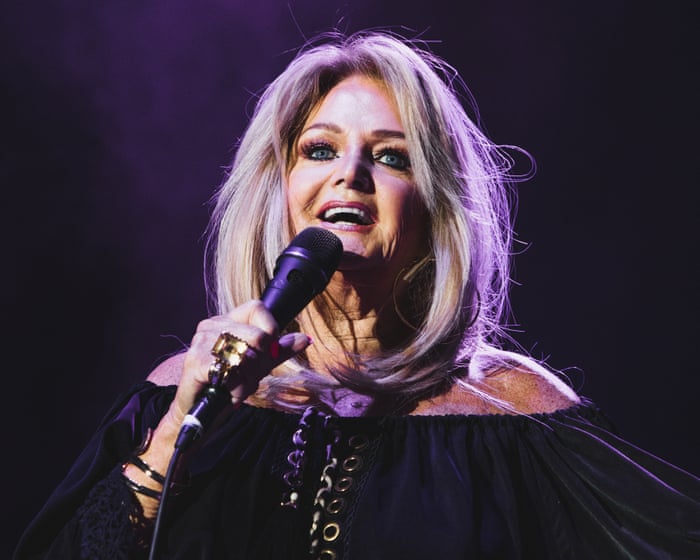
Bonnie Tyler had an unusual career: two separate bursts of worldwide success that seemed almost completely unrelated, except for the name on the records. Her first big British hits—”Lost in France” in 1976 and “It’s a Heartache” in 1977—were great examples of what writer Pete Paphides later called “medium wave pop.” This was the kind of music that actually filled the charts and Radio One’s playlists at a time when simplified rock histories would have you believe the whole country was obsessed with punk. The songs were a bit soft rock, a bit country, and a bit like the reliable mid-70s hitmakers Smokie. They were so catchy that hardly anyone noticed that between these releases, Tyler’s voice had changed dramatically. On “Lost in France,” she had a sweet tone, but after surgery to remove nodules from her vocal cords, she developed a striking, Rod Stewart-like huskiness by the time of “It’s a Heartache.”
It seemed like “It’s a Heartache” would make Tyler a huge star. It sold 6 million copies, and the album reached the Top 3 on the US country chart. But that success was hard to keep going, especially since her record label seemed unsure what to do with her. Should they have her cover Tom Petty and the Heartbreakers, like on “Louisiana Rain”? Aim her at the easy listening market with a version of “Sometimes When We Touch”? Or push her toward disco, as on the fabulously camp “(The World is Full of) Married Men”? None of it really worked, and that might have been the end—if Tyler hadn’t taken matters into her own hands.
A rock fan, she thought about asking Phil Collins or Jeff Lynne to work with her, but she was lucky enough to approach Jim Steinman at just the right time. The producer and songwriter’s relationship with Meat Loaf was strained after 1981’s Dead Ringer failed to match the multi-platinum sales of Bat Out of Hell. Meanwhile, his solo album Bad for Good had proven that no one wanted to hear Steinman sing his own songs. After two flops, Steinman clearly felt he had something to prove, and the best way to do that was to go all in. He was never a man for subtlety, and the songs he gave Tyler were over-the-top even by his standards, making Bat Out of Hell sound like an ambient album.
Because Tyler’s voice reminded him of John Fogerty, he suggested they cover Creedence Clearwater Revival’s “Have You Ever Seen the Rain?” Steinman’s version turned the rootsy acoustic original into a mix of mock-classical piano and screeching, metal-like guitar solos, complete with castanets. This, it turned out, was just a warm-up for the main event.
“Total Eclipse of the Heart” went on for seven minutes. It featured a pipe organ solo that sounded like it was being played by Count Dracula and was punctuated by explosions meant to represent nuclear bombs. As usual, Steinman claimed it was heavily influenced by Wagner. It would have sounded completely ridiculous, if not for the fact that Tyler’s vocal made it clear she didn’t think it was ridiculous at all. She sang as if her life depended on it. To use a modern term, she committed to the bit so completely that her voice became the song’s star attraction, rather than being drowned out by the chaos around it. Fast forward to about three and a half minutes in: Count Dracula has just finished his part, a choir of backing vocalists keeps urging “bright eyes” to turn around, and fake nuclear explosions are going off everywhere. But when Tyler’s voice comes back—”EVERY NOW AND THEN I FALL APART!”—you forget everything except her.
The end result couldn’t have been more different from “It’s a Heartache” if it tried. It went platinum in nine countries, hit number one on both sides of the Atlantic, and pushed Tyler’s album Faster Than the Speed of Night to sales of 3 million.The song proved completely immune to changing trends. In the 21st century, it kept popping back into the charts in the UK, US, Canada, France, Denmark, Belgium, and Hungary. By 2026, it had surpassed a billion streams on Spotify.
It was a level of success Tyler couldn’t replicate, though she came close with Holding Out for a Hero, another Steinman masterpiece from the Footloose soundtrack. With more explosions, another powerful Tyler vocal, and a Giorgio Moroder-style synth backing, it became another huge hit.
[Image: Bonnie Tyler performing in 1984. Photo: David Redfern/Redferns]
But Total Eclipse of the Heart might have actually hurt her partnership with Steinman because it was so successful. His career revived, Steinman was suddenly in high demand, working with everyone from Barbra Streisand to Def Leppard to wrestler Hulk Hogan. This meant he was only partly involved in her 1986 album Secret Dreams and Forbidden Fire. He executive produced and wrote four of the nine songs—fans of his over-the-top style should check out Rebel Without a Clue—while others filled in with mixed results. With all due respect, Freda Payne’s 1970 soul hit Band of Gold probably wasn’t the best choice for a Steinman-style makeover, even if it was reportedly the song that got Tyler noticed when a talent scout heard her sing it in a Swansea club back in the 1970s.
After that, her career in the UK and US faded, and she was unlucky not to have a comeback with The Best, the lead single from her 1988 album Hide Your Heart. It’s hard to understand why it wasn’t a big hit anywhere except Norway. It clearly wasn’t the song’s fault, since when Tina Turner covered it the following year, it sold millions and became her signature tune. (Modest as ever, Tyler said Turner had “done it much better than me.”) Not even the big push of her 1995 album Free Spirit—which briefly reunited her with Steinman, and included collaborations with Jeff Lynne, guest spots from Lenny Kravitz, and dance remixes by Ralphi Rosario—could get her back on the charts.
Still, she kept selling platinum albums in Europe well into the 90s, and her tours continued to fill arenas. A woman who, in the early 80s, had paused her string of Steinman-produced hits to record a duet with Shakin’ Stevens, her musical style stayed incredibly diverse. She seemed just as happy making prog rock with Rick Wakeman or former Genesis guitarist Steve Hackett, or gamely singing the UK’s 2013 Eurovision entry, as she did collaborating with David Guetta, re-recording her vocal from Total Eclipse of the Heart for his 2025 single Together. Once again, she sang as if her life depended on it.
Frequently Asked Questions
Here is a list of FAQs about Bonnie Tyler focusing on how she outshone her powerballad rivals and created a diverse range of pop music
BeginnerLevel Questions
1 What exactly is a power ballad and why is Bonnie Tyler famous for them
A power ballad is a slow emotional rock song that builds to a loud dramatic chorus Bonnie Tylers huge raspy voice and hits like Total Eclipse of the Heart made her the queen of this style in the 1980s
2 What song made Bonnie Tyler a global star
Total Eclipse of the Heart was her biggest hit Its a dramatic sevenminute power ballad that dominated charts worldwide
3 How did Bonnie Tylers voice get that unique raspy sound
She developed nodes on her vocal cords in the 1970s Instead of surgery she underwent voice therapy which left her with a permanent husky rock growl that became her trademark
4 Is Bonnie Tyler just a onehit wonder
No While Total Eclipse of the Heart is her most famous song she had many other hits like Its a Heartache Holding Out for a Hero and Lost in France She has sold over 100 million records worldwide
5 Did she only sing slow sad songs
Not at all While shes famous for ballads she also made upbeat rock songs country tunes and pop anthems Holding Out for a Hero is a fast powerful rock track not a ballad
AdvancedLevel Questions
6 How did Bonnie Tyler outshine other powerballad singers of her era
Singers like Celine Dion or Whitney Houston had perfect smooth voices Tylers raw gravelly voice felt more desperate and real She brought a gritty rockandroll edge to the ballad making her sound tougher and more passionate than her pop rivals
7 Whats the secret behind her diverse pop music range
She worked with different legendary songwriters Jim Steinman gave her theatrical operatic rock Other writers gave her countrypop and hard rock