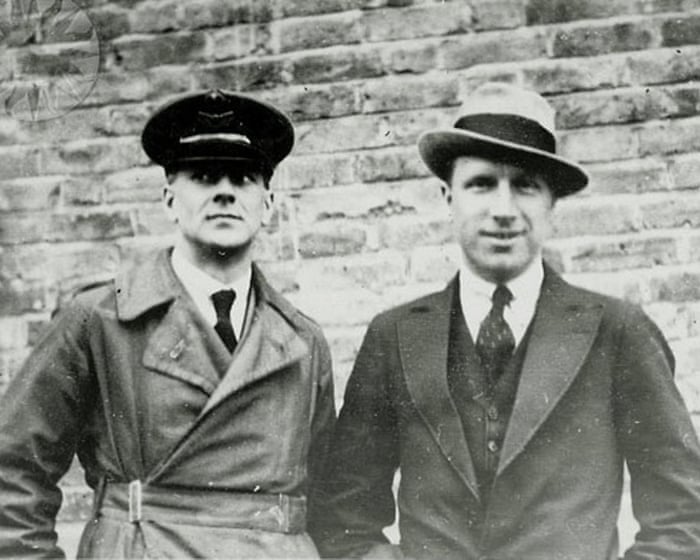
In the spring of 1944, Elsie Barber, a member of the Women’s Auxiliary Air Force, had a brief romance with a Royal Air Force pilot named Arthur Brown, who went by the nickname Buster. Their relationship at the RAF base near High Ercall in Shropshire was kept secret. She was 24 and single, while he was a recently married 21-year-old.
Buster died a few months later on D-day, when his Mosquito fighter plane crashed in the Netherlands. This left Elsie facing a difficult situation alone. She was pregnant, and after giving birth to a daughter, she decided to give her up for adoption.
The girl grew up not knowing her true origins – until, decades later, she decided to look into it and uncovered a story of family secrets, heartbreak, and heroism. Judy Bain is now 81 years old and a living connection to a legendary figure in aviation, who was born on July 23, 140 years ago.
Buster’s father – Judy’s grandfather – was Arthur Whitten Brown Sr., who, along with John Alcock, completed the first nonstop transatlantic flight in 1919. They flew 1,950 miles (3,138 km) from Canada to Ireland in 16 hours and 12 minutes, a feat that amazed and captivated the world.
For aviation enthusiasts, Brown’s birthday on July 23, 1886, carries a sad note because when he died in 1948 – heartbroken after losing Buster, his only child – it was believed he had no descendants. In fact, he has seven: Judy, her two children, and four grandchildren.
“One of the things that saddens me is that when he died, and his son died, there was no other family,” said Judy, speaking from her home in Perth, Australia. “Neither of them knew about me, and there were no other relatives at all.”
Piecing together her family’s story was bittersweet, but discovering a touch of fame was a welcome surprise. Alcock and Brown’s flight in a World War I Vickers Vimy biplane from Newfoundland to Clifden in County Galway was an achievement that showed the potential of long-distance air travel and earned both men acclaim and knighthoods.
Buster followed his father into the RAF, married in 1943, and had his romance with Elsie while stationed at the training base in Shropshire from January to March 1944. He was on a scouting mission when he was killed.
Later that year, Elsie gave up their baby for adoption to a couple in Cornwall. When Judy was about 10, the couple told her she was adopted, but then refused to talk about it. It wasn’t a happy childhood, she said. “I didn’t fit into that family. I was adventurous, and they weren’t.”
After studying social science at the University of Liverpool, Judy married a Scotsman named Andy Bain, and they moved to Western Australia in the 1960s. Andy died of a brain tumor, leaving Judy to raise their son and daughter while juggling various jobs, including teaching.
In the 1990s, Judy, with the help of a researcher, found and traced her birth mother to Cornwall. Elsie was in her 70s and married with two adult children to Tom Salmon, a retired BBC TV journalist. Mother and daughter met in Cornwall in 1994, said Judy. “We got on really well.”
However, Elsie misidentified Judy’s father. She seemed to think the father was another RAF man she had a relationship with in 1944, and she died in 2000 at age 81 without identifying Buster.
Elsie’s daughter-in-law, Elizabeth Salmon, had a passion for genealogy and DNA research, and with Judy’s permission, she looked into her parentage. “I’m like a Jack Russell – once I start, I never let go,” said Elizabeth. After confirming that the other RAF man was not the father, she identified Buster in 2020. “It was the eureka moment.”
Judy had never heard of the doomed young pilot, but as a schoolgirl, she had read about Alcock and Brown’s famous flight.RL had learned about his famous father. “It was exciting to find out I had a historical grandparent,” she said. One of her four grandchildren—Brown’s great-great-grandson—has visited the biplane at London’s Science Museum.
Brendan Lynch, an Irish author who wrote about Alcock and Brown’s achievement in his 2008 book Yesterday We Were in America (published by the History Press), helped Salmon with her research on Brown and has formed a close bond with Judy. He hopes she will attend a commemoration of the landing in Clifden.
[Image description: Brendan Lynch, center, with Tony Alcock, nephew of John Alcock, left, and Tony Kilmister, a friend of Arthur Brown, at the 2008 launch of Lynch’s book about the 1919 transatlantic flight. Photograph: Brendan Lynch]
“At previous events, there was an Alcock relative, and I really felt the absence of a Brown relative. It would mark a long-overdue reunion and a fitting end to one of aviation’s most daring achievements.”
Illegitimate children carried a stigma in the 1940s, but Lynch believes the aviation pioneer would have welcomed Judy if he had known about her.
“As well as being a fearless pilot, Arthur Whitten Brown was known to his peers as a thoughtful and considerate man. I’m convinced he would have faced the controversy of his son’s situation and welcomed his granddaughter.”
Brown was still grieving for Buster when he died in 1948 at age 62 from an overdose of sleeping pills. Some say it was an accident, while others suspect he took his own life. “I like to think that if he had met Judy, he would have given her a good home—it might have been a positive thing for him,” said Lynch.
Judy has inherited her grandfather’s love of adventure. She drove a camper van across Australia and went scuba diving into her 70s. Despite a recent hip operation, she still loves the ocean. “I enjoy snorkeling. There’s a really good spot just down the road from me.”
In the UK and Ireland, Samaritans can be contacted on freephone 116 123. In the US, you can call or text the 988 Suicide & Crisis Lifeline at 988 or chat at 988lifeline.org. In Australia, the crisis support service Lifeline is 13 11 14. Other international helplines can be found at befrienders.org.
Frequently Asked Questions
Here is a list of FAQs based on the premise Overdue Reunion Aviation Heros LongLost Granddaughter Discovers Secret Past
BeginnerLevel Questions
1 What is Overdue Reunion about
Its a story about a woman who discovers her late grandfather was a famous secretive aviation hero She uncovers his hidden past and the family secrets he kept leading to a lifechanging reunion with his legacy
2 Who is the main character
The main character is the longlost granddaughter Shes usually an ordinary person who never knew her grandfathers heroic side
3 Why was the granddaughter longlost
She was separated from her grandfathers side of the family due to a family feud a secret adoption or her mother being estranged She grew up without knowing his true identity or story
4 What kind of secret past did the aviation hero have
It could involve being a war hero a test pilot for a topsecret aircraft a spy or a pilot who survived a famous crash that was covered up
5 Is this a romance or a mystery
Its usually a mix of both The main plot is a family mystery but there is often a romantic subplot with a historian journalist or pilot who helps her investigate
IntermediateLevel Questions
6 How does the granddaughter find out about her grandfather
Common triggers include finding an old medal or photo in an attic receiving a mysterious letter watching a documentary or inheriting a box of his belongings after a parent passes away
7 What are the biggest obstacles she faces
She often faces a closedoff family who refuses to talk missing or destroyed military records a rival family or corporation trying to hide the truth and her own doubts about whether she deserves to know
8 Is the aviation hero still alive in the story
Usually no The hero has passed away so the granddaughter must piece together his story through old letters diaries interviews with his aging comrades and declassified files
9 What role does the reunion play
The reunion isnt with the grandfather Its a reunion