For most people, spending hours deep underground in total darkness might seem like a strange way to get healthier. But every morning, a group of Armenians go down 250 meters into an active salt mine. They spend six hours in large rooms carved out of rock salt, hoping the air below will help them breathe more easily.
“I tried every possible treatment, and this is the only thing that worked,” said Mikayel Torosian, an asthma patient visiting the clinic. “I thought it was complete nonsense before I tried it, but now I truly believe in it. It saved me.”
Since it opened in 1987, patients have traveled to this Soviet-era mine for an alternative treatment called speleotherapy. The idea is that the mine’s air, which is full of salt and free of allergens, can help with breathing problems.
[Image description: Anush Voskanyan (right), a speleotherapy doctor, and Alvart Alihanyan, a nurse, walk around the clinic to gather patients for breathing exercises.]
[Image description: Anush Voskanyan, left, and Alvart Alihanyan, right, do breathing and fitness exercises with patient Marine Koklyan.]
But the clinic, one of the only hospitals in the world located in a deep salt mine, is now at risk. Armenia stopped funding it from the state budget, raising questions about the government’s role in supporting alternative medicine.
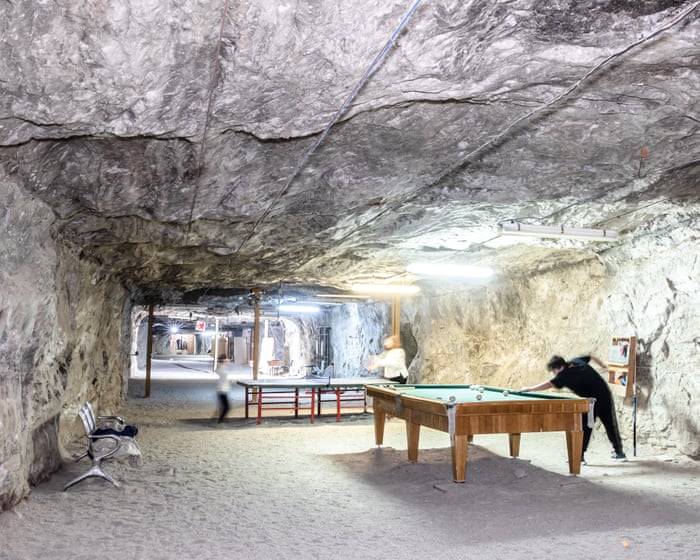
Getting to the hospital starts with a noisy industrial lift that takes patients deep below a residential area on the outskirts of Yerevan. At the bottom, a maze of tunnels stretches through the rock. At first glance, the underground cavern looks more like a Cold War bunker than a hospital. Behind curtains, patients nap on narrow beds. Others play billiards, walk around, do breathing exercises, or just sit quietly, passing the time in what might be one of the world’s most unusual medical facilities.
[Image description: Doing activities in the salt caverns is thought to help treat bronchial asthma, bronchitis, allergic and chronic sinus diseases, allergies, and skin diseases.]
“It looks unusual, but after a few days, people start to enjoy the peace,” said Anush Voskanyan, a doctor who has worked at the clinic since 1989. She guided visitors through the large chambers.
Voskanyan said the idea for the clinic came after doctors noticed that workers in salt mines seemed to have very low rates of breathing problems, even though they spent their lives underground. She said researchers began studying the mines’ microclimate, which eventually led to the creation of specialized underground clinics in parts of the Soviet bloc.
Voskanyan believes the health benefits come from a mix of factors: air rich in salt, a constant temperature of 19°C all year, and no allergens, pollution, noise, or radiation.
[Image description: Dr. Anush Voskanyan attributes the health benefits to salt-rich air, year-round 19°C temperatures, and an absence of allergens, pollution, noise, and radiation.]
“This is the perfect climate to live in. You basically don’t age here,” she said.
Patients usually spend six hours a day underground over a three-week treatment course. Doctors say the first week lets the body adjust to the mine’s unique environment, and then the benefits slowly build up.
At its peak, thousands of patients came to the Avan mine every year, many getting treatment for free through Armenia’s healthcare system.
“We used to admit 60 people at a time,” Voskanyan said, looking around the mostly empty rooms. “Today, there are probably five.”
The clinic’s situation changed in 2019 when the Armenian government stopped funding it, arguing that speleotherapy didn’t have enough scientific evidence to justify public support. Patients who once attended for free now have to pay about £20 for each treatment session.
This decision came as Armenia started reforming its healthcare system and preparing to introduce new policies.The introduction of universal health insurance has forced officials to make tough choices about which treatments the state should cover.
“We’re on the verge of shutting down,” Voskanyan said. “We’re still open, but barely—we could close any day now.”
Voskanyan insists the treatment works, especially for children with asthma and allergies.
View image in fullscreen: Marine Koklyan prepares for a nap as part of her treatment. She suffers from birch tree allergies that affect her breathing. “There have even been cases where asthma attacks stopped completely after just one course of treatment,” she said.
Although speleotherapy has been used for decades across Eastern Europe and the former Soviet Union, few large-scale studies have been done, and most clinics have since closed. Many respiratory specialists see it as a complementary therapy that may relieve symptoms but should not replace standard medical care.
For supporters, however, the lack of solid research doesn’t erase years of patient testimonials. “If it didn’t help, I wouldn’t keep coming back,” said Alvart Alihanyan, who has returned to the clinic from Russia repeatedly over the past 10 years.
For now, each morning, the elevator continues its descent beneath Yerevan. Whatever the debate about its medical benefits, the mine offers something increasingly rare above ground: hours of total silence, no wifi, and a brief escape from the noise of the outside world.
Frequently Asked Questions
Here is a list of FAQs about deep breathing at the asthma clinic located inside an Armenian salt mine
Beginner Questions
Q What is this asthma clinic inside a salt mine
A Its a special treatment center built 250 meters underground in an active Armenian salt mine People with asthma and other lung conditions go there to breathe in the dry salty air which can help clear the lungs and reduce inflammation
Q Why is breathing in a salt mine supposed to help my asthma
A The air inside the mine is very dry has a stable temperature and is filled with tiny salt particles When you breathe this air the salt can help break up mucus reduce swelling in your airways and kill bacteria Combined with deep breathing exercises it can make it easier to breathe
Q Do I just sit there and breathe normally or do I have to do special exercises
A You do both Youll be in a calm environment breathing the salty air but the clinic also guides you through specific deep breathing techniques These exercises help you expand your lungs fully and use your diaphragm more effectively
Q How long do people usually stay in the mine for one session
A A typical session lasts about 60 to 90 minutes Some people do this daily for a few weeks as part of a treatment program
Q Is it safe to go 250 meters underground if I have trouble breathing
A Yes it is considered safe for most people with stable asthma The mine has clean filtered air with no dust or pollen However you should always check with your regular doctor before going especially if you have severe or unstable asthma
Advanced Practical Questions
Q How is the air quality inside the mine different from a regular salt room or halotherapy spa
A The main difference is the depth and the natural environment At 250 meters deep the air pressure is slightly higher the humidity is very low and the temperature stays constant yearround The salt particles are naturally generated from the mine walls not from a machine which some believe makes them more effective
Q What specific deep breathing techniques are taught at the clinic
A They typically focus on diaphragmatic breathing and pursedlip breathing The