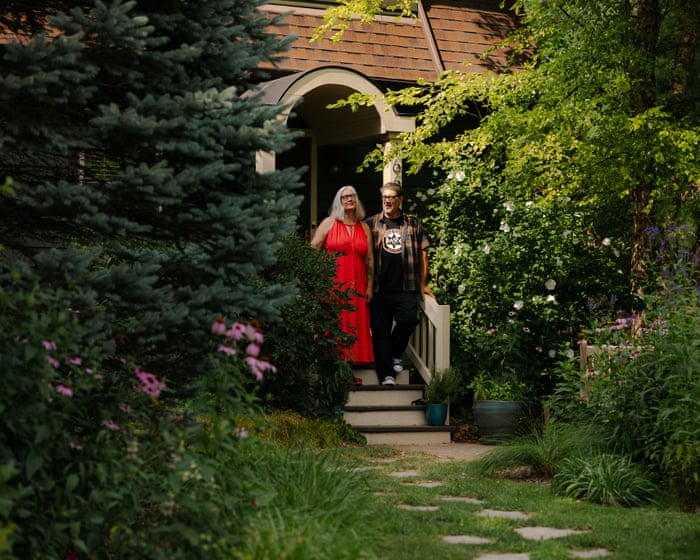
When James Reed McGuire and Crystal Fritz first decided to swap their lawn for native plants, they had no real idea what they were doing. They had moved from Chicago to the suburb of Highland Park, Illinois, and as former city-dwellers, they had never done much gardening together—just a few pots of herbs and flowers on their balcony.
But for McGuire, an avid birdwatcher who couldn’t stand the idea of a lawn that does “absolutely nothing for the environment,” finding an alternative to the typical suburban yard was essential.
Their first attempts at rewilding the lawn were full of what they now see as mistakes. They bought mixed wildflower seed packets and scattered them randomly, instead of picking species native to their area and planning where to plant them. They also tried digging up the turf by hand with a shovel—a task so tough that McGuire laughs when he thinks back on it.
Still, every mistake taught them something. Even though neither of them had any formal training in horticulture—Fritz works as a personal assistant, and McGuire is a creative director and writer—they slowly learned how to identify native plants for their region and figured out the best ways to grow them from seed to keep costs down.
They designed their garden so they could enjoy blooms for as much of the growing season as possible. Each year, they added a few more native plants, and each year, they saw more pollinators and birds come to the garden.
Now, their lawn has gone from a plain stretch of grass to a thriving native ecosystem right in the middle of the suburbs. The many native plants offer food and shelter for all kinds of wildlife: birds, butterflies, bees, rabbits, bats, and foxes are now common sights.
“It’s really a stunning environment,” says McGuire. “It brings us a lot of peace and calm in a very troubled world.”
As the first people in their neighborhood to make this change, McGuire and Fritz have gotten an “unbelievable amount of positive feedback” from people passing by. Families go out of their way to walk past the house so their kids can see all the fireflies. A nearby couple even asked McGuire for help turning their own yard into a native habitat.
The house has been part of a local garden tour for the past few years, and the city gave the couple permission to landscape the roadside strip in front of their home to expand the habitat they’ve created.
It’s not just the human neighbors who appreciate what they’ve done. In 2023, their garden was named a Certified Wildlife Habitat by the National Wildlife Federation, proving that their landscaping is good for wildlife too.
“It’s so rewarding,” says Fritz.”We’ve done this little thing with this small piece of land, but it’s made a big difference, at least in our own small part of the world.” Fritz and McGuire might have been the first on their street to change their lawn, but they’re far from the only ones. Across the US, people are starting to tear up lawns that need lots of pesticides and fertilizer, and instead planting things that support more biodiversity and fit better with the local climate and wildlife needs.
According to Doug Tallamy, an entomologist who has become one of the country’s biggest supporters of what he calls “conservation landscaping,” lawns originally came to the US from Europe. “We copied the aristocracy,” Tallamy says. “We wanted to show we were rich and had high status. Back then, the only way you could have a lawn was if you had enough land that you didn’t need to farm it, and enough wealth to have slaves or sheep to maintain it.” With the invention of the lawnmower, plus the arrival of pesticides and fertilizers, lawn care became possible for many more people. By the mid-20th century, having a turf lawn had become a firmly established status symbol for suburbanites. Today, an estimated 160,000 square kilometers (40 million acres) of the US is turf – including golf courses – with more land given over to lawns than to individual irrigated crops like corn or wheat.
While a lawn might seem better than concrete, for example, grass lawns are actually harmful to the environment, Tallamy says. First, US lawns usually consist of European grass species with short roots, which do little to pull carbon and water deep into the soil. When it rains, water runs off the top of these lawns instead of being absorbed, carrying pesticides and fertilizers with it and dumping those chemicals into nearby rivers and lakes, where they cause serious damage to waterways. Second, non-native turf grasses don’t support pollinators or a healthy food web, which starts with insects. Tallamy says: “We have parks and reserves, but we’re heading toward a sixth extinction event, because those areas are too small, too isolated, and there are too few of them. And the way we landscape the spaces between parks and reserves doesn’t support biodiversity.”
The good news is that it doesn’t take much to start fixing these environmental problems. From Tallamy’s point of view, it doesn’t even mean getting rid of lawns entirely – if short grass is useful in one part of your garden so your kids can play, that’s great. For him, it’s about shifting the balance so native plants become the norm, and lawns are created only when they serve a purpose. If everyone in the country cut their lawn in half and planted the other half with native species, it would go a long way toward creating and connecting the kinds of habitats that would let wild species survive today’s ecological crises, he says.
That’s the idea behind Homegrown National Parks, an American conservation initiative founded by Tallamy that encourages people to bring the wild to their homes by planting native species. Camille Dungy, an American poet and academic, is also known in her neighborhood in Fort Collins, Colorado, for her beautiful garden. Dungy spent ten years turning her single-species lawn into a biodiverse haven of native plants that supports birds and pollinators all year round and uses less water. But she has also kept room for a few non-native (though still non-invasive) species, such asShe chose irises because they remind her of someone she loves, and she kept some lawn space for her child to play on, though she replaced the Kentucky bluegrass with native grasses. Now, her garden is about 70% native plants and 30% non-native.
Even that shift has made a real difference in how well her garden supports biodiversity, says Dungy, who wrote about the experience in her 2023 book Soil: The Story of a Black Mother’s Garden. Along the way, she’s also noticed a slow change in how people view lawns.
When she first moved to Fort Collins in 2013, a member of the Homeowners’ Association—groups that manage shared spaces in US residential areas—would walk around with a ruler, checking if plants grew above a set height, which favored lawns. By 2023, Colorado had passed a law stopping these associations from banning “water-wise” landscaping, which often uses native plants to save water in this drought-prone state.
“We started as the first house on the block, and now everyone has some elements of this low-water, pollinator-friendly landscaping,” Dungy says.
This shift is happening in other places too. Some parts of California now give homeowners rebates for every square foot of lawn they replace with a “xeriscaped” garden—a dry landscape that uses drought-tolerant plants, smarter watering methods, and mulch to cut water use. Minnesota and Pennsylvania pay residents to swap lawns for native plants, and Virginia has banned the sale of invasive species, some of which were once seen as exotic ornamentals. In Marco Island, Florida, a program pays residents to let endangered burrowing owls nest in their lawns.
View image in fullscreen
Attracting pollinators is one reason people are choosing native gardens.
Now, there’s growing evidence that even if state governments don’t reward this choice, homebuyers might—real estate agents are finding that native gardens can be a selling point.
Once you start and see the rush of pollinators and new birds showing up, you may never go back. That’s one of the most powerful parts of this movement for Tallamy: while installing solar panels or switching to an electric car does real good, it’s hard to see the impact of those choices. But when you rewild your lawn, “you get to see the results, and that empowers you,” he says. “You see the biodiversity return to your yard, and even though you’re not saving the whole planet, you are saving the piece of the planet you ‘own’ in a very real way.”
The Guardian receives support for visual climate coverage from the Outrider Foundation.
The Guardian’s coverage is editorially independent.
Frequently Asked Questions
Here is a list of FAQs based on the story of the couple who replaced their lawn with a wildlife haven covering everything from the basics to advanced tips
General Motivation
1 Why would anyone want to replace their lawn
Lawns require a lot of water time and chemical fertilizers to stay green By replacing it with native plants you create a habitat for local wildlife save water and reduce your carbon footprint Plus it looks beautiful in a natural wild way
2 What exactly is a wildlife haven
Its a garden designed to provide food water shelter and nesting spots for local animals Instead of a monoculture of grass it uses a variety of native flowers shrubs and trees to create a thriving miniecosystem right in your backyard
3 Is this just a trend or does it actually help
It genuinely helps Native plants support local insects which in turn feed birds and other animals Since native plants are adapted to your local climate they also need far less water and no pesticides which keeps chemicals out of the soil and groundwater
4 Im not a gardener Is this too complicated for me
Not at all You can start small You dont have to rip out your whole lawn in one weekend You can start by converting a single flower bed or a corner of your yard Native plants are actually often easier to grow than highmaintenance grasses and exotic flowers because theyre already suited to your soil and weather
The HowTo Practical Steps
5 How do I actually get rid of my existing lawn
There are a few ways
Smothering Cover the grass with cardboard or a tarp for a few weeks to kill it
Sodcutting Rent a machine to peel the grass up
Lasagna gardening Layer cardboard compost and mulch right on top of the grass It breaks down over time and enriches the soil
Avoid using chemical herbicides if you want a truly healthy wildlife garden
6 What plants should I choose
Look for native plants specific to your region A good rule of thumb is to include
Flowers that bloom in different seasons