Venice is a city of tradition and imagination—a place that inspires the minds of millions who come from elsewhere. Known as the “impossible city,” suspended on water, it often seems unchanged, frozen in time. Yet, like the water that supports it, the city is always shifting in subtle ways.
We often talk about Venice as if it were static. We call it timeless, as though it exists outside history, untouched by change. But Venice is changing. It is fragile, exposed, and under pressure. On one side, rising sea levels and more unpredictable tides are reshaping the lagoon and threatening a delicate balance. On the other, mass tourism continues to alter the city from within. Homes turn into short-term rentals, local shops give way to businesses aimed at visitors, and more residents leave the historic center every year. The spaces left behind by those who move away are often filled by tourism itself—both a cause and a result of this transformation.
Yet beyond the common stories of overtourism and climate breakdown, another quieter shift is happening. Venice is built on contradictions—appearance versus structure, illusion versus rootedness. One of these tensions shows up in the role of women in shaping the city’s identity. While many Venetian traditions have long relied on women’s labor, from lace-making to textile work and other crafts, women have been shut out of what truly defines public space in Venice: the water.
In Venice, water acts as the street. The city is crossed by about 150 navigable canals, which remain its main routes for movement, work, and social life. For centuries, these waterways have been governed by explicit rules and unwritten codes that largely excluded women. Just as women have historically been pushed out of the streets in many other cities, in Venice they have been pushed out of the water—out of steering boats, out of jobs like gondolier or sandolist, out of boatbuilding and competitive rowing. Today, those boundaries are starting to change.
Journalist Anna Toniolo has lived with Venice her whole life, born and raised just a few kilometers from the city. This project grew from years of observing Venice and from a shared realization with photographer Daniela Sala that some of the city’s most vital spaces remain closed off to women—not through formal bans, but through traditions deeply woven into daily life. Between November 2025 and March 2026, they spent weeks documenting the experiences of women whose work and lives are closely tied to the lagoon, through field reporting.Through interviews and observation, this project gathers stories that challenge the usual image of Venice.
The stories collected here show how women are reclaiming space through tradition itself. They carry forward skills and trades that have long shaped Venetian identity, while also transforming them.
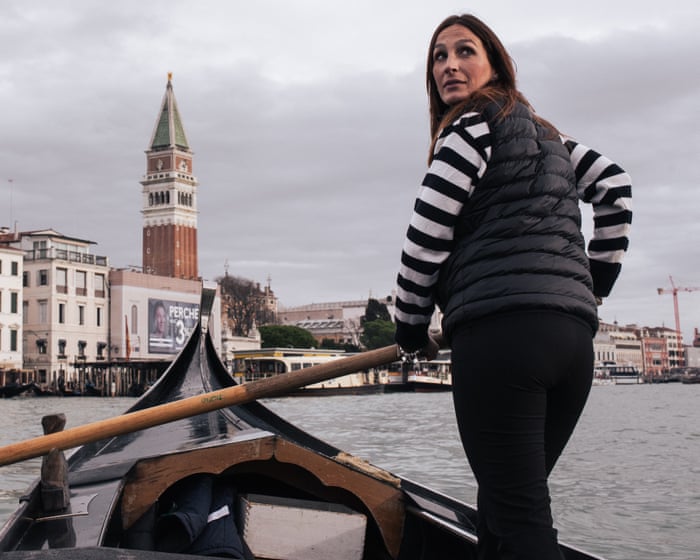
In 2010, Giorgia Boscolo became the first woman to earn a gondolier’s license, breaking a centuries-old barrier and paving the way for others. Even today, few women work in this role. According to fellow gondoliers, the number of active female gondoliers can be counted on two hands, though more women have passed the licensing exam in recent years. Venice has about 440 licensed gondoliers, plus around 200 substitutes—qualified gondoliers who have passed the exam but don’t yet have their own license.
A related profession is that of the sandolista, who rows a sandolo, a traditional flat-bottomed Venetian boat once commonly used for daily travel across the lagoon. Today, only about 20 sandolisti remain, and just one is a woman: Chiara Curto.
In the city’s remaining squeri—the traditional boatyards where wooden boats are built and repaired—Silvia Scaramuzza is the only female maestra d’ascia, or master boatbuilder. After a decade of apprenticeship at another boatyard, she opened her own workshop with her business partner, Francesco Stenghel, in 2022. A new gondola costs around €30,000–35,000 (£26,000–£30,000), not including decorations, carvings, upholstery, or other custom work.
Other women are forging new paths into these spaces. In 2020, Marta Canino founded “Fie a Manetta,” a name that roughly means “Girls at Full Speed,” while also hinting at women taking the helm. It’s the first—and still the only—motorboat navigation school in Venice run by women and open to everyone.
The idea grew from recognizing that boating remains a largely male-dominated field. “Girls, we need to start acknowledging each other and giving social value and political weight to our role in this city,” Canino said.
Slowly, and often without fanfare, women are entering and occupying Venice’s public spaces through their daily practice. Their presence doesn’t just take up space on the water—it starts to reshape what that space means.
Frequently Asked Questions
Here is a list of FAQs about the Memory of Water photo essay written in a natural tone with clear concise answers
General Beginner Questions
Q What is Memory of Water the women reshaping Venice in pictures
A Its a photo essay that highlights the work of women who are actively trying to solve Venices biggest problems like flooding overtourism and population decline It focuses on their personal stories and practical projects
Q Is this about a scientific theory that water has memory
A No not at all The title is poetic It refers to the memory of the cityits history and cultureand how these women are working to preserve it for the future
Q Who are the women featured in the pictures
A They are a diverse group of locals including architects urban planners activists and artisans They arent celebrities they are everyday experts who are taking action to protect the city they love
Q I havent read the article What is the main message of the photo essay
A The main message is that the future of Venice isnt just in the hands of politicians or engineers Its being shaped from the ground up by a new generation of determined women who are offering fresh communitybased solutions to complex problems
Q Is this a news article or just a collection of pretty pictures
A Its a visual news story While the photos are beautiful they are used to illustrate a serious journalistic piece about urban resilience climate change and gender roles in city planning
Specifics The Womens Work
Q What kind of problems are these women actually solving
A The main problems are
1 Acqua Alta Finding ways to live with rising sea levels
2 Overtourism Trying to keep the city livable for locals not just daytrippers
3 Population Decline Making it affordable and practical for young people to stay
4 Cultural Erosion Saving traditional crafts and local neighborhoods from disappearing
Q Can you give me an example of a specific project they are working on