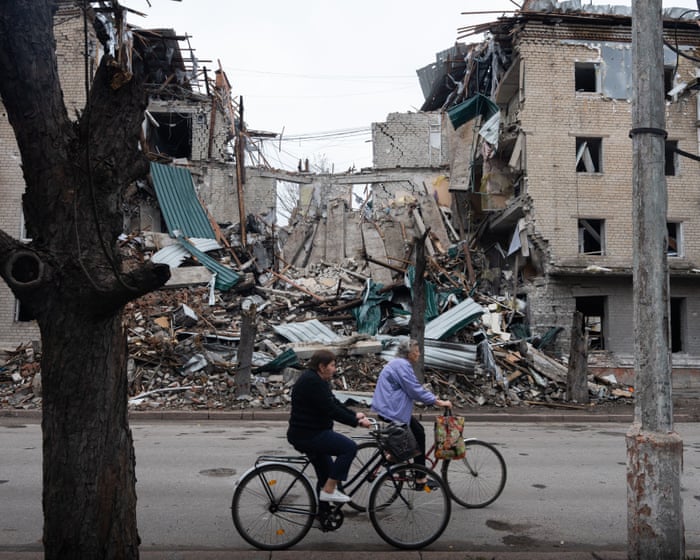
Vladimir Putin’s army has made little progress in Ukraine this year, and his goal of annexing four Ukrainian provinces remains out of reach, even after more than four and a half years of war. That helps explain his recent push to break Ukrainians’ will to resist by launching constant drone and missile strikes on their cities, hitting residential buildings, large open-air markets, shopping malls, the Dobrobut medical centre and the National Academy of Sciences, both in Kyiv. The capital has suffered the worst, but other cities—Dnipro, Kharkiv, Kherson, Odesa, Mykolaiv and Sumy—have not been spared. Air-raid sirens cut through the quiet of night. People rush to shelters, if any are nearby, or in Kyiv race to underground subway stations. Even walking down city streets, shopping or filling up your car at a petrol station—all prime targets—can lead to injury or death. I got a sense of what these relentless attacks are like during a trip to Ukraine in September. One night in Mykolaiv, I counted more than a dozen alerts between midnight and dawn. In Kopyliv, about 31 miles west of Kyiv, I was having dinner in a restaurant when a deafening bang made the walls shake. A drone had hit a building about 500 metres away; orange flames swallowed its roof within seconds. Incidents like this are now part of daily life for Ukrainians, but they are no less nerve-racking for that. During September, Russia launched 3,177 jet-powered drones at Ukraine, mainly Geran variants: nearly 12% more than in August, and a huge increase compared with 350 such strikes in June. Drones, jet-powered or not, are often backed up by ballistic missiles such as the Iskander, which is extremely hard to intercept with its top speed of 5,600mph and ability to swerve in flight. The aim of Putin’s escalating bombardment is to make life so unbearable for Ukrainians that they decide the only way out is to satisfy his unfulfilled annexationist ambitions: his army occupies almost all of Luhansk, but has yet to conquer the regions of Donetsk, Kherson and Zaporizhzhia completely. Putin would rather keep killing than admit he has lost. As a winter of misery looms in Ukraine, Nato must step in | Simon Tisdall Read more But his drone and missile campaign will not force Ukraine to give in. In December 2025, a Kyiv International Institute of Sociology poll showed that Ukrainians’ resistance to trading land for peace remains strong. Three-quarters of those surveyed rejected a hypothetical deal that included these terms: Ukraine’s withdrawal from the unoccupied part of Donetsk, recognition of Russia’s legal ownership of Crimea and Donbas, and giving up its Nato aspirations. Asked separately whether they would approve a settlement that required ceding the unoccupied parts of the two southern provinces, two-thirds said no. These responses are all the more significant because by the end of last year, Russia had begun attacking Ukraine’s power grid as a brutal winter approached. Putin might still calculate that a massive bombing campaign this winter—turning off the lights, disrupting heating and damaging water and sanitation systems—will break Ukrainians’ willpower and create conditions for Russia to end the war with more territory in hand. His calculation is not unreasonable, given Ukraine’s severe shortage of ballistic missile interceptors, which cut interception rates from 70% in March to 20% in July. Ukraine is working with a European coalition to develop the cost-effective Freya ballistic missile defence system, and will acquire the Franco-Italian SAMP/T NG missile defence system, which offers much easier mobility for rapid relocation and is now under development. Neither, however, will be deployed in sufficient numbers any time soon. Still, the Russian leader’s strategy runs into some inconvenient facts, quite apart from Ukrainians’ proven toughness. TheHistory shows that bombing campaigns don’t break morale—they strengthen it. Ukrainians will be no exception. They see resistance to Russia as essential to their national survival. When I’ve asked them why they keep fighting, the answer, in one form or another, is that the alternative is losing their independence. You could dismiss this as bravado, but what matters is that Ukrainians believe it.
Alongside this is a widespread belief that Putin will use any deal to buy time and regroup before attacking Ukraine again. This also makes Ukrainians wary of land-for-peace proposals, especially those from Donald Trump and his two envoys, Steve Witkoff and Jared Kushner, whom they see as Putin’s allies rather than neutral mediators.
Besides, Putin is under pressure too. According to the head of the UK’s defence staff, his army has suffered 1.5 million casualties. And while Ukraine faces a manpower shortage, so does Russia—despite having 3.5 times the population. That’s why it relies on North Korean soldiers and Asian and African mercenaries. What’s more, the Russian army has barely gained any territory this year. In the first six months of 2026, it captured only 28% as much land as in the same period last year, and its troop losses now exceed its monthly recruitment by 6,000.
In addition, Ukrainian drone strikes on Russia’s roads and rail lines running through occupied territory in southern Ukraine have left Russian troops in Crimea, Kherson, and Zaporizhzhia short of critical supplies. Most recently, Operation Vivaldi, carried out by Ukraine’s 3rd Army Corps, caught Russian troops off guard in the Lyman sector of northern Donetsk, forcing them to retreat eastward.
The war has hurt Russia’s economy. The army’s huge demand for manpower has caused severe labour shortages that have damaged businesses. The 2027 budget draft allocates 35% of federal spending to defence. By June, Ukraine’s strikes on refineries deep inside Russia had cut their output by about 30% year on year, causing chronic fuel shortages, widespread rationing, long lines at petrol stations, and a 21% rise in petrol prices since January.
Taken together—Ukrainians’ refusal to give up land, the historical failure of bombing campaigns to break civilian morale, and Russia’s own various problems—it seems unlikely that Putin’s drones and missiles will force Ukraine to accept peace on his terms, even under the strain of winter.
Rajan Menon is a professor emeritus of international relations at the City College of New York and a senior research scholar at Columbia University’s Saltzman Institute of War and Peace Studies.
Frequently Asked Questions
Here is a list of FAQs based on Rajan Menons article regarding Putins bombing campaign and Ukrainian resolve
1 What is the main argument of Rajan Menons article
The article argues that Russias intensified bombing of Ukraines infrastructure will not break the Ukrainian peoples will to fight It suggests that history shows this strategy usually fails and often makes the targeted population more determined to resist
2 What exactly is Russia targeting in this new campaign
Russia is mainly targeting critical infrastructure This includes power plants water systems and heating facilities The goal is to make life unbearable for civilians as winter approaches
3 Why does the article say this strategy is bound to fail
It fails because it targets civilians rather than military targets Historically when you attack a populations survival they tend to unite against the attacker rather than surrender It creates anger and resilience not submission
4 What historical examples does the author use to prove this
The article points to World War II Specifically the German bombing of London and the Allied bombing of German cities In both cases the bombings did not crush the morale of the people instead they hardened their resolve to keep fighting
5 What is morale in the context of war
Morale is the spirit and confidence of a group of people In war high morale means people are willing to keep fighting and endure hardship Low morale means they want to give up
6 Does the article suggest that bombing has no effect at all
No The article admits that bombing causes terrible suffering death and destruction It makes life incredibly hard However it argues that this suffering does not translate into a political victory for the attacker
7 Why would Putin use a strategy that history says doesnt work
Leaders often use bombing because they lack better options on the ground If their army is struggling to win battles they turn to longrange weapons to try to force a surrender without having to fight directly
8 What is the difference between shock and awe and strategic bombing
Shock and awe is a rapid intense attack meant to paralyze the enemy immediately Strategic bombing is a longer campaign meant to slowly destroy a countrys ability to fight and its will to resist