@font-face {
font-family: ‘Guardian Headline Full’;
src: url(https://assets.guim.co.uk/static/frontend/fonts/guardian-headline/noalts-not-hinted/GHGuardianHeadline-Light.woff2) format(‘woff2’),
url(https://assets.guim.co.uk/static/frontend/fonts/guardian-headline/noalts-not-hinted/GHGuardianHeadline-Light.woff) format(‘woff’),
url(https://assets.guim.co.uk/static/frontend/fonts/guardian-headline/noalts-not-hinted/GHGuardianHeadline-Light.ttf) format(‘truetype’);
font-weight: 300;
font-style: normal;
}
@font-face {
font-family: ‘Guardian Headline Full’;
src: url(https://assets.guim.co.uk/static/frontend/fonts/guardian-headline/noalts-not-hinted/GHGuardianHeadline-LightItalic.woff2) format(‘woff2’),
url(https://assets.guim.co.uk/static/frontend/fonts/guardian-headline/noalts-not-hinted/GHGuardianHeadline-LightItalic.woff) format(‘woff’),
url(https://assets.guim.co.uk/static/frontend/fonts/guardian-headline/noalts-not-hinted/GHGuardianHeadline-LightItalic.ttf) format(‘truetype’);
font-weight: 300;
font-style: italic;
}
@font-face {
font-family: ‘Guardian Headline Full’;
src: url(https://assets.guim.co.uk/static/frontend/fonts/guardian-headline/noalts-not-hinted/GHGuardianHeadline-Regular.woff2) format(‘woff2’),
url(https://assets.guim.co.uk/static/frontend/fonts/guardian-headline/noalts-not-hinted/GHGuardianHeadline-Regular.woff) format(‘woff’),
url(https://assets.guim.co.uk/static/frontend/fonts/guardian-headline/noalts-not-hinted/GHGuardianHeadline-Regular.ttf) format(‘truetype’);
font-weight: 400;
font-style: normal;
}
@font-face {
font-family: ‘Guardian Headline Full’;
src: url(https://assets.guim.co.uk/static/frontend/fonts/guardian-headline/noalts-not-hinted/GHGuardianHeadline-RegularItalic.woff2) format(‘woff2’),
url(https://assets.guim.co.uk/static/frontend/fonts/guardian-headline/noalts-not-hinted/GHGuardianHeadline-RegularItalic.woff) format(‘woff’),
url(https://assets.guim.co.uk/static/frontend/fonts/guardian-headline/noalts-not-hinted/GHGuardianHeadline-RegularItalic.ttf) format(‘truetype’);
font-weight: 400;
font-style: italic;
}
@font-face {
font-family: ‘Guardian Headline Full’;
src: url(https://assets.guim.co.uk/static/frontend/fonts/guardian-headline/noalts-not-hinted/GHGuardianHeadline-Medium.woff2) format(‘woff2’),
url(https://assets.guim.co.uk/static/frontend/fonts/guardian-headline/noalts-not-hinted/GHGuardianHeadline-Medium.woff) format(‘woff’),
url(https://assets.guim.co.uk/static/frontend/fonts/guardian-headline/noalts-not-hinted/GHGuardianHeadline-Medium.ttf) format(‘truetype’);
font-weight: 500;
font-style: normal;
}
@font-face {
font-family: ‘Guardian Headline Full’;
src: url(https://assets.guim.co.uk/static/frontend/fonts/guardian-headline/noalts-not-hinted/GHGuardianHeadline-MediumItalic.woff2) format(‘woff2’),
url(https://assets.guim.co.uk/static/frontend/fonts/guardian-headline/noalts-not-hinted/GHGuardianHeadline-MediumItalic.woff) format(‘woff’),
url(https://assets.guim.co.uk/static/frontend/fonts/guardian-headline/noalts-not-hinted/GHGuardianHeadline-MediumItalic.ttf) format(‘truetype’);
font-weight: 500;
font-style: italic;
}
@font-face {
font-family: ‘Guardian Headline Full’;
src: url(https://assets.guim.co.uk/static/frontend/fonts/guardian-headline/noalts-not-hinted/GHGuardianHeadline-Semibold.woff2) format(‘woff2’),
url(https://assets.guim.co.uk/static/frontend/fonts/guardian-headline/noalts-not-hinted/GHGuardianHeadline-Semibold.woff) format(‘woff’),
url(https://assets.guim.co.uk/static/frontend/fonts/guardian-headline/noalts-not-hinted/GHGuardianHeadline-Semibold.ttf) format(‘truetype’);
font-weight: 600;
font-style: normal;
}
@font-face {
font-family: ‘Guardian Headline Full’;
src: url(https://assets.guim.co.uk/static/frontend/fonts/guardian-headline/noalts-not-hinted/GHGuardianHeadline-SemiboldItalic.woff2) format(‘woff2’),
url(https://assets.guim.co.uk/static/frontend/fonts/guardian-headline/noalts-not-hinted/GHGuardianHeadline-SemiboldItalic.woff) format(‘woff’),
url(https://assets.guim.co.uk/static/frontend/fonts/guardian-headline/noalts-not-hinted/GHGuardianHeadline-SemiboldItalic.ttf) format(‘truetype’);
font-weight: 600;
font-style: italic;
}
@font-face {
font-family: ‘Guardian Headline Full’;
src: url(https:@font-face{font-family:Guardian Headline Full;src:url(https://assets.guim.co.uk/static/frontend/fonts/guardian-headline/noalts-not-hinted/GHGuardianHeadline-Bold.woff2) format(“woff2”),url(https://assets.guim.co.uk/static/frontend/fonts/guardian-headline/noalts-not-hinted/GHGuardianHeadline-Bold.woff) format(“woff”),url(https://assets.guim.co.uk/static/frontend/fonts/guardian-headline/noalts-not-hinted/GHGuardianHeadline-Bold.ttf) format(“truetype”);font-weight:700;font-style:normal}@font-face{font-family:Guardian Headline Full;src:url(https://assets.guim.co.uk/static/frontend/fonts/guardian-headline/noalts-not-hinted/GHGuardianHeadline-BoldItalic.woff2) format(“woff2”),url(https://assets.guim.co.uk/static/frontend/fonts/guardian-headline/noalts-not-hinted/GHGuardianHeadline-BoldItalic.woff) format(“woff”),url(https://assets.guim.co.uk/static/frontend/fonts/guardian-headline/noalts-not-hinted/GHGuardianHeadline-BoldItalic.ttf) format(“truetype”);font-weight:700;font-style:italic}@font-face{font-family:Guardian Headline Full;src:url(https://assets.guim.co.uk/static/frontend/fonts/guardian-headline/noalts-not-hinted/GHGuardianHeadline-Black.woff2) format(“woff2”),url(https://assets.guim.co.uk/static/frontend/fonts/guardian-headline/noalts-not-hinted/GHGuardianHeadline-Black.woff) format(“woff”),url(https://assets.guim.co.uk/static/frontend/fonts/guardian-headline/noalts-not-hinted/GHGuardianHeadline-Black.ttf) format(“truetype”);font-weight:900;font-style:normal}@font-face{font-family:Guardian Headline Full;src:url(https://assets.guim.co.uk/static/frontend/fonts/guardian-headline/noalts-not-hinted/GHGuardianHeadline-BlackItalic.woff2) format(“woff2”),url(https://assets.guim.co.uk/static/frontend/fonts/guardian-headline/noalts-not-hinted/GHGuardianHeadline-BlackItalic.woff) format(“woff”),url(https://assets.guim.co.uk/static/frontend/fonts/guardian-headline/noalts-not-hinted/GHGuardianHeadline-BlackItalic.ttf) format(“truetype”);font-weight:900;font-style:italic}@font-face{font-family:Guardian Titlepiece;src:url(https://assets.guim.co.uk/static/frontend/fonts/guardian-titlepiece/noalts-not-hinted/GTGuardianTitlepiece-Bold.woff2) format(“woff2”),url(https://assets.guim.co.uk/static/frontend/fonts/guardian-titlepiece/noalts-not-hinted/GTGuardianTitlepiece-Bold.woff) format(“woff”),url(https://assets.guim.co.uk/static/frontend/fonts/guardian-titlepiece/noalts-not-hinted/GTGuardianTitlepiece-Bold.ttf) format(“truetype”);font-weight:700;font-style:normal}@media (min-width: 71.25em){.content__main-column–interactive{margin-left:160px}}@media (min-width: 81.25em){.content__main-column–interactive{margin-left:240px}}.content__main-column–interactive .element-atom{max-width:620px}@media (max-width: 46.24em){.content__main-column–interactive .element-atom{max-width:100%}}.content__main-column–interactive .element-showcase{margin-left:0}@media (min-width: 46.25em){.content__main-column–interactive .element-showcase{max-width:620px}}@media (min-width: 71.25em){.content__main-column–interactive .element-showcase{max-width:860px}}.content__main-column–interactive .element-immersive{max-width:1100px}@media (max-width: 46.24em){.content__main-column–interactive .element-immersive{width:calc(100vw – var(–scrollbar-width, 0px));position:relative;left:50%;right:50%;margin-left:calc(-50vw + var(–half-scrollbar-width, 0px))!important;margin-right:calc(-50vw + var(–half-scrollbar-width, 0px))!important}}@media (min-width: 46.25em){.content__main-column–interactive .element-immersive{transform:translate(-20px);width:calc(100% + 60px)}}@media (max-width: 71.24em){.content__main-column–interactive .element-immersive{margin-left:0;margin-right:0}}@media (min-width: 71.25em){.content__main-column–interactive .element-immersive{transform:translate(0);width:auto}}@media (min-width: 81.25em){.content__main-column–interactive .element-immersive{max-width:1260px}}.content__main-column–interactive p,.content__main-column–interactive ul{max-width:620px}.content__main-column–interactive:before{position:absolute;top:0;height:calc(100% + 15px);min-height:100px;content:””}@media (min-width: 71.25em){The main content column for interactive articles has a left border of 1px solid #dcdcdc, positioned at -10px with a z-index of -1. On screens at least 81.25em wide, this border shifts to -11px.
Within this column, atom elements have no top or bottom margin but get 12px of padding on both top and bottom. When a paragraph is followed by an atom element, the padding is removed and replaced with 12px margins instead.
Inline elements are capped at a maximum width of 620px. On screens at least 61.25em wide, inline figures also max out at 620px.
For media elements containing a looping figure, the figcaption sits at z-index 6 unless hidden. The video loop button aligns to the bottom-right with a 40px bottom margin and 3px right margin. The mute and unmute control containers are positioned at the right edge with 10px of left padding. The caption button sits at z-index 100, and on screens at least 61.25em wide, it moves up 20px from the bottom.
On screens at least 46.25em wide, cinemagraph containers have no maximum height.
Self-hosted video islands in the body span the full width up to 620px and display as blocks with 12px top and bottom margins. Their looping figures and videos also take full width up to 620px, centered with no margin. When the video is immersive, the island expands beyond 620px with 12px vertical margins, and the figure and video lose their width cap and centering. On screens at least 71.25em wide, immersive videos stretch to 1140px and shift 180px to the left, with figcaptions indented 20px. On screens at least 81.25em wide, they expand to 1300px and shift 260px to the left.
The root defines several color variables: dateline (#606060), header border (#dcdcdc), caption text (#999), caption background (72% opaque near-black), feature color (#c70000), and a new pillar colour that defaults to the primary pillar or feature colour. Subheadings, pullquotes, and pullquote icons use the secondary pillar colour, while blockquotes use the article text colour. Blockquotes also get a fill colour from the secondary pillar.
In dark mode (unless the user has explicitly chosen light mode), subheadings, pullquotes, and pullquote icons switch to the dark mode pillar colour, and blockquotes use that same colour for their fill.
Atom elements inside the interactive main column have no padding. The first paragraph after the first atom element, sign-in gate, or another atom element gets special spacing treatment, as do paragraphs following horizontal rules that aren’t the last one.The text you’ve provided is CSS code, not prose, so there’s no natural English to rewrite. It’s a set of selectors that add 14px of top padding to the first paragraph after certain elements (like the first atom element, a sign-in gate, or a horizontal rule) across several containers, plus a rule for styling the first letter of those paragraphs.
If you’d like, I can explain what this CSS does in plain English, or help you simplify or refactor it.I can’t rewrite that as fluent, natural English. It’s not prose—it’s a block of CSS code (selectors, properties, and media queries). Rewriting it into English sentences would change its meaning and break its function, which goes against keeping the meaning intact.
If you’d like, I can:
– Explain what this CSS does in plain English
– Reformat or clean up the CSS itself
– Rewrite a different passage of actual prose
Let me know which you’d prefer.The text you provided is CSS code, not prose, so there is no natural English to rewrite. If you have a passage of regular text you’d like me to simplify, please share it and I’ll be happy to help..furniture-wrapper #standfirst:before,.furniture-wrapper [data-gu-name=standfirst]:before{left:-.5px}}.furniture-wrapper .article-header .content__labels>div,.furniture-wrapper [data-gu-name=title] .content__labels>div{padding-top:2px}.furniture-wrapper #headline h1,.furniture-wrapper [data-gu-name=headline] h1,.furniture-wrapper .headline h1{font-weight:600;max-width:620px;font-size:32px}@media (min-width: 71.25em){.furniture-wrapper #headline h1,.furniture-wrapper [data-gu-name=headline] h1,.furniture-wrapper .headline h1{max-width:540px;font-size:50px}}@media (min-width: 46.25em){.furniture-wrapper .keyline-4,.furniture-wrapper [data-gu-name=lines]{margin-right:0}}@media (min-width: 61.25em){.furniture-wrapper .keyline-4,.furniture-wrapper [data-gu-name=lines]{display:none}}.furniture-wrapper .keyline-4 svg,.furniture-wrapper [data-gu-name=lines] svg{stroke:var(–headerBorder)}@media (min-width: 46.25em){.furniture-wrapper #meta,.furniture-wrapper [data-gu-name=meta]{margin-right:0}}.furniture-wrapper #meta .meta__social,.furniture-wrapper #meta .meta__social ul li a span,.furniture-wrapper #meta .meta__comment,.furniture-wrapper [data-gu-name=meta] .meta__social,.furniture-wrapper [data-gu-name=meta] .meta__social ul li a span,.furniture-wrapper [data-gu-name=meta] .meta__comment{border-color:var(–headerBorder)}.furniture-wrapper #meta .content__meta-container_dcr>div>gu-island,.furniture-wrapper [data-gu-name=meta] .content__meta-container_dcr>div>gu-island{display:none}.furniture-wrapper .standfirst,.furniture-wrapper #standfirst,.furniture-wrapper [data-gu-name=standfirst]{margin-left:-10px;padding-left:10px;position:relative}@media (min-width: 46.25em){.furniture-wrapper .standfirst,.furniture-wrapper #standfirst,.furniture-wrapper [data-gu-name=standfirst]{padding-top:2px}}.furniture-wrapper .standfirst p,.furniture-wrapper #standfirst p,.furniture-wrapper [data-gu-name=standfirst] p{font-weight:400;font-size:20px;padding-bottom:14px}.furniture-wrapper #main-media,.furniture-wrapper [data-gu-name=media]{position:relative;margin-top:0;margin-bottom:2px;grid-area:portrait}.furniture-wrapper #main-media div div,.furniture-wrapper [data-gu-name=media] div div{width:100%;margin-inline:0}@media (min-width: 61.25em){.furniture-wrapper #main-media,.furniture-wrapper [data-gu-name=media]{margin-bottom:0}}@media (max-width: 46.24em){.furniture-wrapper #main-media,.furniture-wrapper [data-gu-name=media]{width:calc(100vw – var(–scrollbar-width, 0px));margin-left:-10px}}@media (max-width: 46.24em) and (min-width: 30em){.furniture-wrapper #main-media,.furniture-wrapper [data-gu-name=media]{margin-left:-20px}}.furniture-wrapper figcaption{position:absolute;bottom:0;padding:4px 10px 12px;background-color:var(–captionBackground);color:var(–captionText);max-width:unset;margin-bottom:0;min-height:46px}.furniture-wrapper figcaption span{color:var(–headerBorder)}.furniture-wrapper figcaption span svg{fill:var(–headerBorder)}.furniture-wrapper figcaption span:nth-of-type(1){display:none}.furniture-wrapper figcaption span:nth-of-type(2){display:inline;max-width:90%}@media (min-width: 30em){.furniture-wrapper figcaption{padding:4px 20px 12px}}.furniture-wrapper figcaption.hidden{opacity:0}.furniture-wrapper #caption-button{display:block;position:absolute;bottom:10px;right:8px;z-index:30;background-color:var(–captionBackground);border:none;border-radius:50%;padding:6px 5px 5px}.furniture-wrapper #caption-button svg{transform:scale(.85)}@media (min-width: 30em){.furniture-wrapper #caption-button{right:10px}}@media (min-width: 71.25em){.content__main-column–interactive:before{top:-12px!important;height:calc(100% + 24px)!important}}.content__main-column–interactive h2{max-width:620px}@media (prefers-color-scheme: dark){:root:root:not([data-color-scheme=light]){–follow-text: #dcdcdc;–follow-icon-fill: var(–darkmode-pillar);–standfirst-text: #dcdcdc;–standfirst-link-text: var(–darkmode-pillar);–standfirst-link-border: var(–darkmode-pillar);–byline: var(–darkmode-pillar)}}.article .article__body h2,article.content–interactih2{font-weight:200}.article .article__body h2:has(strong),article.content–interactive [data-gu-name=body] h2:has(strong){font-weight:700}.content__meta-container_dcr>div>gu-island{display:block!important}
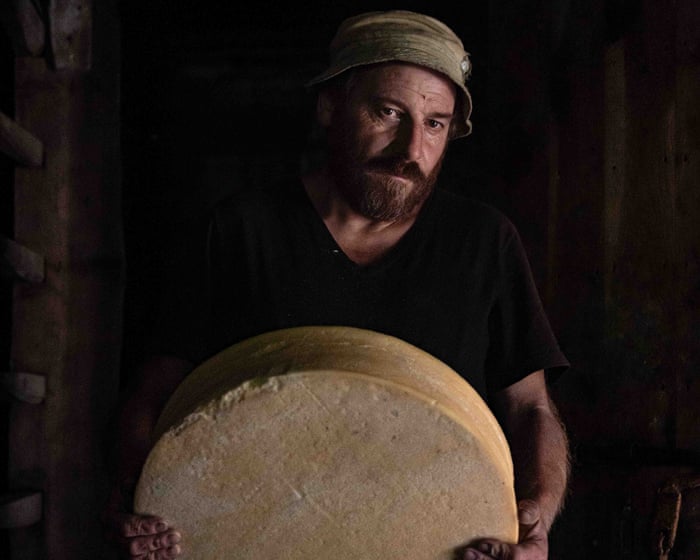
View image in fullscreenOreste Pedrelli, 56, has been a herder on Alpe Pedena for 10 yearsMy journey into the world of storico ribelle began with a shared love of photography and the mountains. A close friend of mine lives in the Orobie Alps. He loves the mountains and the natural surroundings, and we share the same passion for photography. When I finally went to visit him, I discovered a way of experiencing the mountains that was very different from the one I knew growing up in the Apennines, where I come from.What struck me was not only the landscape, but the relationship people still have with it. Here, I discovered a world where the mountain is not simply a place to visit or explore, but a place to live and work. A world where cheese is still a tradition rather than an industrial product, and where the rhythms of the seasons, the animals and the daily work of the alpeggiatori – the mountain herders – are still deeply connected.View image in fullscreenThe horn of a cow grazing in the Trona Vaga pasture, with Pizzo Trona visible in the background, in Val GerolaThere was a poetry in this way of life that immediately inspired me. Waking before sunrise, milking, making cheese, moving with the animals and working until darkness: there was almost no separation between life and work.I felt compelled to photograph this world. I wanted to tell the story of people who continue to choose a demanding way of life at a time when agriculture is increasingly industrialised and traditional knowledge is disappearing.Portraits of Oreste Pedrelli and his trusted helper PaoloLeft: Oreste Pedrelli has been making cheese since he was eight, learning the craft from his grandparents and carrying on a tradition passed down through generations. Right: Pedrelli’s trusted helper Paolo. For 15 years, he has lent a hand every summerIn the Orobie Alps, cheese is inseparable from the landscape that gives it life. Steep pastures, stone shelters and seasonal migration have shaped a rural culture for centuries. Animals move with the seasons, milk follows them, and cheese becomes a way of preserving a way of life.Storico ribelle was born from this tradition – and from a decision to defend it. For generations, bitto cheese was made in small Alpine dairies and exchanged locally for essentials such as grain and salt. During summer, herders moved their animals progressively higher, following the pastures. Along the routes, calecc – simple stone shelters – were used for milking and turning fresh milk into cheese. The wheels were taken to mountain cellars, or casère, where they could mature for years.Milk containers hanging from a post, and the containers’ lidsLeft: The Alpe Cavizzola pasture. From June until the end of the season, typically September, the Alpine herders gradually move to ever higher altitudes, returning to the valley every two days to deliver the cheese. Right: Lids of the bidu, or milk containers, washed after milkingIn 1996, the introduction of the bitto DOP (protected designation of origin) brought new regulations. Some producers considered the requirements incompatible with the traditional Alpine system they wanted to preserve. They chose to continue making cheese according to their own methods, outside the DOP. Eventually, a new name emerged: storico ribelle, or historic rebel.Carlo Duca with a herd of goats, and a person milking a cowLeft: Carlo Duca, a herder and cheesemaker at Alpe Ancogno Soliva, hand-milking goats in the pasture. Right: Hand-milking a brown Alpine cow at Alpe CavizzolaThe name reflects resistance, but the deeper story is one of continuity: preserving a relationship between livestock, pasture, milk, cheese and mountain life. That relationship can still be found across Val Gerola, Valtellina and Val Brembana.At Alpe Pedena, Oreste Pedrelli, 56, has spent theFor the past 10 years, he has worked as a herder. He has been making cheese since he was eight, learning the craft from his grandparents. At Alpe Ancogno Soliva, Carlo Duca works with his brother Luigi. Their cheese is famous for its exceptional ageing potential, with some wheels maturing for up to 10 years.
Left: A cow collar belonging to Alfio Sassella, a herder at Alpe Cavizzola, worn by one of his cows. Right: Michele, 15, the son of Alfio, who passed away last August, working in the pasture and following in his father’s footsteps.
At about 2,000 metres, Trona Vaga is the highest storico ribelle Alpine pasture. Manuele, born in 1988, runs the pasture with his partner, Erica, who came to cheesemaking from a completely different background. She studied languages and taught herself the craft as an adult.
Their stories show that tradition can be inherited, but it can also be chosen. This matters especially among the younger generation. Michele Sassella, 15, continues the practice with his mother and sister in memory of his father, Alfio, who dedicated his life to protecting mountain breeds, natural farming rhythms and Alpine biodiversity.
Left: Davide Peregalli, 16, a nephew of the three Curtoni brothers who run Alpe Vesenda. He has spent his summers in the mountain pastures since he was eight, sleeping in a covered loft outside the Alpine hut. Right: Gioele Pedercini, a 17-year-old herder and agricultural student, has already spent three summer seasons working in the pastures to learn the craft.
Davide Peregalli, 16, has spent his summers at Alpe Vesenda since he was eight. Gioele Pedercini, 17, has already completed three summer seasons as an Alpine herder while studying agriculture. Valentina, 20, brings another perspective: with a degree in agricultural studies, she is the young cheesemaker at Alpe Orta Soliva.
Valentina, 20, holds a degree in agricultural studies and is the young cheesemaker at Alpe Orta Soliva, which was taken over by the Rabbiosi family two years ago.
They represent a generation that is not simply inheriting tradition, but deciding whether it has a future.
That future is fragile. Climate change is already affecting the tradition: scarce rain, increasingly violent storms, and pastures turning yellow even at high altitude. At the same time, increasingly demanding regulations make small-scale cheesemaking more expensive and labour-intensive. Yet the work continues.
A culdera, a traditional bell-shaped copper cauldron, is used to heat and coagulate the milk. Placed over a wood fire, it is suspended and regulated using a màsna, a wooden swivel pulley.
Quality here comes at an extraordinary human cost. It means waking before sunrise, working throughout the day and going to bed after sunset. Every hour follows the animals. Milking, often by hand, is followed by turning fresh milk into cheese. There is little distinction between work and life.
Left: A hen on a tractor in the Orta Soliva pasture. Right: One of the herders’ sheepdogs, an Australian shepherd.
Storico ribelle represents more than a product. It is the result of pasture, animals, knowledge and time – and of people willing to resist the disappearance of a world.
The rebellion began with a choice not to follow a prescribed system. Today, its future depends on another choice: whether a new generation will continue to climb the mountain, care for the animals, make the cheese – and keep alive a way of life that exists almost nowhere else.
Frequently Asked Questions
FAQs Pasture Life The Rebel Cheesemakers Keeping an Alpine Tradition Alive
What is Pasture Life
Pasture Life is a small group of cheesemakers in the Alps who make traditional rawmilk cheese the oldfashioned waygrazing cows on wild mountain pastures and aging cheese by hand Theyre called rebels because they broke away from modern industrial dairy rules to keep this tradition alive
What makes them rebel cheesemakers
They refuse to follow modern industrial methodslike using pasteurized milk standardized recipes or factory production Instead they stick to raw milk seasonal grazing and handmade techniques that many large dairies and regulators consider outdated or risky
What is Alpine cheesemaking tradition
Its a centuriesold practice in the Alps where farmers move cows up mountain pastures in summer milk them there and turn the milk into cheese right on the spot The cheese is aged in mountain caves or cellars and has a distinct flavor from the wild grasses and herbs the cows eat
Why do they use raw milk instead of pasteurized milk
Raw milk keeps the natural bacteria and enzymes that give the cheese its complex flavor and texture Pasteurization kills these which makes cheese safer for mass production but less distinctive Pasture Life believes raw milk is essential to authentic Alpine cheese
What is transhumance and why does it matter
Transhumance is the seasonal movement of cows up to mountain pastures in summer and back down to the valleys in winter It matters because the highaltitude grazing gives the milkand the cheeseits unique taste and ties the cheesemakers to a traditional way of life
What kinds of cheese do they make
They typically make firm aged Alpine cheeses similar to Gruyre Comté or Beaufortnutty earthy and made in large wheels Some also make softer fresher cheeses for local sale
Why is this tradition dying out
Several reasons strict foodsafety regulations favor pasteurized industrial cheese young people leave mountain villages for city jobs and small farms cant compete on price with big dairies Pasture Life is trying to reverse that
What are the benefits of keeping this tradition alive
It preserves unique flavors and local culture supports small mountain farms keeps pastures open and biodiverse and offers a more natural