The sacrifice – F1
I used to cover auto racing and still follow Formula One with a skeptical eye. I knew exactly what to expect from F1: The Movie—a film that asks, what if the world’s most elite sport were reimagined as a western? But once Brad Pitt fills the screen with his blue-eyed winks, wry smiles, and Butch Cassidy swagger, you can’t help but go along for the ride. I should have been more annoyed that this rigid sport turns its biggest rebel into a hero. Yet I left my disbelief behind as Pitt’s Sonny Hayes scraped and battled his way to the season finale in Abu Dhabi. After much drama, his wingman (Damson Idris) takes over the tricky tactics at Yas Marina, sacrificing himself—along with producer Lewis Hamilton (not again!)—to help Sonny win his first race and save their struggling team from a hostile takeover. When the lights came up at my nearly empty midday screening, I was still on the edge of my seat, my disbelief nowhere in sight.
—Andrew Lawrence
The impregnation – Marty Supreme
Where to begin? Josh Safdie’s ping-pong epic delivers one brilliantly imagined scene after another, any of which could be the year’s best. The death camp honey-licking? The orange-ball sales pitch? The Chalamet ass-whipping? The ping-pong club as a mob lounge? You’re spoiling us, Mr. Safdie. But the most eye-popping moment might just be the animated opening credits, which follow a spermatozoa race to the ovum—a pseudo-real take on what Woody Allen did in Everything You Always Wanted to Know About Sex. It ties into the film’s opening scene and, without giving too much away, connects to the ending. It’s been a long time since my jaw actually dropped in a theater; if nothing else, it signals that something… unusual… is on the way.
—Andrew Pulver
The loft – The Mastermind
Many of us saw a silent comic in Josh O’Connor when he wandered through La Chimera, and this year in Wake Up Dead Man he leaped triumphantly into physical comedy. But as the hapless heistman JB in Kelly Reichardt’s beautiful The Mastermind, he’s a wonderfully low-key kind of clown. JB is an everyman chasing an easy win, a little guy hindered by his own ineptitude and beset by forces beyond his control. I especially loved the scene where he struggles up a rickety ladder in a dark pigsty to hide his stolen paintings in a hayloft. The camera lingers on the wobbling ladder and the snuffling hog below as JB huffs and puffs. You just know that ladder is going to fall, which says everything about the likely success of his plan. Sooner or later, this slapstick Sisyphus will end up flat on his back in the pig muck.
—Pamela Hutchinson
The dance – Sinners
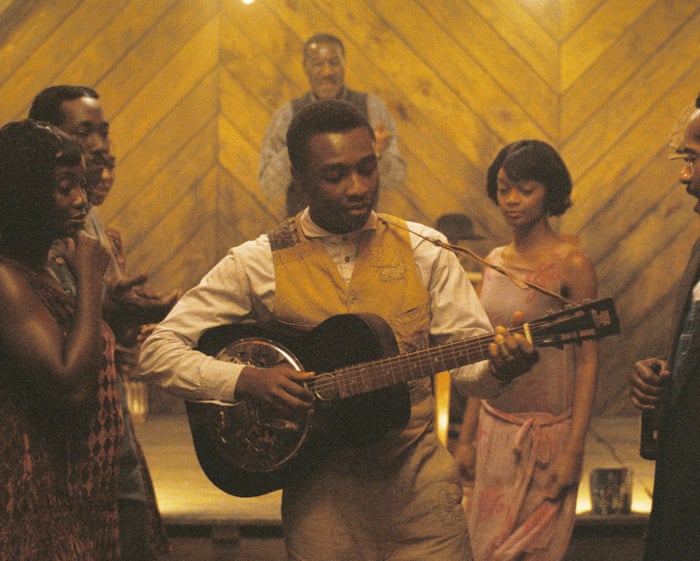
I’m often indifferent to musical performances in movies; they rarely capture the magic of live music. But midway through Ryan Coogler’s 1930s vampire thriller Sinners, Sammie (Miles Caton) sings an original song, I Lied to You, at his cousins’ juke joint opening night. What starts as a standard party interlude becomes a seductive and sublime centerpiece. With cinematographer Autumn Durald Arkapaw’s Imax aspect ratio and Caton’s deep, buttery voice, the room seems to bend around Sammie, his talent suspending the laws of physics. In what feels like one sumptuous, swirling shot, a futuristic Bootsy Collins-like figure appears, followed by a Zaouli dancer, a DJ, Memphis jookin dancers, and a ballerina—Black ancestors and descendants of the partygoers gathered under one roof, summoned by Sammie’s song. “This music is ours,” legendary harmonica player Delta Slim tells Sammie in a flashback. “We brought this…”Watching from home with us is a risk that Coogler takes, and it pays off beautifully, offering an intoxicating glimpse of transcendence. When I first saw it in a packed theater, I felt everyone become completely absorbed in a way that now feels almost meta—savoring the art, feeling its ecstasy and defiance. As Slim put it: “It’s sacred and big.” —Tammy Tarng
The Fight – Splitsville
This past late summer, I briefly stopped lamenting the death of the big-screen comedy. That break lasted about 104 minutes, as I found myself actually laughing out loud in a theater at the self-proclaimed “unromantic comedy” Splitsville. The film is both absurdly silly and neatly relatable—a chaotic, thoughtful, yet deranged look at straight couples navigating the brave new world of non-monogamy. While there were many great small jokes, what has really stayed with me is the ridiculously extended fight between the central friends-turned-rivals, played by the film’s writers Michael Angelo Covino and Kyle Marvin.
Since Bridget Jones, it’s become an easy joke to mock polite middle-class men who get into fights without knowing what they’re doing. When this one starts with a slap, you might expect the same tired routine. Instead, we see two men who do know what they’re doing—albeit messily—proceed to destroy their friendship and the beautiful house around them in a spectacularly violent, brilliantly directed set piece. It’s an early, unhinged reminder that behind the sleek, smugly progressive facade of certain “modern” couples lies pettiness, rage, and a desire to drown your best friend in a bathtub full of fish. —Benjamin Lee
The Play – Hamnet
For weeks, I’ve been urging everyone I know to see Hamnet, Chloé Zhao’s adaptation of Maggie O’Farrell’s novel. It proves that sometimes, a great ending can save an otherwise okay movie. Zhao’s film about Shakespeare’s domestic life before Hamlet struggles to balance a sylvan fairytale with brutal, beautiful realism. I was put off by the remote romance between William (Paul Mescal) and Agnes (Jessie Buckley), then riveted by the unsparing horror of their child’s final hours, and later lukewarm on the biopic-style treatment of grief.
But the ending! The stellar, knockout, bravura ending—light spoilers ahead—in which Agnes attends the inaugural performance of Hamlet at the Globe, saves the whole film and accomplishes the stunning feat of briefly collapsing time. Watching the title character face death, Agnes reaches for her late son; the audience, moved by the performance, reaches for the departing prince; and we, watching a new imagining of a 425-year-old play, reach toward the same question that has haunted all humans: how do you endure when to live means losing the ones we love? I left in tears, reminded once again that such reaching—for others, for the lost, for connection, for a moment of transcendence through great art—is really all we have. —Adrian Horton
The Chase – One Battle After Another
Right in the middle of Paul Thomas Anderson’s latest opus, after years of living an incognito, marijuana-saturated life far from everything, the heat descends on former revolutionary Pat Calhoun in the form of a militarized team reminiscent of Ice stormtroopers. It’s time for him to run like hell.
Crawling through a homemade spider hole, Pat emerges yards from his house, eventually grabs a burner phone, gets help from his teenage daughter’s ready-for-anything martial arts instructor (played charmingly by Benicio del Toro), repeatedly tries to call his former revolutionary comrades (but gets rebuffed because he can’t remember the password), wanders through an immigration raid (orchestrated to cover the operation to abduct Pat), leaps across rooftops, and trips over his own feet at least half a dozen times. On one level, this chase is extraordinary filmmaking.This filmmaking is choreographed like a ballet, blending pathos, high-wire thrills, and absurd comedy into one. On another level, it is profoundly prescient in a way only movies can be, capturing the feeling of living in a would-be authoritarian America in 2025. It also serves as a showcase for the later work of Leonardo DiCaprio and the powerful chemistry he shares with Del Toro. With its seemingly endless energy, its paranoid ability to combine the uncombinable, its slapstick humor, and its finger-on-the-pulse realism, this segment of One Battle After Another seems destined to be remembered. It was the best part of one of the year’s best films, and something I will be thinking about for a long time.
The first half of Spike Lee’s Highest 2 Lowest unfolds mostly in the rarified world of David King, a wealthy, respected, and gregarious but stubborn music mogul played by Denzel Washington. He lives in a Dumbo penthouse with his family, travels by private car, and works in a skyscraper office in Manhattan. Lee captures this world with clear, crisp digital cinematography that borders on antiseptic, enhanced by static and sometimes oddly placed camera angles. However, when a family friend is accidentally kidnapped in place of David’s son and he reluctantly agrees to pay the ransom, the film’s visual strategy shifts. As David boards a subway in Brooklyn to drop off the money in the Bronx, Lee switches to 16mm celluloid, capturing the less controlled, vibrant energy of a crowded 6 train making its way through multiple boroughs—on a day that coincidentally features both a Yankees game and the Puerto Rican Day parade. David’s insulated version of New York falls away. It takes a good while before any traditional thriller action begins, yet in this transition, the movie vibrates with subway-like excitement, as if it’s about to break into song. Forty years into his career, Lee continues to find new ways to express his love for the city and for cinema.
Iranian filmmaker Jafar Panahi made It Was Just an Accident in secret, his usual method to resist censorship from an Iranian regime that recently sentenced him (in absentia) to another year in prison. This clandestine approach led to one of the film’s most surprisingly subversive moments, captured in an overhead shot where the filmmaking team is recording and directing from a rooftop. In Panahi’s soul-searching tragicomic allegory about how Iran’s people will move forward from oppression and trauma, the occupants of a stalled white van—including a bride in a full white gown—hop out into Tehran’s traffic to push the vehicle along. They are in a panic because these former political prisoners have an abducted man, whom they believe to be their torturer, knocked out and tied up in the back. The moment arrives as a joyous bit of comic relief from the narrative’s urgency. But it grows even more transcendent when passersby, at least one of whom is not an actor according to the film’s cinematographer, come to help the stranded passengers. It’s one of the many fissures between fiction and reality in It Was Just an Accident, a potent and unassuming image of hope and community, where the people of Iran participate in the film’s political resistance, whether they know it or not.
Perhaps the most arrestingly mysterious opening scene of the year was in Rungano Nyoni’s On Becoming a Guinea Fowl, a drama of memory and reconciliation set in present-day Zambia. The film opens on Susan Chardy’s city-dwelling Shula, driving alone at night on a dark rural road. She is clad in a glittery mask, as if having just come from a party.A masquerade ball, with the lively classic tune “Come on Home” by the Lijadu Sisters playing brightly on the radio. Her pleasant, though strange, journey takes a sudden dark turn when she discovers a body lying on the road. What follows in Nyoni’s captivating film is grim, haunting, and occasionally funny. That mood is perfectly set from the very start, as dreamy surrealism collides with cold, hard reality. —Richard Lawson
The Skeeting – Predators
At first, David Osit’s documentary examines the troubling legacy of To Catch a Predator, the popular mid-2000s Dateline NBC show that lured would-be pedophiles to a house full of hidden cameras and exposed them for attempting to meet underage children. But the show is just a starting point for a broader look at a culture of abuse and exploitation. This leads to a particularly gripping segment on YouTube imitators who have adapted the same TV formula for the digital age. In one scene, Osit’s camera captures a chaotic sting operation in a seedy motel, where Skeet Hansen, a popular host, bursts out of a closet to confront a man who believed he was meeting a 14-year-old girl. The man is so deeply shaken by his actions that it undermines Hansen’s triumphant “gotcha” moment. Yet Hansen has a brand to uphold, resulting in the most comically serious delivery of his catchphrase imaginable: “You’ve just been Skeeted.” —Scott Tobias
Frequently Asked Questions
Of course Here is a list of FAQs about the cinematic trend of combining dancing fighting and romance inspired by the unforgettable movie moments of 2025
General Beginner Questions
Q What does Dancing fighting romance refer to in movies
A It refers to a popular filmmaking style where scenes seamlessly blend elements of dance choreography with combat often driven by or intertwined with a romantic storyline The emotions and physicality overlap to create powerful memorable moments
Q Why did this become such a big trend in 2025
A Audiences in 2025 craved fresh emotionally charged spectacles Blending these three elements created a unique physical storytelling that was visually stunning emotionally resonant and incredibly shareable on social media
Q Can you give a simple example of how these elements combine
A Imagine a couples first argument Instead of just shouting their frustration erupts into a stylized dancelike fight in a rainslicked alley Every block and grab feels like a rejected dance move visually showing their conflict and attraction
Q Is this just for action movies or musicals
A Neither It became a genreblending technique It appeared in scifi romances fantasy epics and even dramatic thrillers The key is using the physicality to advance the story and relationship
Benefits Appeal
Q Whats the benefit of mixing dance and fighting instead of just having a normal fight scene
A It elevates the emotional subtext A pure fight scene is about winning A dancefight is about communicationpower dynamics pushandpull unspoken desire or tragic conflict It tells you more about the characters relationship
Q Why is romance the common thread
A Romance provides the high emotional stakes that make the physical interplay meaningful The tension trust betrayal or passion of a romance gives the dancefighting its narrative weight and makes the audience care deeply about every move
Q What makes these moments so unforgettable
A They engage multiple senses and emotions at once You get the thrill of action the beauty of dance and the heart of a character storyall wrapped into one visually iconic sequence that feels new and poetic