In 1932, the Berlin-born writer Gabriele Tergit set out to capture a world she saw fading away: the lives and fates of the city’s Jews. By 1945, after fleeing the Nazis to Czechoslovakia, then Palestine, and finally Britain, Tergit had completed her novel. Yet it wasn’t published until 1951 as The Effingers. Even then, few German booksellers wanted to stock it. For a German public that had witnessed—if not participated in—the Holocaust, the book seemed too strange.
Though overlooked at the time, it has since been rediscovered as a classic in Germany and is now available in English for the first time. The novel chronicles three affluent Jewish families in Berlin from 1878 to 1942, with an epilogue set in 1948 based on Tergit’s return to her devastated city. Tergit understood the Nazis’ danger firsthand. As a court reporter, she covered the trials of Adolf Hitler and Joseph Goebbels in the 1920s, which made her a target. She fled Berlin in March 1933 after narrowly escaping a raid by the SA, the Nazi paramilitary “Brownshirts.”
Reading The Effingers in 2025 feels eerie because the Nazis’ rise to power occurs largely on the periphery of the protagonists’ lives. They recognize the Nazis as bad actors, yet feel insulated in their Tiergarten villas, surrounded by fine dresses and social connections.
A similar atmosphere of looming political danger pervades Cabaret, the 1972 film based on Christopher Isherwood’s Berlin novels. The Weimar Republic is portrayed as a hedonistic era, with the Nazis slowly emerging from the background. One character even remarks, “The Nazis are just a gang of stupid hooligans—but they do serve a purpose: let them get rid of the communists, and later we’ll be able to control them.” This sense of underestimated peril feels strikingly contemporary.
Discourse on fascism is ubiquitous today, especially in Germany, where it’s debated in articles, books, exhibitions, and public lectures. There are arguments over whether the politics of the Alternative für Deutschland (AfD) can be called fascism, or if this 21st-century form of right-wing authoritarianism is fundamentally different.
To better understand these historical precedents and our own times, I enrolled in an evening seminar on fascism titled “Monsters” of Fascism Yesterday, Today and Tomorrow, held at the left-wing Berthold Brecht Literary Forum in Berlin. The lecturer explained that defining fascism is the first step in building resilience against it. Despite some challenges, we agreed on a few markers: attempts to create an ethnically “pure” nation, the use of paramilitary forces and excessive violence, anti-liberal and anti-democratic sentiments, and support from wealthy backers in the economic elite.
When the discussion turned to the AfD and where to place them on the spectrum, a depressing mood settled over the seminar room. We were moving from theory to the political reality of Germany in 2025. While the AfD doesn’t have its own paramilitary or openly advocate excessive violence, there are reasonable concerns about the other criteria. This is a party that won over 30% of the blue-collar and unemployed vote in February’s federal elections, coming in second nationally with 20.8% of the vote, behind the CDU’s 28.5%. Recent polling shows the AfD leading with 26% to the CDU’s 24%. The AfD has been classified as “right-wing extremist” by Germany’s own Federal Office for the Protection of the Constitution.
One historical delusion Germany’s establishment risks repeating is the idea that the old elites canMaintaining control over newly emerging far-right powers is crucial. Just weeks before the 2025 election, Christian Democrat (CDU) Chancellor Friedrich Merz broke the so-called “firewall”—the agreement among all democratic parties not to cooperate with the AfD in parliamentary votes. Merz pushed through a proposal to crack down on illegal migration with AfD support. Since then, several CDU members have urged Merz to abandon the firewall entirely.
Last month, when Germany commemorated the victims of the Nazi pogroms of November 1938, our symbolic head of state, Frank-Walter Steinmeier, gave a speech that clearly warned against the AfD without naming them directly. He called on Merz’s government to uphold the firewall and even suggested exploring legal options to ban anti-democratic political parties. While banning the AfD has been widely debated, it seems unlikely and avoids addressing the deeper roots of its support.
For those resisting right-wing extremism, a key priority is showing solidarity with those under threat. In Germany in 2025, this primarily means asylum seekers—especially Syrians, Afghans, and Ukrainians, but more broadly, young men with migration backgrounds. There have been some public displays of such solidarity.
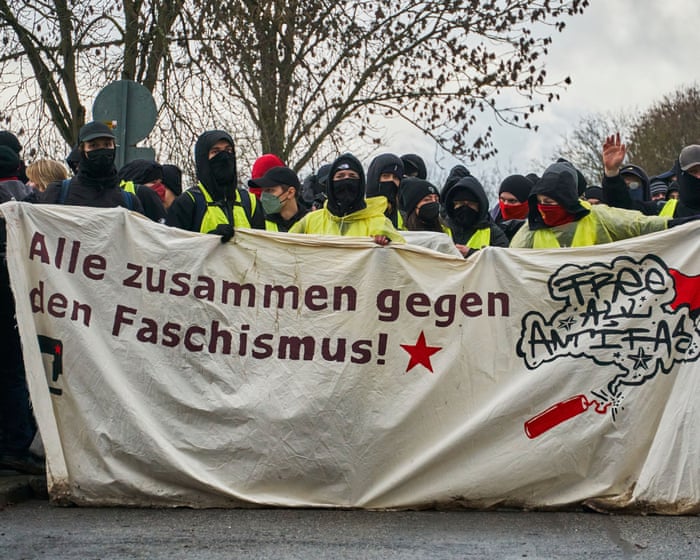
In January 2024, millions braved freezing temperatures to protest across Germany after the investigative platform Correctiv exposed a secret “remigration” conference in Potsdam attended by neo-Nazis and AfD members. Yet neither this public outrage nor concerns over the weakening parliamentary firewall appear to have had a lasting impact on Merz’s government.
The bitter moral lesson of Tergit’s novel comes in the final letter, written by the elder Effinger on his way to a concentration camp: “I believed in the good in people—that was the gravest error of my misguided life.” We should not stop believing in people’s goodness, but we must also heed history’s warnings. The Effingers teaches us not to underestimate the danger of fascism and to fight against it on all fronts—before it is too late.
Tania Roettger is a journalist based in Berlin.
Frequently Asked Questions
Of course Here is a list of FAQs about enrolling in an evening class on fascism in Berlin to counter the AfD designed with clear natural questions and direct answers
Beginner General Questions
1 Whats the connection between a class on historical fascism and the modern AfD
The class provides the analytical tools to recognize the patterns rhetoric and strategies used by fascist and authoritarian movements throughout history This helps you identify similar tactics when used by contemporary groups like the AfD moving from a feeling of unease to a clear evidencebased understanding
2 Im not a historian or politician Is this class for me
Absolutely These classes are designed for engaged citizens not academics They focus on realworld patterns media literacy and civic discourse making the lessons accessible and immediately relevant
3 Whats the main benefit of taking such a class
It transforms anxiety and opposition into informed effective action You learn to dismantle populist arguments logically understand the root causes of their appeal and communicate more persuasively with people who might be swayed by them
4 Where can I find a class like this in Berlin
Look at community education centers university public outreach programs political foundations and cultural centers Many explicitly frame courses around democracy strengthening or historical analogies
Advanced Strategic Questions
5 Beyond historical analysis what practical counterstrategies are taught
Classes often cover factchecking and debunking techniques recognizing logical fallacies and emotional manipulation in rhetoric strategies for productive difficult conversations and ways to support and engage with democratic institutions and civil society groups
6 How do you discuss this without just preaching to the choir or further polarizing people
A good class emphasizes listening and understanding the reasons behind AfD supportsuch as economic anxiety or social dislocationbefore counterarguing It focuses on defending democratic values and addressing underlying grievances rather than just attacking the party itself which can be more effective in reaching undecided voters
7 Whats a common mistake people make when trying to counter parties like the AfD
Using only moral outrage or calling them Nazis This often backfires by allowing them to play the