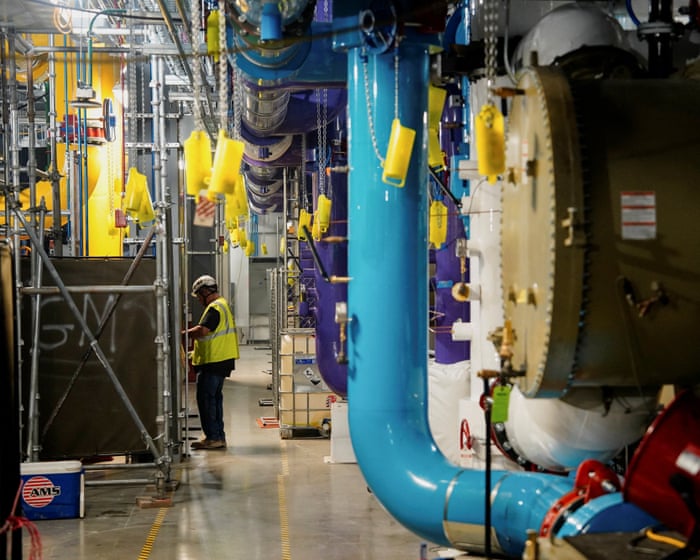
Microsoft, Amazon, and Google have seen their combined carbon emissions rise by nearly a fifth over the past year, mainly due to the construction of data centers. In the financial year ending March 2026, the three tech companies emitted 119 million metric tonnes of carbon dioxide equivalent (mTCO₂e)—about a third of France’s total emissions. The previous year, they emitted roughly 101 million mTCO₂e, similar to the Czech Republic’s 2024 emissions.
The climate goals of these US companies have taken a hit in recent years because of a surge in demand for cloud services—like storing data or running servers online—driven by training and operating chatbots and other AI products.
Cecilia Rikap, an economics professor at University College London, said: “Claims by Microsoft, Amazon, and Google that their clouds are eco-friendly and sustainable are just a marketing strategy. Governments should keep these growing carbon footprints in mind when the same companies offer AI solutions to tackle the ecological crisis. And as more businesses move to their clouds, storing data and training or using AI models and other digital technologies, these other companies are outsourcing their own digital and AI carbon footprint to the cloud giants. Basically, shifting to the cloud helps other corporations hide their environmental impact.”
Microsoft, Google, and Amazon were contacted for comment.
These increases were recorded in the companies’ annual sustainability reports, released over the past few weeks. In its report released on Thursday, Microsoft said its carbon emissions had risen by 25% over the past year to 20 million mTCO₂e, “driven primarily by the expansion of our datacenter infrastructure.” Google reported an 18% increase in emissions over the past year, “driven by increases in supply chain activities that supported the rapid expansion of our business.” The search company says its AI systems have already helped reduce emissions elsewhere by 41 million tonnes of CO₂ last year.
Amazon reported a 16% overall increase in emissions and a 20% rise in supply chain emissions, which included data center building and construction. In its report, it still described this as “making progress” toward its goal of net zero emissions by 2040.
The bulk of these emissions comes from a major global push to build the infrastructure for artificial intelligence. The world’s biggest tech companies are on track to spend $765 billion (£570 billion) this year, mostly on building AI data centers—in locations from Norway to North Tyneside.
This marks a sharp reversal in the tech giants’ long-standing efforts to cut their carbon emissions. Before this year, Microsoft’s emissions appeared to have leveled off at 16 million mTCO₂e in 2023 and 2024. All three companies still say they aim to achieve net zero emissions: Google and Microsoft by 2030, Amazon by 2040.
“The increases in total carbon emissions are strongly linked to the companies’ AI investments,” said Shaolei Ren, a professor of electrical engineering at the University of California, Riverside. He noted that Microsoft’s sustainability report also suggested fewer carbon credits were available on global markets to offset its emissions. “While companies are actively investing in or buying carbon credits, the data suggests there may not be enough credit supply in the carbon market to meet the tech companies’ needs… Everyone talks about a shortage of physical goods and infrastructure like power, but there might also be a shortage of virtual goods—carbon credits.”
Proposals for building data centers across the global tech sector are becoming more frequent.As demand for AI tools grows and AI companies invest more in the models that power them, the need for data centers is rising fast. JLL, a US property consultancy, predicts that around 1,200 data centers will be built worldwide between now and 2030, with AI driving most of that demand.
This boom in data centers comes with huge projected energy needs. The Uptime Institute, which rates and inspects data centers, estimates that the large data center projects announced last year would use 1.3% of the world’s total electricity—nearly doubling current data center energy consumption. Most of this new power demand is expected to come from projects in the US.
Frequently Asked Questions
Here is a list of FAQs about how data centers are pushing big techs carbon emissions up to a third of Frances total emissions
BeginnerLevel Questions
Q What is a data center
A A data center is a large building filled with computers that store and process data for things like streaming cloud storage AI and social media
Q How do data centers cause carbon emissions
A They need huge amounts of electricity to run the computers and to keep them from overheating If that electricity comes from fossil fuels it creates carbon emissions
Q What does a third of Frances total emissions mean
A It means the carbon emissions from big tech data centers are now equal to about onethird of all the emissions produced by the entire country of France
Q Is this a new problem
A Its getting much worse quickly As we use more AI streaming and cloud services the number of data centers is exploding so their energy use and emissions are rising fast
IntermediateLevel Questions
Q Why are big tech companies emissions rising if they claim to be green
A Their overall business is growing faster than their ability to buy clean energy Even if they build solar farms the surge in demand for AI and cloud computing outpaces that clean energy supply so they still burn fossil fuels
Q Which companies are the biggest contributors
A The Big Three are Google Microsoft and Amazon Together their data center emissions are massiveoften larger than the entire carbon footprint of many small countries
Q Is the problem just the electricity or do data centers use other resources
A The electricity is the main source of emissions But they also use huge amounts of water for cooling and building the data centers themselves creates a lot of embodied carbon
Q How does AI make this worse
A AI models require thousands of times more computing power than a simple Google search Training and running these models 247 is incredibly energyintensive
AdvancedLevel Questions
Q How can data centers reduce emissions if they cant stop growing