As the 10th anniversary of the Brexit vote approaches, the verdict on Britain’s economic performance is clear: leaving the EU has come with serious costs for households and businesses.
The immediate recession predicted by the Treasury forecasts ordered by George Osborne—dubbed “project fear” by the Leave campaign—did not happen. The impact of the Covid pandemic, wars in Ukraine and Iran, and Donald Trump’s trade disputes also make the picture less clear.
But experts agree that the long-term forecasts were accurate: the economy is significantly smaller than it would have been otherwise, trade has suffered, business investment and productivity growth have stalled, and families are on average thousands of pounds worse off each year.
Charlie Bean, a former deputy governor of the Bank of England who reviewed the Treasury forecasts, said: “Osborne has a lot to answer for when he was basically saying, ‘Treasury analysis shows—look, there is going to be a deep recession tomorrow.’
“That was really misrepresenting what you could take from [it] and overselling it, obviously to try and win the political argument. Looking back, we had the vote and the world didn’t fall off a cliff immediately, so Brexit supporters can say [it] wasn’t worth the paper it was written on.
“But the assessment of the broad long-term picture was in the right ballpark. We’re poorer than we would have been otherwise.”
Here are the charts showing the economic consequences.
“In hindsight, we had the vote and the world didn’t fall off a cliff immediately, so Brexit supporters can say the Treasury analysis wasn’t worth the paper it was written on.”
— Charlie Bean
The pound is below its pre-EU referendum level
The value of the pound swung wildly after polls closed on 23 June 2016. As Nigel Farage seemed ready to concede defeat, the currency gained. But early Leave victories in key areas, including Sunderland, caused a 10% drop in the pound—its biggest ever one-day fall.
The pound’s collapse raised the cost of importing goods, triggering an inflation shock that hurt public finances and caused financial pain for households across the country.
[Chart]
Exporters—who usually benefit from a weaker currency because their products become cheaper for overseas buyers—failed to take advantage as uncertainty dampened trade appetite.
A decade later, the pound has never returned above its pre-Brexit level, hitting British holidaymakers in the wallet. From nearly $1.50 against the dollar and €1.31 against the euro just after polls closed, the pound now stands at $1.34 and €1.15.
UK growth has slowed
There are reasons why the Brexit recession never happened: mainly because the Treasury forecast assumed an immediate no-deal departure, rather than continued EU membership until 31 January 2020—followed by an 11-month transition period and other deals since.
According to the Office for Budget Responsibility, the independent Treasury watchdog, the UK is on track to suffer a 4% hit to national income over 15 years.
At the decade mark, analysis by Nick Bloom, a leading British economist at Stanford University in the US, and others in a research paper for the US National Bureau of Economic Research, shows that UK GDP per head is between 6% and 8% lower than it would have been without Brexit.
[Chart]
Based on performance compared to 33 other advanced economies, the analysis shows that Britain roughly tracked these countries closely until 2016, before a large gap in output opened up.
“The statistics are really clear: the UK has grown more slowly after Brexit than before,” Bloom said. “Is it because of Brexit? Probably. You can’t be absolutely certain, but I don’t see anything else that would open up this gap between the UK and everyone else.”
Trade has suffered from more border friction
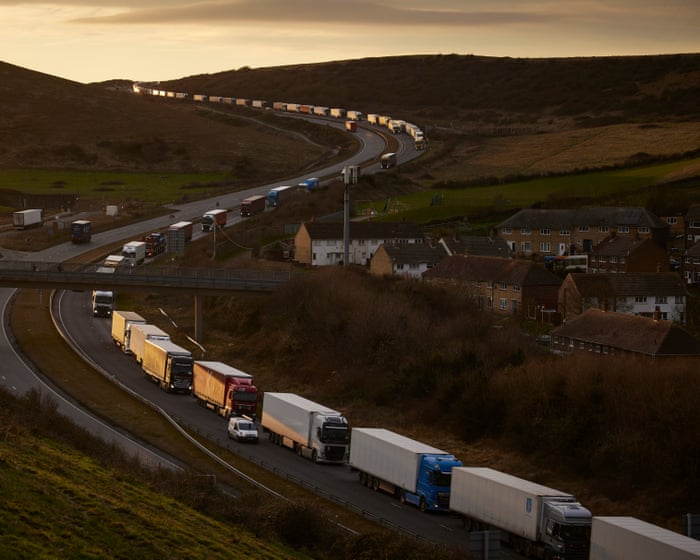
Brexit involved putting up trade barriers, which has hit goods exports. The EU is still the UK’s largest trading partner: inIn 2025, exports to the EU were worth £385 billion, making up 41% of all UK exports, while imports stood at £474 billion, or 49% of the total.
Since the end of the EU transition period on 31 December 2020, UK goods exports have grown more slowly compared to other G7 countries. However, service exports have performed better. The OBR believes this is because the UK-EU trade and cooperation agreement, which Boris Johnson negotiated with Brussels, created more barriers for goods than for services. Exporters, in particular, face more red tape and border delays.
Bloom compared the situation to a shop moving from the town centre to the outskirts: “You make it harder for people to get there and back, and not surprisingly, demand drops. And you add to the uncertainty by opening and closing all the time, so people aren’t sure if you’re even there.”
Uncertainty held back business investment
After the shock referendum result, neither the government nor the Leave campaign had a clear plan. This led to years of infighting over what Brexit—never properly defined and often subjective—should actually look like. In the midst of this political turmoil, businesses froze their investment plans.
As a result, investment is estimated to be nearly 18% lower than it would have been if the UK had remained in the EU, and productivity is up to 4% lower. This reflects businesses’ reluctance to invest in equipment and projects due to the uncertainty.
John Springford from the Centre for European Reform said: “The investment freeze started in 2016 and continued until 2021-22, then began to pick up once there was more certainty about the trading relationship.
“That has an impact on productivity. It means workers don’t have the best equipment, and existing capital—like machinery and buildings—is deteriorating. So you can definitely attribute some of the GDP losses to that.
“Brexit is more a story of stagnation and a slow leak than of recession and rising unemployment.”
Employment has suffered
Unemployment in the UK fell after the Brexit referendum to some of the lowest levels since the 1970s, before rising sharply during the pandemic. However, experts say this hid deeper problems.
First, wage growth has stalled. Average real wages barely grew until they started picking up after the pandemic. Even with recent faster growth, after accounting for inflation, they are only £43 a week higher on average.
The UK became the worst-performing G7 country for recovering workforce participation after pandemic restrictions were lifted. Rising ill-health has pushed up economic inactivity—when working-age adults are neither employed nor looking for work.
Young people have been hit hardest by weaker participation rates. The number of 16- to 24-year-olds not in education, employment, or training (known as Neet) has risen to over a million, the highest level since 2013.
According to Bloom, employment in the UK is between 3% and 4% lower than it would have been if the country had remained in the EU.
Support for Brexit has faded
Public support for Brexit has steadily declined since the 52%-48% vote to leave. Polling last month by YouGov shows that 70% of Britons want a closer relationship with the EU, without rejoining the bloc, its single market, or customs union.
More than two-thirds think looser ties would be a mistake. A majority—56%—would support rejoining the EU outright. Support for rejoining is strongest among Green and Labour voters, and weakest among supporters of Nigel Farage’s Reform UK, where 83% are opposed.
Net immigration surged, but is now falling
After Brexit, despite promises from the Leave campaign and the Conservative government, net migration to the UK rose sharply, reaching a record high of nearly 1 million in the year to June 2023.
The war in Ukraine and pent-up demand for migration after the easing of Covid restrictions played a role. But changes to migration rules after Brexit also had an impact.
Almost 90% of arrivals have been from outside the EU, while net migration from the 27-country bloc has fallen. Employers have struggled with staff shortages amid the changes.The loss of EU workers who were once easy to hire, especially in construction, hospitality, and manufacturing, has been significant. Net migration has dropped further, falling to 171,000 last year, due to stricter controls first introduced by the Conservatives and then tightened even more under Labour.
Frequently Asked Questions
Here is a list of FAQs based on the topic How Brexit has made Britain poorer shown in charts written in a natural clear and concise tone
BeginnerLevel Questions
1 What does it mean that Brexit has made Britain poorer
It means that the UK economy is smaller and peoples average income is lower than it would have been if the UK had stayed in the EU Its not that everyone has less money in their pocket right now but the country as a whole is growing slower than it used to
2 How can charts actually show this
Charts compare the UKs economic performance to similar countries that stayed in the EU They show a clear gap the UKs line falls below where it was predicted to be before the 2016 referendum
3 Is this just because of COVID or the war in Ukraine
No While those events hurt every country the charts control for them They show that the UK has recovered from those shocks more slowly than other major economies and the main reason cited by economists is the new trade barriers with the EU
4 What is the main reason Brexit made Britain poorer
The biggest reason is that it created more paperwork checks and delays for businesses trading with the EU This makes it harder and more expensive to buy and sell goods which slows down the whole economy
5 Did Brexit help British businesses at all
Some businesses in specific sectors hoped to benefit but overall the extra costs of trading with our biggest market have hurt far more businesses than theyve helped
Advanced Detailed Questions
6 What specific economic indicators show the Brexit effect in the charts
The most common indicators are
GDP per capita
Business investment
Trade volumes
Labour shortages
7 How much poorer is the UK estimated to be
Major studies estimate the UK economy is