Last week’s news that the Trump administration had approached FIFA, world football’s governing body, about replacing Iran with Italy at this year’s World Cup shocked insiders and pundits of the beautiful game. It also shed new light on the unusual and evolving relationship between Donald Trump and Giorgia Meloni.
In recent weeks, the Italian prime minister’s status as the darling of the US right has been threatened by an unexpected rift with the White House. Trump dramatically distanced himself from his Italian ally after she refused to join US attacks on Iran. In an interview, the US president told the Italian newspaper Corriere della Sera, “I’m shocked at her. I thought she had courage, but I was wrong.”
The reported US approach to FIFA—which Italian ministers have since ruled out—may have signaled Trump’s desire to mend ties with the Italian leader.
Meloni’s relationship with Trump has never been mainly about policy. Instead, it has been built on politics, ideology, and geopolitics—a trio that has defined both its strengths and its limits.
Politically, Meloni has used her closeness to Trump while maintaining practical ties with EU leaders. This dual approach has boosted her international reputation as a responsible right-wing leader and a key figure in Europe. She has tried to present herself as someone who can bridge different worlds—aligned with the nationalist conservative wave coming from Washington, yet credible and constructive within the European mainstream.
Ideologically, Meloni and Trump both share a vision of the West as a community of nations bound together by common history, religion, and cultural—if not ethnic—homogeneity. Geopolitically, her approach comes from the belief that, in an era of great upheaval and competition between powers, European countries still have a strategic need to stay close to the US, no matter who is in the White House. Adaptation, rather than complaint, has been Meloni’s guiding principle. This explains why she consistently avoided confrontation every time Trump lashed out at Europe.
The problem is that her closeness to Trump has brought few real benefits for Italy—apart from maybe some leniency on US imports of Italian pasta. Where Italy has given in to Trump—on tariffs or higher defense spending—it has done so alongside the rest of Europe. Where it has resisted US pressure—on Ukraine or Greenland—it has done so by coordinating with EU partners, not through direct leverage with Washington.
The war with Iran has exposed the strategic limits of this approach. Its economic effects have been felt directly by Italians at the gas pump. The war has also reinforced a broader feeling among Italians that Trump is not only trying to subordinate European allies but is also making the international system structurally unstable.
Meloni’s balancing act has therefore become increasingly difficult, especially after last month’s domestic setback in the referendum on judicial reform, where her association with Trump proved to be a liability. Having initially refused to condemn the war in the Middle East, she eventually stated publicly that it was not in Italy’s interest.
Then came the breaking point. Trump’s personal attack on Pope Leo XIV, after the pope criticized the US administration’s war on Iran, left Meloni with little room to maneuver. For an Italian conservative and self-proclaimed Catholic leader, staying silent was not an option.
Even then, she avoided direct confrontation. Her response was measured: she defended the pope’s dignity and said the president’s words were “unacceptable.” Most likely, she hoped she could create some distance without causing a rupture. But Trump’s repeated personal insults toward her turned the situation into a political headache.
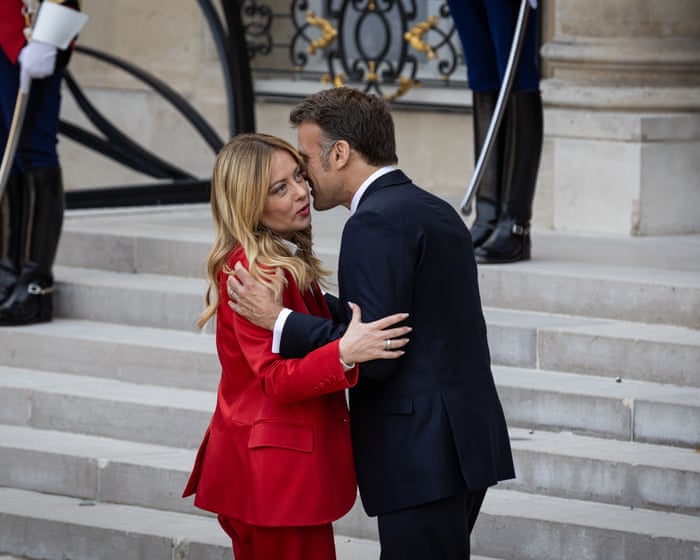
In the short term, the rift might even bring her political benefits. Meloni hasShe has emerged as a defender of Italy’s national interests and the Catholic Church, even earning some support from the opposition, which hasn’t yet taken advantage of her ties to Trump. In the long run, things won’t be so easy for Meloni. Her best option now seems to be focusing more on practical relationships within Europe. Her presence at the recent Paris summit on the Strait of Hormuz—where she made a point of physically embracing Emmanuel Macron, a figure despised by the Italian far right—shows this shift.
At the same time, she’ll try to repair relations with Washington. If Trump had been less blunt about his displeasure, this adjustment might have gone unnoticed. The suggestion that Italy could replace Iran in the World Cup came from Paolo Zampolli, an Italian national working for Trump as a US special envoy, which might be seen as an indirect gesture of goodwill toward Meloni. But the tepid response in Italy shows the risk of trying to mend ties in such an unusual way. It could easily be viewed as Meloni making an undignified apology, costing her some of the political support she gained by standing up to a US president who is deeply unpopular in Italy.
So Meloni is at a crossroads. She can lean more strongly toward Europe or try to re-engage with the US on Trump’s terms. Her past suggests she’s reluctant to make such clear-cut choices, but circumstances may soon force her hand. If Europe continues to be left out of key decisions affecting its security, like on Ukraine, and its economic stability, like on Iran, her association with Trump could become a heavy burden at a critical point in her career.
She’ll enter the campaign season—the next general election in Italy is scheduled for no later than December 2027—with no major reforms tied to her government, a struggling economy, and a worsening security situation that many Italians blame largely on Trump.
The tension between Meloni the party leader and Meloni the statesperson is no longer just theoretical. It may become unsustainable. The question isn’t whether she can keep balancing the two, but for how much longer.
Riccardo Alcaro is head of research at IAI, Istituto Affari Internazionali in Rome.
Frequently Asked Questions
Here is a list of FAQs about Giorgia Melonis relationship with Donald Trump written in a natural tone with clear direct answers
BeginnerLevel Questions
1 Why was Giorgia Meloni so close to Donald Trump in the first place
They share similar nationalist conservative and antiimmigration views Meloni has praised Trumps America First style and sees him as a kindred spirit in the fight against globalism and the European Unions bureaucracy
2 Is Meloni still publicly supporting Trump
Publicly she has toned down the outright support While she still shares ideological affinities she now emphasizes her role as a responsible European leader especially since Trumps return to the White House has caused trade tensions and security concerns for Europe
3 Whats the main problem with her relationship with Trump now
The biggest problem is that Trumps policies directly hurt Italys economy and security Meloni now has to choose between her personal alignment with Trump and her national duty to protect Italys interests
4 Is Meloni trying to distance herself from Trump
Yes but carefully She doesnt want to alienate her farright voter base but she is quietly signaling that she is a reliable partner for the EU and the US establishment on issues like Ukraine and trade
IntermediateLevel Questions
5 How has Trumps stance on Ukraine created a problem for Meloni
Meloni has been a strong supporter of Ukraine because it aligns with NATO and EU policy Trump however has criticized US aid to Ukraine and has suggested forcing a peace deal that could favor Russia This puts Meloni in a bind follow Trump or stick with the EU
6 What about trade Is Trumps tariff war a real threat for Italy
Yes Italy exports a lot of luxury goods and machinery to the US If Trump slaps high tariffs on European goods Italys economy would take a major hit Meloni cannot afford that so she has to lobby against iteven if it means clashing with Trump